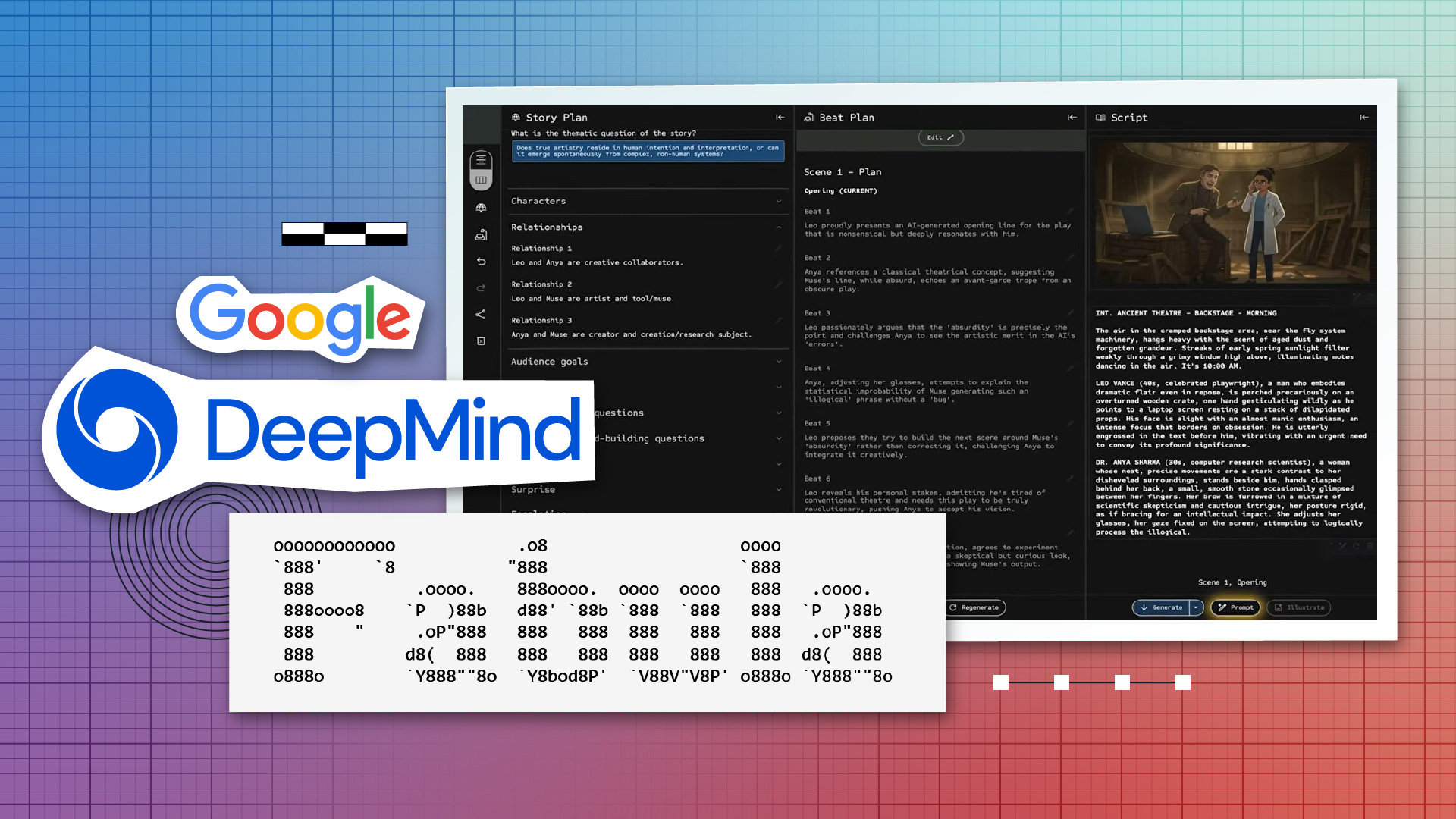
Google DeepMind announced Fabula, a Gemini-powered writing tool for screenwriters and playwrights that does not generate finished stories. The research prototype was demoed at CHI 2026 and is moving through writers' workshops as an invite-only early access program.
Three points worth knowing:
A two-layer architecture keeps a story plan and full script linked, so revising a beat updates the structure beneath it.
The tool was co-designed with 42 screenwriters and playwrights through participatory AI workshops led by Google DeepMind researcher Piotr Mirowski.
Fabula remains a research prototype with no general availability and no published interface footage.
Fabula succeeds the Dramatron research project, DeepMind's 2023 experiment in long-form story generation that produced scripts from a single log line. Where Dramatron tested whether language models could draft scripts end to end, Fabula starts from the opposite premise. "Fabula is not a story generator," Dr. Piotr Mirowski, Senior Staff Research Scientist at Google DeepMind, wrote in the launch announcement. "It is a tool to empower a writer as they go through the creative process."
The architecture keeps story plan and script linked so revisions flow in both directions.
Fabula stores a hierarchical story plan alongside the actual script text on the Fabula research page. Writers can work at the scene level, the beat level, or the story plan level, and the tool regenerates content at the layer of choice while keeping the others coherent. The DeepMind team calls this "convergent iteration": writers move between broad structural decisions and scene-level detail without losing continuity. For media professionals used to script software that tracks revisions linearly, the bidirectional structure is the architectural difference worth noting.
What separates Fabula from end-to-end generators is what it refuses to do.
The writer drives every structural decision while the AI offers suggestions framed against classical narratology principles, specifically the framework laid out in N.J. Lowe's "The Classical Plot and the Invention of Western Narrative" (Cambridge University Press). Mirowski described the approach as built on "the principles of participatory AI" to handle different writing styles and skill levels.
The team, led by DeepMind researcher Piotr Mirowski, co-designed the tool with screenwriters and playwrights from a range of cultural backgrounds. A follow-up workshop was held at Anglia Ruskin University in Cambridge, where Mirowski presented Fabula to the writers' community as part of the ongoing co-design process.
DeepMind has shown the research framing but kept the interface private.
There is no public sandbox, demo reel, or pricing information. Early access is gated through an invitation flow tied to the Fabula research page, with applicants asked to describe their writing background. DeepMind has not announced a release timeline or whether Fabula will ship inside another Google product or stay a standalone prototype. The original Dramatron project lived on as an open-source repository rather than a consumer product. Whether Fabula follows the same path remains unclear.
Fabula's bet is that story structure is the thing AI should hold in memory, freeing writers to focus on craft.
For screenwriters and playwrights, the practical question is whether a story-plan layer that updates with script revisions changes the workflow enough to matter. DeepMind has not shared productivity data from its workshop studies, and the playwrights who evaluated Dramatron in the original SIG CHI 2023 paper noted that its output could feel formulaic, useful for world-building and idea generation but not for finished work. Fabula's two-layer design is a direct response to that feedback. Until the team opens broader access or publishes evaluation results, the prototype remains a research signal about where Google sees AI fitting into screenwriting: as a structural layer the writer controls, with the model holding scene and beat coherence in the background.