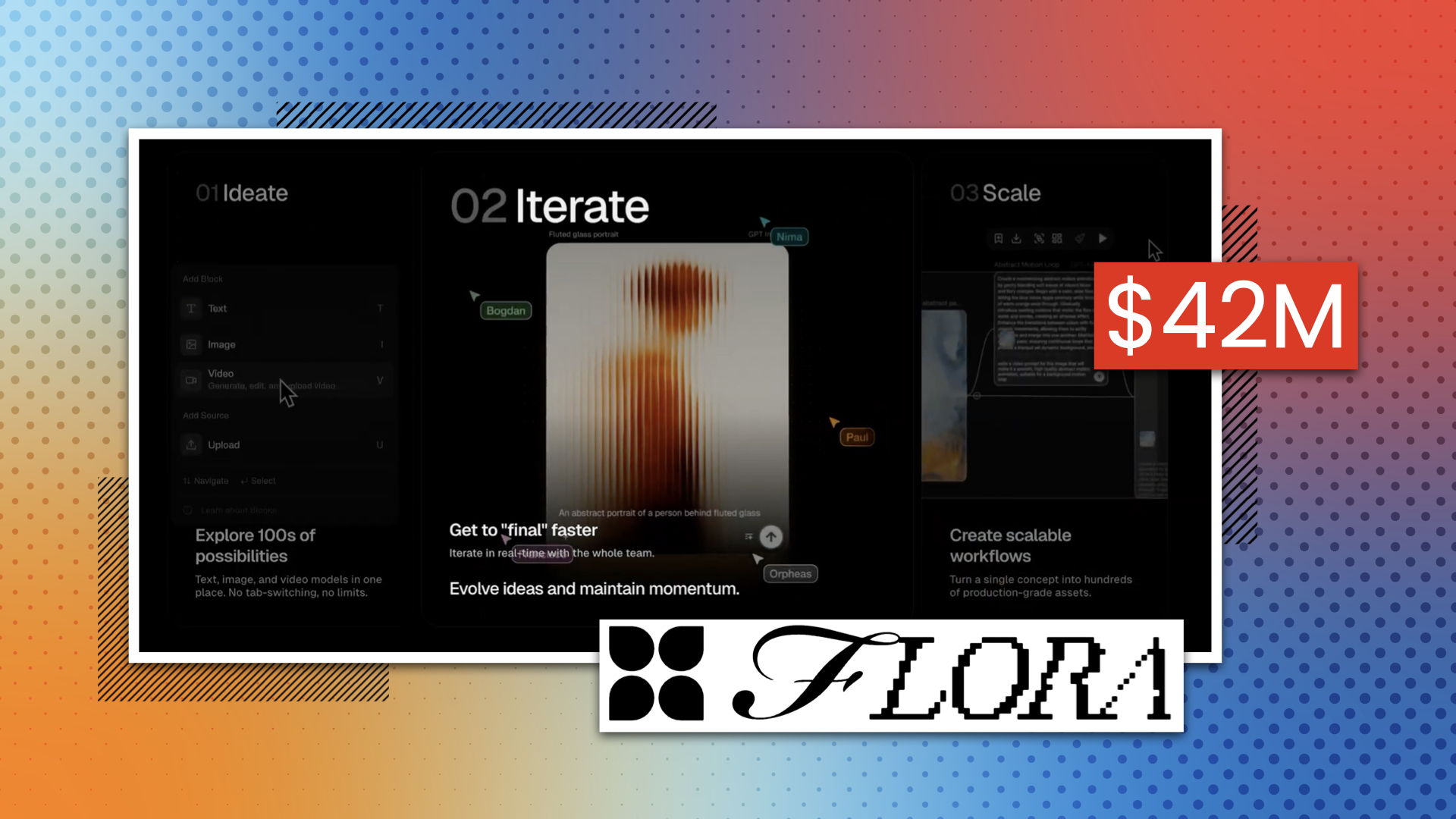
The platform integrates models including GPT-5, FLUX 1.1 Pro, Kling 2.1 Master, Pika, Recraft V3, Seedance, and others, treating them as steps in a workflow rather than destinations.
The Problem: AI Tools Are Toys, Not Power Tools
Founder and CEO Weber Wong started FLORA while working on art projects at NYU ITP. His core observation: creative AI tools were improving quickly, but they were not built for professionals.
Creating with AI felt like a slot machine. You asked, you hoped, you tried again. They were toys, not power tools.
Weber Wong, Founder & CEO
The mismatch Wong identified is fundamental. Traditional creative tools like Photoshop follow a bottom-up process, building outputs pixel by pixel. AI tools invert this: you describe what you want, get an 80% version quickly, then refine. This makes early-stage work faster, but current AI tools fail when precision matters most.
FLORA's approach is to combine rapid AI generation with professional-grade editing control, so creatives can finish work in the same environment where they started it.
Workflows Over Individual Assets
The deeper shift FLORA addresses is how generative AI changes creative production itself.
Traditional creative tools produce one piece of media at a time: a single image, layout, or frame. In the generative era, producing an individual asset is trivial. The real creative opportunity is designing entire workflows.
FLORA treats models as steps in a creative process, not endpoints. Users can connect models together, exploring their creative process faster than before, and codify it into a repeatable system that scales their ideas.
The company has built enterprise-ready features and a team of Forward Deployed Creatives (FDCs), AI-native creative professionals who embed directly with client teams to help them integrate generative tools into their workflows.
The Adobe Parallel
Wong frames the opportunity in historical terms. Every major creative technology shift has required a new interface paradigm.
In 1982, John Warnock founded Adobe to build creative interfaces for personal computing. The interfaces Adobe introduced, layer-based image editing, timeline-based video editing, defined professional creative work for four decades.
FLORA is positioning itself to do the same for generative computing: establish the foundational interface patterns that creative professionals will use for the next era.
What This Means for Media Professionals
For filmmakers and content creators, FLORA represents a category that's maturing quickly: unified AI creative platforms that treat generative models as infrastructure rather than novelty.
The practical implications:
Pre-visualization and concepting can happen faster when multiple AI models are accessible in one workflow
Brand consistency becomes more achievable when systems can be designed once and scaled
Team collaboration improves when AI workflows are shareable and version-controlled rather than trapped in individual tool silos
The $42M raise signals investor confidence that the market is moving from "AI tools as experiments" to "AI tools as production infrastructure."
FLORA is available with a free tier (limited projects and generations) and professional pricing starting at $16 per month. Enterprise pricing is available for teams requiring embedded support.