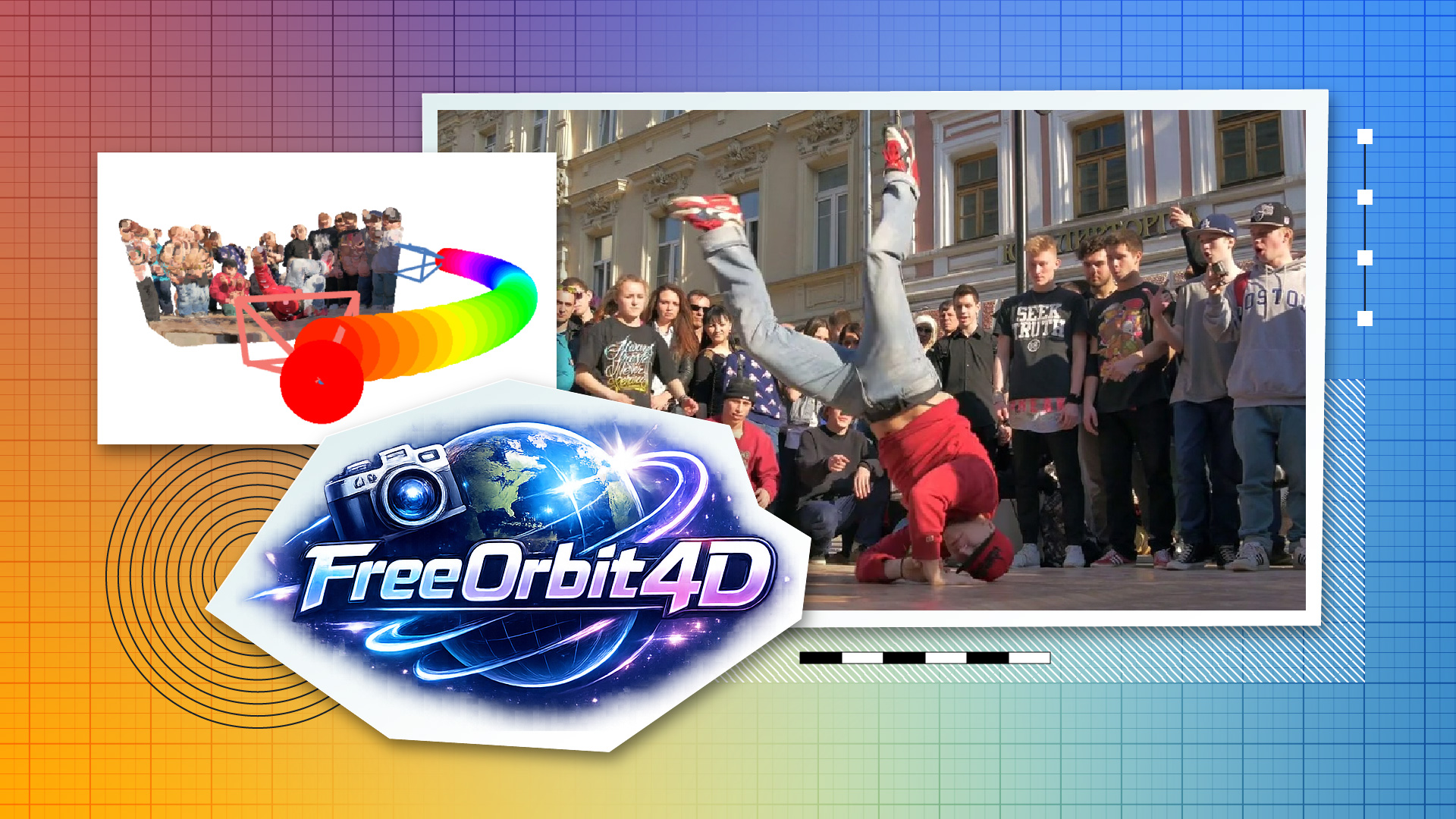
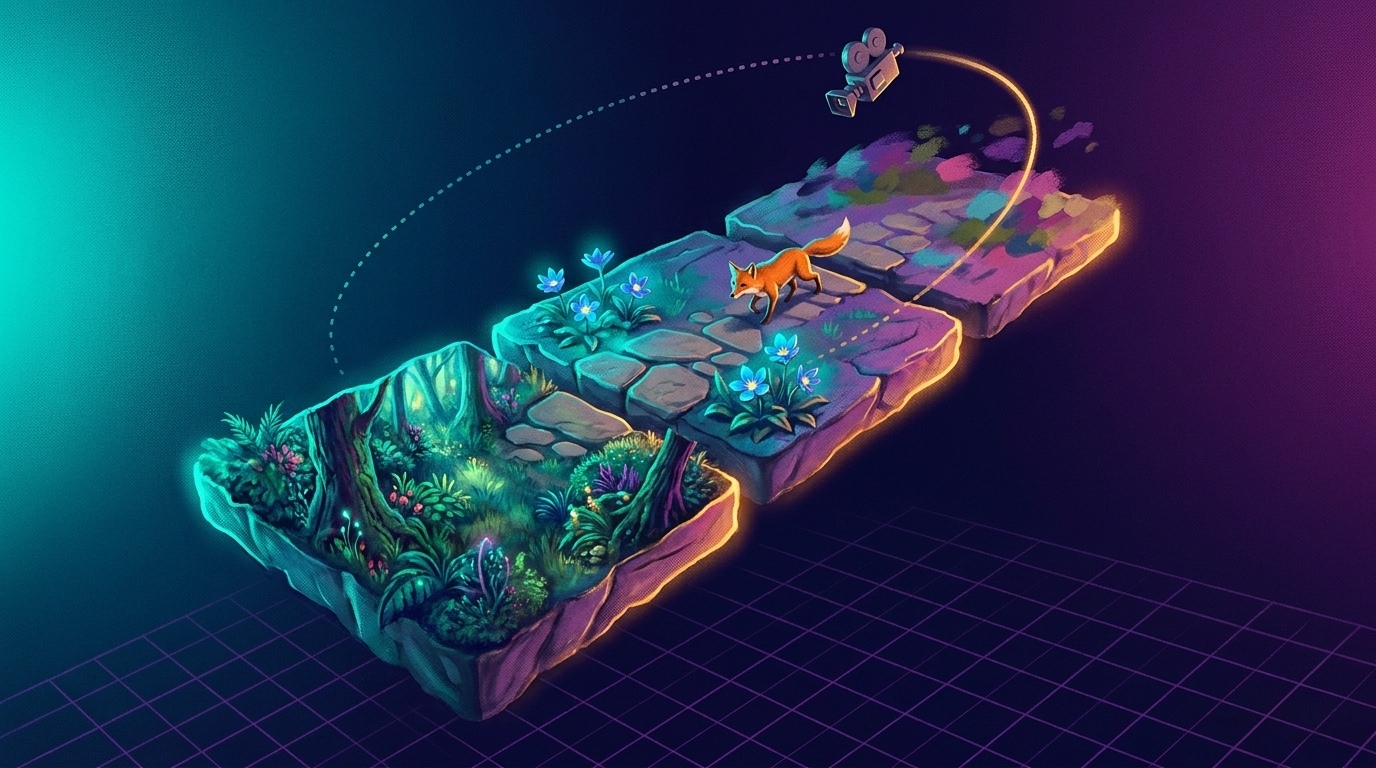
Stage one: 4D reconstruction. The system lifts the monocular video into 3D using PAGE-4D, a feed-forward network that produces point clouds for each frame. SAM2 segments foreground objects from the background. For each foreground object, the multi-view diffusion model SV4D2.0 synthesizes views from four additional angles, then VGGT (Visual Geometry Grounded Transformer) fuses these into geometry-complete point clouds. The result: full 3D models of objects that were only partially visible in the original video.
Stage two: alignment. The geometry-complete object models need to be placed back into the global scene coordinate system. The pipeline establishes dense 3D-to-3D correspondences between the incomplete scene reconstruction and the completed object models, estimates per-frame alignment parameters, and applies Kalman filtering to smooth trajectories across time.
Stage three: rendering. The unified 4D scene is rendered as depth maps along the target camera path. These depth scaffolds feed into Wan2.2-VACE, a depth-conditioned video diffusion model that produces the final output video.
What "Training-Free" Means in Practice
Every component in the pipeline is used as a frozen, off-the-shelf pretrained model. There is no dataset collection, no per-scene optimization, no fine-tuning step. You feed in a video and a camera trajectory; you get output.
This matters because prior approaches to novel view synthesis from monocular video typically required per-scene optimization. NeRF-based and 4D Gaussian splatting methods reconstruct volumetric representations by fitting to each specific scene — a process that can take minutes to hours and still only recovers geometry for surfaces that were actually observed. FreeOrbit4D sidesteps all of this by treating the problem as a composition of existing capabilities rather than a new model to be trained.
Where It Stands Against Alternatives
The team benchmarked against ReCamMaster, TrajectoryCrafter, EX-4D, and GEN3C. FreeOrbit4D scored highest across subject consistency, background consistency, and perceptual similarity metrics, and received a 4.6/5 preference rating in user studies compared to 3.9 for the next best method.
The Production Angle
The practical implication: any footage shot with any single camera becomes potential source material for bullet-time and free-viewpoint effects. What used to require specialized capture setups can now start from a single take. The quality is not yet at the level of a dedicated production pipeline, and the diffusion-based rendering introduces the usual artifacts and temporal inconsistencies. But as a zero-setup, zero-training tool for previz, indie production, or social media content, the workflow reduction is significant.
The system also supports downstream editing. Because it builds an explicit 4D geometric proxy of the scene, users can modify object appearance, scale objects, or composite new elements before the final rendering pass. Code is available on GitHub and the full paper is on arXiv.