That's especially true for media teams working fast:
Summarizing long documents during a call rather than after it
Drafting production emails without switching context from a meeting
Keeping up with live planning sessions where notes need to happen in real time
Speed is infrastructure in those scenarios. A fast-action model like 3.5 Flash is what makes the difference between an AI that feels like a live collaborator and one that feels like a slow search engine.
Gemini Spark and the Always-On Layer: Google's description of Spark in this announcement is brief, but the framing matters.
Spark isn't positioned as a chatbot or a prompt interface — it's described as an agentic experience that runs on Gemini 3.5 and delivers continuous, proactive help. Think less "ask a question, get an answer" and more "a system quietly working in the background while you're focused on something else."
For production environments, that maps to a growing set of workflow needs:
Prepping agendas and call sheets from calendar and email threads
Maintaining continuity notes across shared docs and chat histories
Surfacing relevant reference material while you're still in a writing or review session
The blog post doesn't go deeper than the app-level framing — no API details, no specific integrations — but the direction is consistent with how Google has been threading Gemini into productivity and creative contexts.
How This Connects to Google's Broader Creative Push: We've been tracking Google's Gemini integrations into creative tools across several recent stories, and 3.5 Flash fits a clear pattern.
In our coverage of Gemini's conversational image editing in AI Studio, the appeal was real-time responsiveness — describing an edit and seeing it applied without breaking your creative flow. In our piece on Google's AI-powered pointer, Gemini was positioned as a live collaborator that acts on the interface in response to natural language — an experience that only feels usable if latency is low. And in our coverage of the Avid–Google Cloud partnership, Avid outlined plans to embed Gemini models and Vertex AI deeper into the editorial environment.
Gemini 3.5 Flash fits the same trajectory. Google appears to be building toward a tiered model structure where:
Flash variants handle fast interaction, orchestration, and background task execution
Higher-capacity models handle deeper reasoning and heavier content generation
If that pattern holds in media tools — including through the Avid integration — a model like 3.5 Flash would likely handle "always-on" assistant roles: fetching scene notes, filtering transcripts, checking continuity metadata. The heavier creative work would route to more capable (and slower) models. The official announcement doesn't draw that line explicitly, but the positioning points that way.
What's Still Missing: The gaps in this announcement are worth naming clearly, because they matter for anyone evaluating Gemini 3.5 Flash for production use.
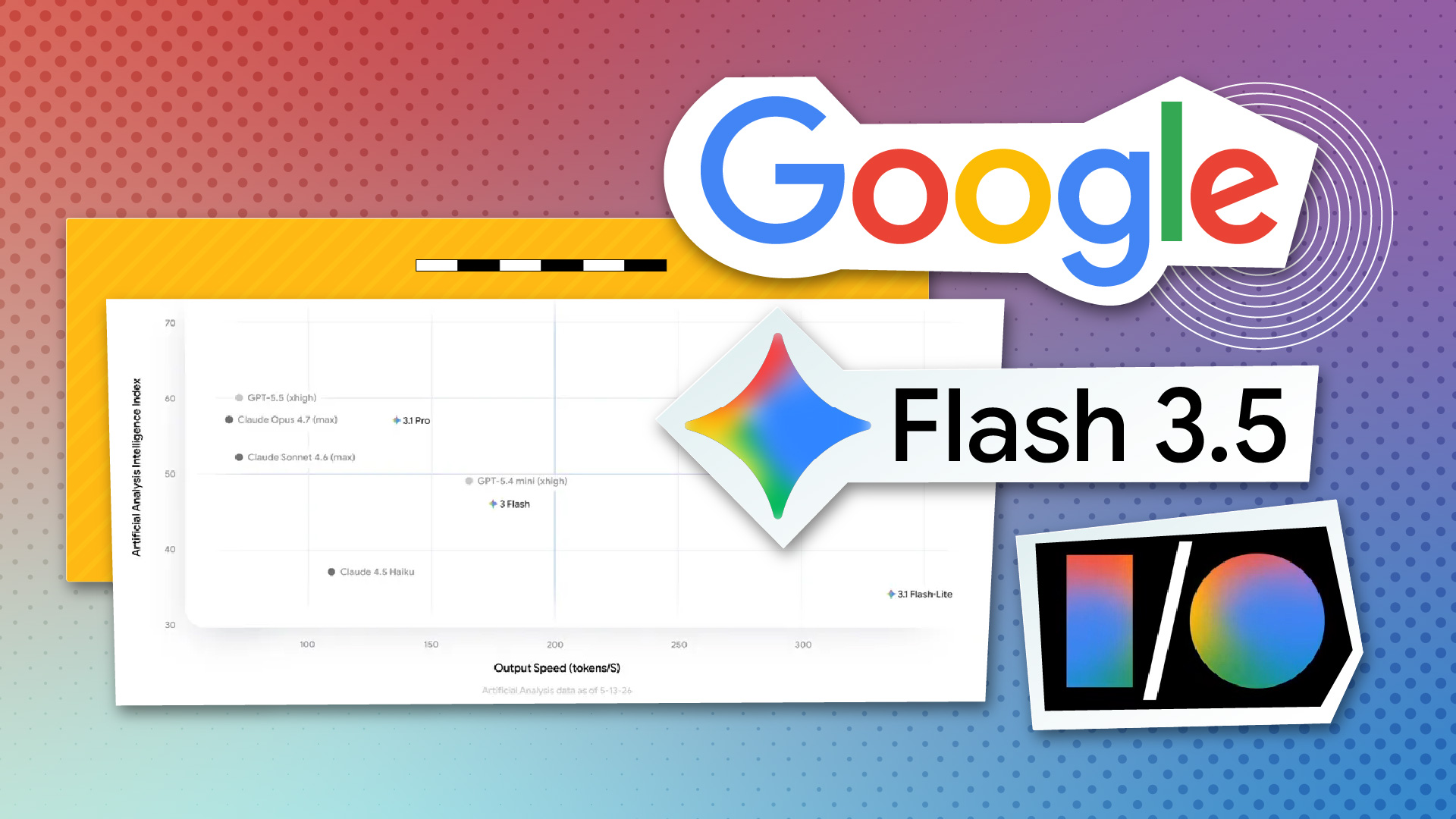
No benchmarks: There's no published data on how 3.5 Flash compares to earlier Flash-tier models in latency or throughput
No context window or token pricing: For long-form media work — scripts, transcripts, edit logs — those specs are practical necessities, not footnotes
No media-specific examples: The blog post stays at the level of general productivity, not creative production
Until Gemini 3.5 Flash appears in Vertex AI with documented limits and pricing, its viability for large-scale media workloads — batch transcript processing, automated metadata tagging, real-time collaboration features — remains an open question.
Watching the Stack Develop: Google's Gemini 3.5 Flash announcement is a positioning move, not a product launch in the traditional sense — but the direction it signals is worth tracking for anyone building or buying into Gemini-integrated workflows.
What to watch: whether partner tools like Avid start specifying which Gemini models handle which tasks; whether Flash-tier models appear as distinct options in creative tool menus; and whether Google publishes Vertex AI details that clarify 3.5 Flash's suitability for production-scale workloads. The fast-action layer of Google's AI stack is taking shape — how it lands inside the tools filmmakers use daily will be the real measure of its relevance.