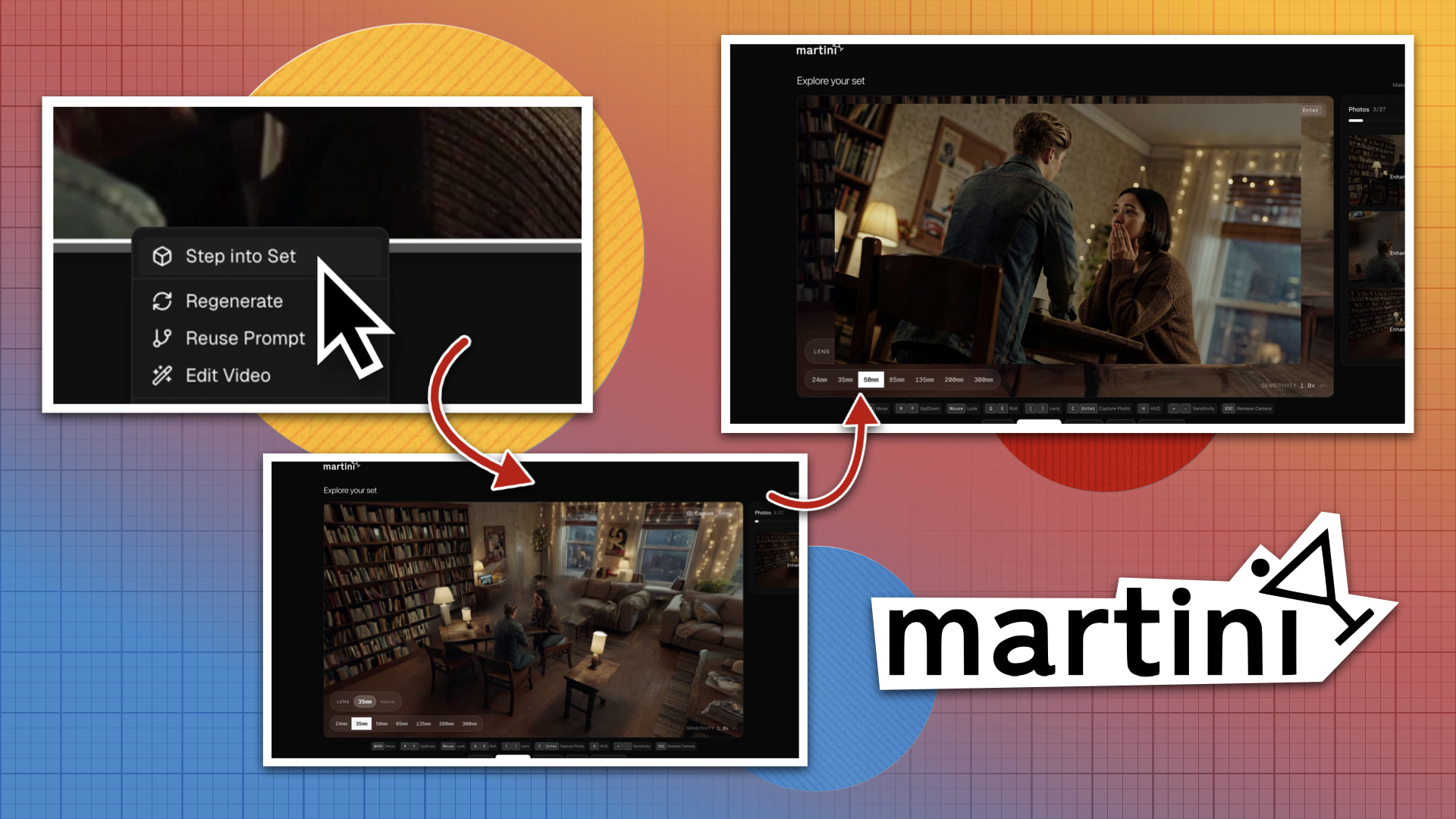
Real-time collaboration for sharing prompts, edits, and feedback across teams
Built-in timeline for creating rough assemblies from generated footage
XML export for moving projects into professional editing software
Integrated image, video, and world models in a single workspace
The company describes itself as "Figma, but for generative film," referencing the design tool known for real-time team collaboration. This positions Martini for production teams and agencies rather than individual creators generating one-off clips.
Model Access and Pricing: Pay-per-second across multiple providers
Martini doesn't train its own video models. Instead, it provides a unified interface to multiple AI video generators with transparent per-second pricing:
Veo 3/3.1: $0.50/second (fast versions at $0.20/second)
Kling 2.1 Standard: $0.10/second
Sora 2 Pro: $0.65/second
Moonvalley Marey: $0.40/second
Minimax 02 Pro: $0.10/second
This model-agnostic approach lets teams choose based on quality needs and budget. A five-second shot ranges from $0.50 on cheaper models to $3.25 on Sora's pro tier.
Traction and Use Cases: 200+ films created during beta
The company reports that over 200 films have been created using Martini during its development period. These projects have appeared as:
TV commercials for broadcast
Artwork displays in galleries and exhibitions
Viral online content across social platforms
This early adoption suggests demand for professional-oriented AI video tools that go beyond basic generation. The Y Combinator Winter 2026 batch backing provides startup credibility and resources for continued development.
Market Context: Where Martini fits in the AI filmmaking landscape
The AI video tool market has been fragmenting into consumer-friendly generators and professional production tools. We've covered Google's Flow platform, which consolidates Veo, Imagen, and Gemini into a unified filmmaking interface with camera controls. Martini takes a different approach by remaining model-agnostic while building cinematography-focused workflows on top.
The camera control emphasis reflects a broader trend. Filmmakers have consistently requested more precise shot direction in AI tools, moving beyond text prompts toward the kind of visual thinking that defines traditional production. Whether this translates to adoption depends on whether the controls deliver meaningful creative precision versus what can be achieved through careful prompting on standard interfaces.
What This Means for Production Teams: A new category of AI video tools
Martini represents an emerging category: professional production layers built on top of AI video generation. For production teams evaluating AI workflows, the key questions are:
Does camera-based control produce meaningfully different results than text prompting?
Does team collaboration justify the additional platform versus using AI generators directly?
Can the timeline and export features integrate with existing post-production pipelines?
The cinematographer-founded angle matters. Tools built by filmmakers for filmmakers often better anticipate actual production needs. Whether Martini delivers on that promise will become clearer as more productions test its workflows against alternatives.
For media professionals experimenting with AI video, Martini offers a demo booking through its website. The model-agnostic pricing structure allows direct cost comparison across different AI video generators within the same interface.