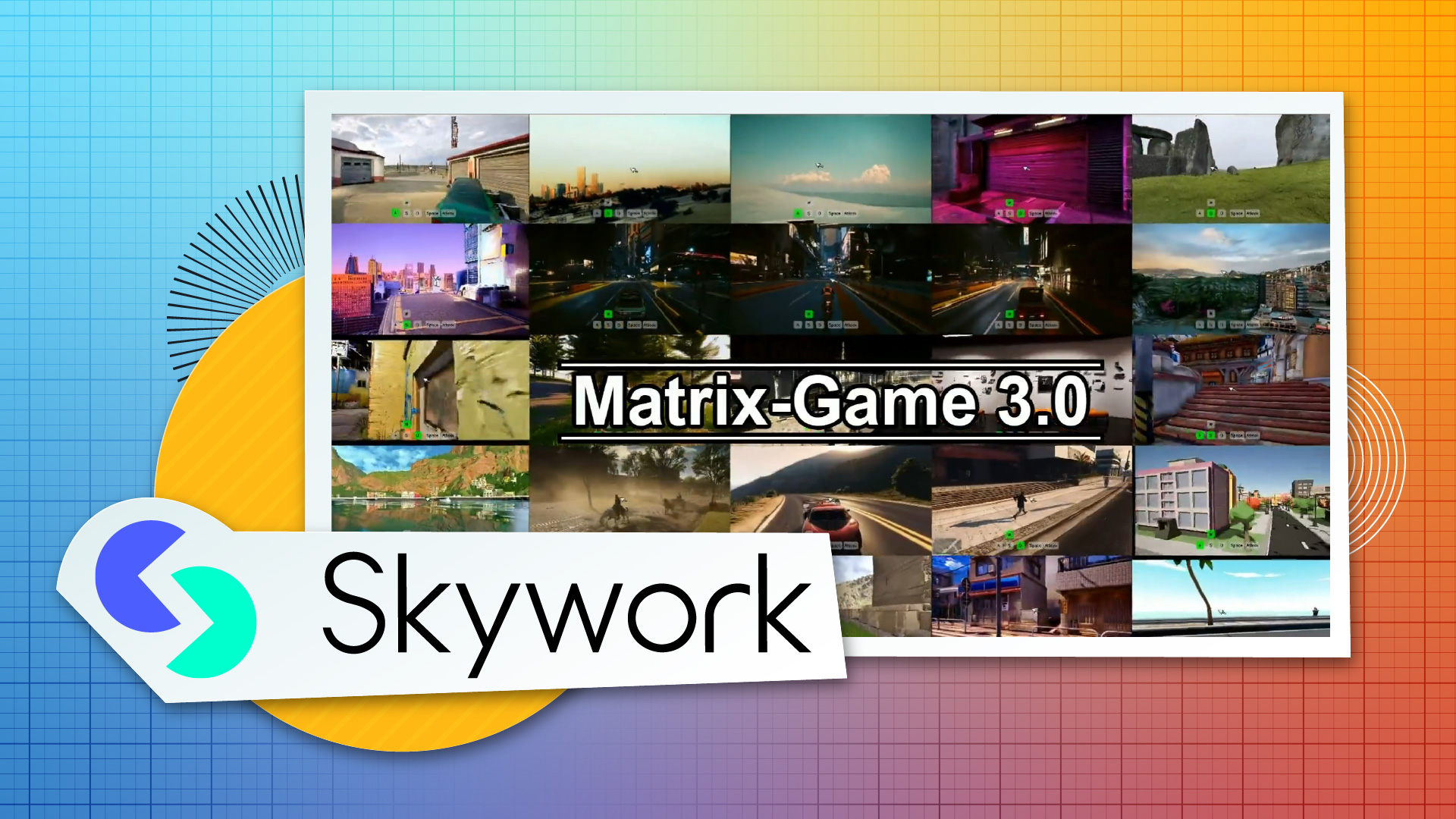
Skywork has released Matrix-Game 3.0, an open-source world model that generates 720p video at 40 frames per second while responding to user actions in real time. The 5B-parameter system is aimed at interactive scene generation, not passive clip output, and the weights are available for developers and studios to run on their own hardware.
Key points for production teams:
Real-time output at 720p, 40 FPS, fast enough to treat the model as a live scene engine rather than a render queue.
Action controllability built in, meaning generated frames respond to user inputs instead of replaying a fixed prompt.
Minute-long memory consistency, a shift from the short-horizon drift that has limited prior open world models.
What the Architecture Changes
Matrix-Game 3.0 is built on a memory-augmented Diffusion Transformer paired with what Skywork calls an error-aware base model. The memory layer is the reason the system can hold a scene together across a full minute rather than losing continuity after a few seconds, and the error-aware training is meant to reduce compounding visual drift when the model is asked to keep generating.

For filmmakers and virtual production supervisors, those two components matter more than the parameter count. Long-horizon consistency is what separates a usable interactive environment from a novelty demo, and drift has been the practical ceiling on real-time generative tools tested in previsualization pipelines.
Why 40 FPS Matters
Generative video at cinema frame rates is not new, but running it interactively is. Matrix-Game 3.0 is positioned as a world model, which means the system is producing frames in response to ongoing action signals rather than rendering a complete clip from a single prompt. At 40 FPS, the output clears the threshold where a director or operator can treat it as something to navigate, not something to wait on.
That framing puts Matrix-Game 3.0 closer to the real-time engines used in virtual production stages than to batch text-to-video models. Studios experimenting with AI-driven backlots, previs rigs, or interactive pitch tools now have an open option to benchmark against proprietary systems.
What Media Teams Can Do With It
Because the model is open source, teams can fine-tune it on proprietary environments, integrate it into existing production tools, and deploy it locally without routing footage through a third-party API. Likely early uses include:
Interactive previs where a director explores a generated environment in real time before committing to a final build.
Scene scouting for sequences that would be expensive to construct physically or in a game engine.
Prototype shots for pitch decks and concept reels, produced without a full CG pipeline.
Research integrations into virtual production stages, testing how generative worlds compose with tracked cameras and LED volumes.
The Open-Source Angle
The decision to release Matrix-Game 3.0 openly lowers the barrier for studios that have been reluctant to pipe creative IP through closed commercial models. It also gives VFX vendors a base to build on rather than license from, which is the pattern that accelerated adoption of earlier open image and video models.
Where This Lands
Open-source real-time world models have been the missing piece between text-to-video generators and the interactive pipelines studios actually use. Matrix-Game 3.0 will not replace a game engine or an LED volume on its own, but at 40 FPS with minute-long memory, it is the first freely available model credible enough to test inside a real production workflow.