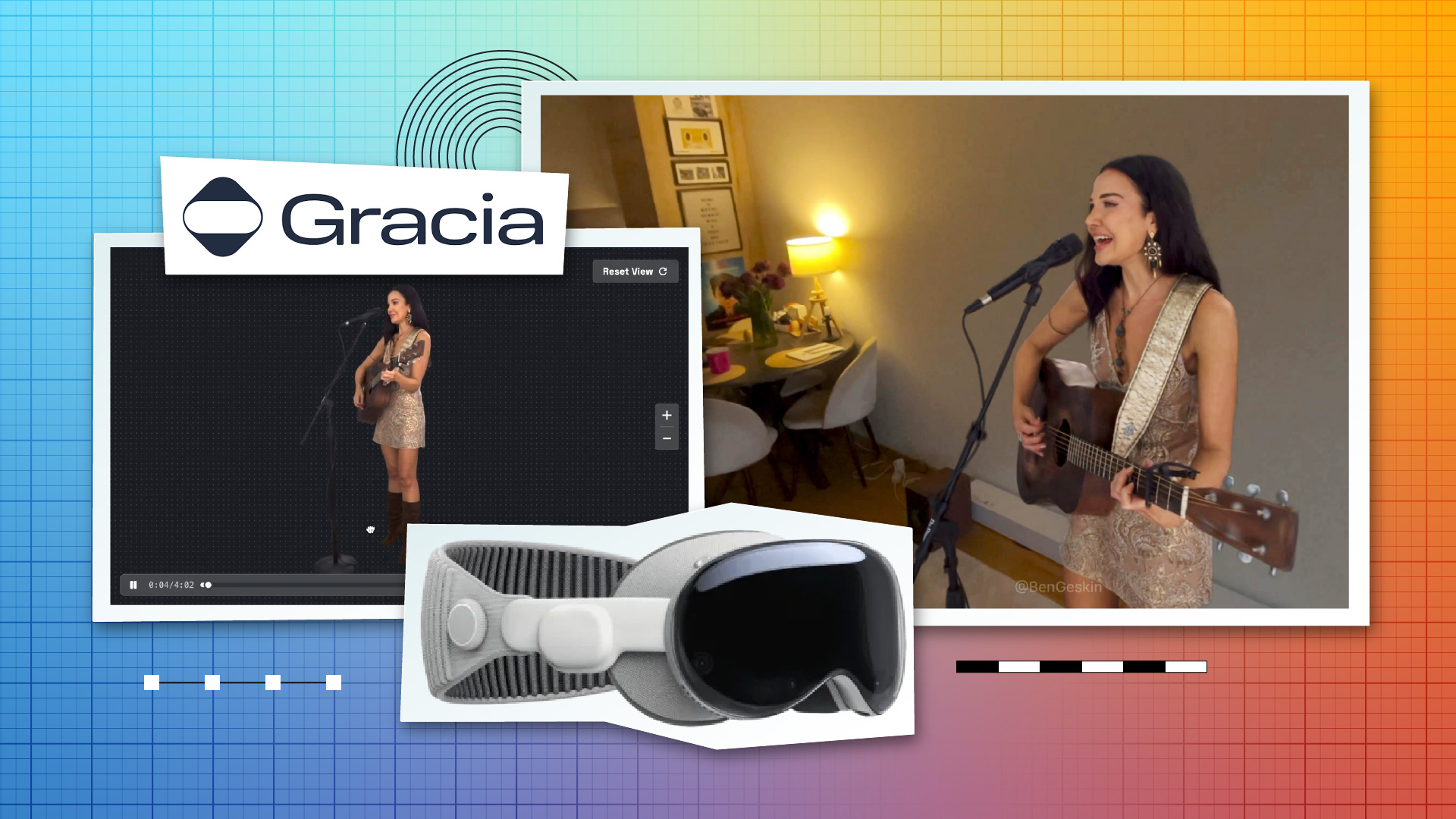
Investor and consumer tech commentator Ben Geskin demoed Gracia's 4D Gaussian Splatting playback on Apple Vision Pro and reported watching life-sized volumetric performers appear in his physical room as if they were physically present. The clip streamed in real time over a standard internet connection, with no local download required.

The session is one of the clearest public looks at what XR practitioners have been promising for volumetric capture: photoreal performers that behave like regular streaming video.

  • 4D Gaussian Splatting (4DGS) playback runs in-browser through WebXR on Vision Pro, Meta Quest 3/3S, and PCVR headsets

  • Viewers can move freely around the captured scene, choosing their own angle inside a performance

  • Playback starts without a download or dedicated app, even for full-length performances

Performance As a Stream: The platform built by Gracia sends compressed Gaussian frames over a regular connection and renders them on-device, treating a volumetric performance the way a CDN treats an HLS ladder.

Volumetric video has historically required gigabyte-scale assets and dedicated playback hardware, so streaming a captured performer in-browser through WebXR is the engineering shift the Geskin demo highlights. The London-based company has been showing the platform across Meta Quest 3/3S and PCVR headsets through WebXR, and the Vision Pro demo from Geskin is among the first public looks at the format running on Apple's headset. Geskin described the experience as feeling "like real humans are standing in front of you."

Behind the Splats: 4D Gaussian Splatting extends the 3D Gaussian Splatting technique that has become a standard in photoreal scene reconstruction.

Each Gaussian carries position, color, opacity, and orientation; 4DGS adds a time dimension so the ellipsoids deform and move across a captured sequence. Research from NVIDIA's Play4D project focuses on compressing those time-varying Gaussians for low-latency streaming, which is the throughput problem Gracia is solving in production.

The technique is photographic in origin, capturing real performers rather than driving a CG rig. That removes the retopology, rigging, and shading passes a traditional volumetric pipeline carries, and gives the output a different visual register than mesh-and-texture VFX work.

The Vision Pro Splat Ecosystem: Gracia arrives inside a small but active group of Vision Pro tools built around Gaussian Splatting.

  • Static splat scenes can be viewed through Spatial Fields, a mixed reality viewer with full spherical harmonic support for view-dependent lighting effects

  • Native PLY playback ships through MetalSplatter, an open-source Metal renderer for visionOS, iOS, and macOS

  • Single-image splat generation runs on-device through Apple's open-source SHARP model, which produces a 3D Gaussian splat from one 2D photo in under a second on a standard GPU

Together these tools form a creation, conversion, and playback stack that lets the format live entirely on the headset. Apple's release of SHARP has lowered the capture barrier even further, and combined with streamed playback like Gracia's, the gap between recording a subject and showing it in a headset is collapsing.

What This Opens Up: Streamable 4DGS reframes volumetric capture as a deliverable rather than a long-form download.

A music performance, a stage play, a remote keynote, or a captured interview can move from camera array to headset over the same infrastructure that already handles flat video. For media and entertainment teams building XR content, the bottleneck shifts from data weight to capture quality, color management, and direction inside a 6DoF scene. UploadVR's coverage of Gracia's dynamic splat work traces the platform's path from static scenes to moving captured performers, and the Vision Pro demo extends that trajectory to live streaming playback inside a consumer headset.

Reply

Avatar

or to participate

Keep Reading