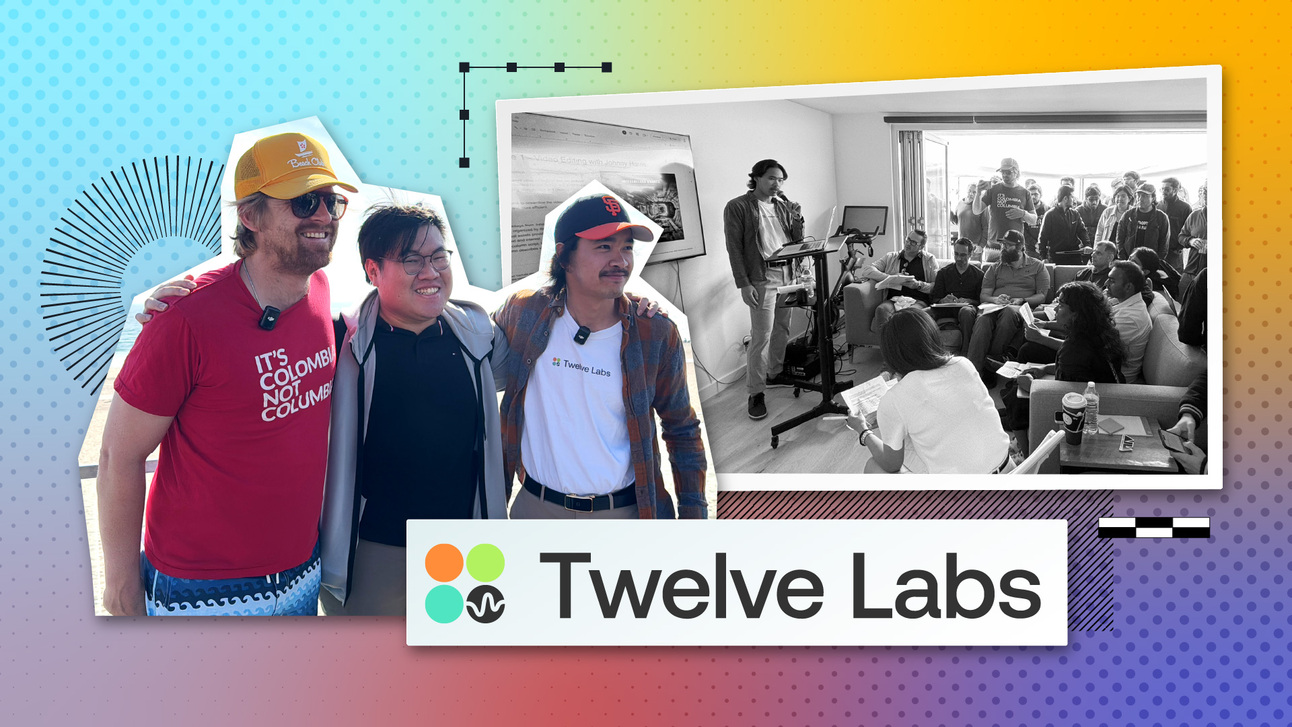
Twelve Labs and FBRC.AI hosted a 24-hour hackathon in Los Angeles, bringing together multimodal AI talent and the AI community to focus on AI applications in media and entertainment.
The event showcased how multimodal AI is revolutionizing the industry by enabling computers to interpret video by analyzing visual, audio, textual, and other data types together.
Participants had the option to tackle one of four challenges:
1. Video Editing with Johnny Harris: Developing an AI-powered video editing tool to analyze footage and script, automating the process of finding relevant clips and creating montages.
2. Highlight Reel Generation with Drew Binsky: Creating an AI-powered tool to analyze travel footage and generate engaging highlight reels.
3. Sports Press Conference Summarization and Highlight Generation: Developing an AI-powered tool to generate concise summaries and highlight reels from sports press conference videos.
4. AWS-Powered Video Q&A Chatbot with RAG: Developing an AI-powered chatbot to answer questions about movie and TV show trailers using the RAG (Retrieval-Augmented Generation) approach.
The hackathon aimed to expand the possibilities of multimodal AI, building upon Twelve Labs' existing applications in the media and entertainment industry.
Here’s a recap of the top three (actually four) winning teams and their projects.
First Place: ThirteenLabs Smart AI Editor
Challenge
Dylan Ler from Team ThirteenLabs developed the Smart AI Editor, an AI-powered video editor that automates the process of creating highlight reels and summaries from video content. The tool leverages Twelve Labs' multimodal AI APIs to generate transcriptions, video descriptions, object classifications, and metadata, which are then processed by a language model to create a coherent narrative based on user prompts.
How it Works
The input video is processed using Twelve Labs' APIs, generating a transcript, metadata, and timestamps for each segment.
The transcript, metadata, and user prompt are fed into a Google Java 9 1.5 language model, which outputs a new transcript with selected timestamps to create a cohesive story.
A Python movie editor function concatenates the selected video segments based on the output transcript and timestamps.
Additional features include video dubbing, which translates the video into other languages using the speaker's voice, and lip-syncing, which matches the speaker's lip movements to the dubbed audio.
The tool can be used for various applications, such as summarizing press conferences, creating highlight reels from travel footage, and generating engaging video content based on user prompts.


