TwelveLabs launched Marengo 3.0, a video understanding model designed for production deployment rather than benchmark optimization. The company claims it's 6x more storage-efficient than Amazon Nova while processing video 30x faster.
Key Details
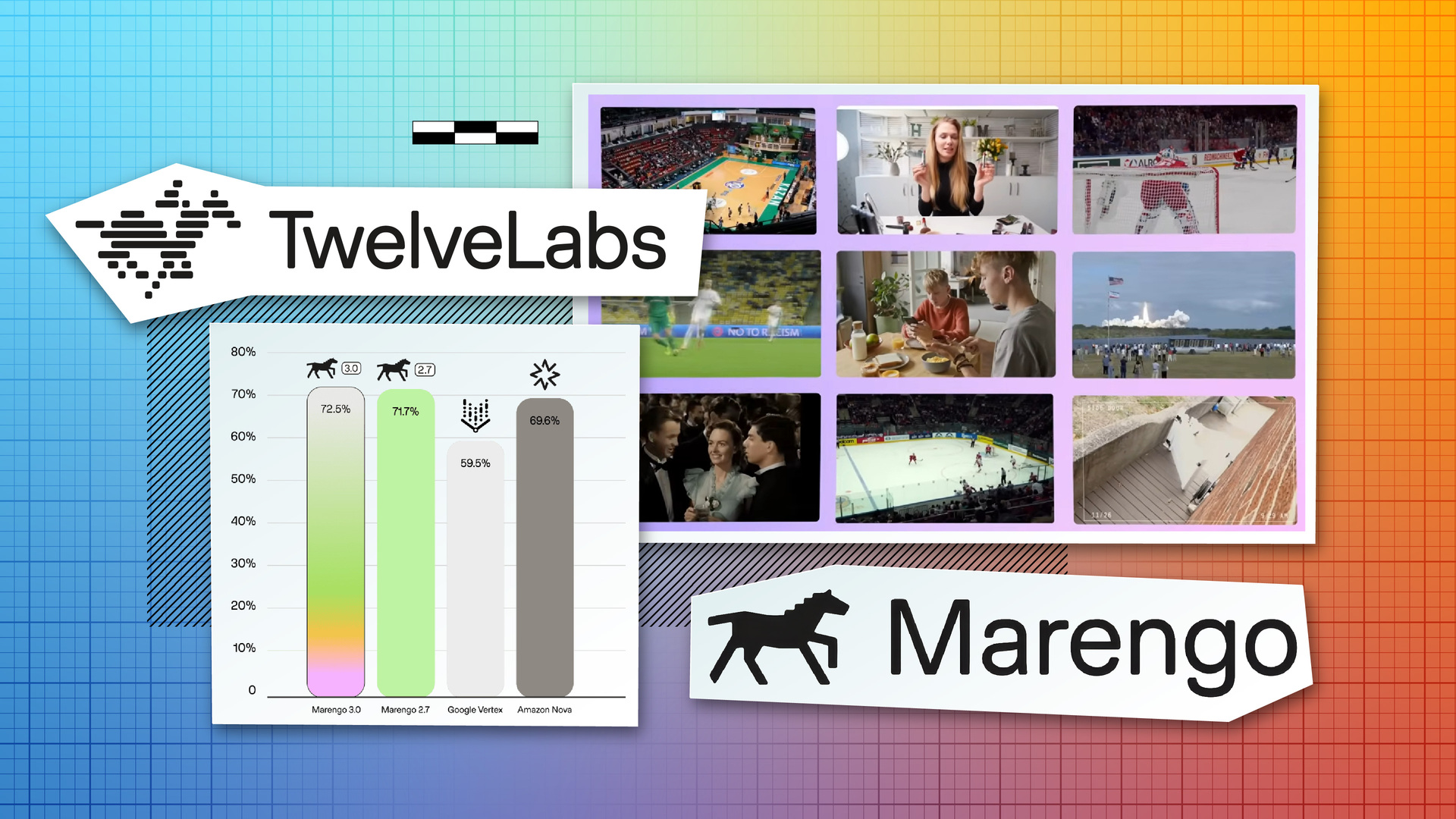
TwelveLabs launched Marengo 3.0, a video understanding model designed for production deployment rather than benchmark optimization. The company claims it's 6x more storage-efficient than Amazon Nova while processing video 30x faster.
Key Details
Speed advantage - Marengo 3.0 processes video at 0.05 seconds per second of content, compared to 0.5 seconds/second for Google Vertex and 1.5 seconds/second for Amazon Nova. For a 1,000-hour video library, that's the difference between 86 hours and 164 hours of compute time.
Composed retrieval - The model combines image and text inputs into a single query embedding, a capability competing models don't offer. Adding a single image to text-only search improved accuracy from 34.4% to 38.5% on their basketball action search benchmark.
Sports-specific training - On SoccerNet-Action, Marengo 3.0 hit 79.4% accuracy compared to 23.0% for Nova and 21.5% for Vertex—a 3.5x performance lead on fine-grained action recognition.
Efficiency design - Uses 512-dimension embeddings versus Amazon Nova's 3072 dimensions and Google Vertex's 1408 dimensions, directly reducing database costs and search latency.
Native multilingual support - Achieved state-of-the-art results in Korean (87.2% R@5) and matched best-in-class performance in Japanese (91.1%) on the Crossmodal 3600 benchmark.
The model's available now through AWS Bedrock for enterprise deployments and TwelveLabs' own Search API and Embed API with Python and Node.js SDKs. TwelveLabs plans to add hybrid semantic-lexical search and extended composed retrieval capabilities.
Tencent released Hy-Nomas, an open-source video world model that builds a scene one video segment at a time while you direct each new segment with text instructions, camera trajectories, or both, according to the Hy-N…
Block's AI research lab has introduced Dessa, a research preview of a full-duplex speech-to-speech model that the company says was trained only on speech, with no text and no pretrained models. Because nothing passes…
BytePlus introduced Seedance 2.5 4K, a video model whose Draft mode lets creators test shots on what the company calls lower-cost 480p previews before generating the final version in 4K, according to its announcement…