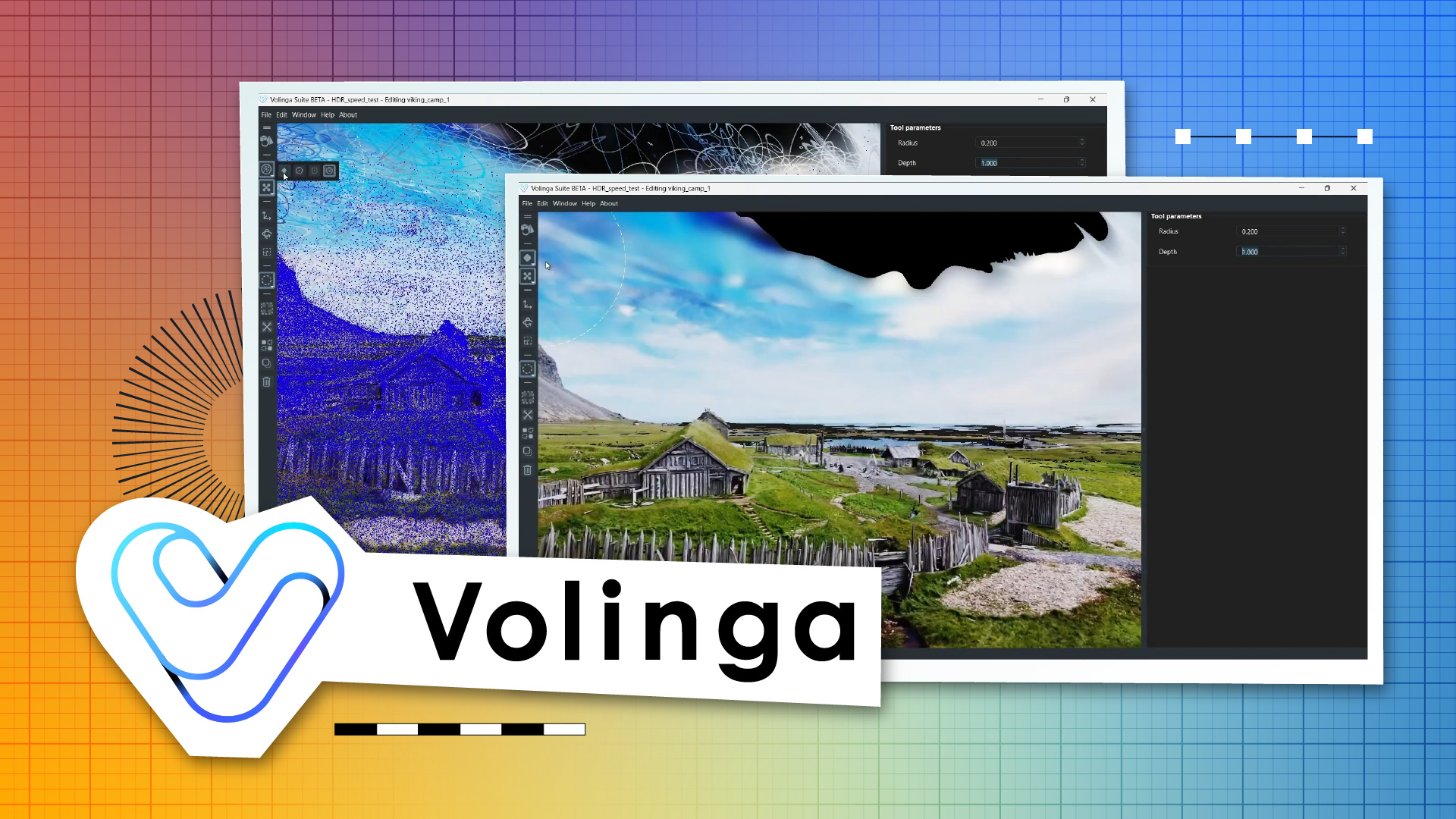
For virtual production supervisors pulling location plates into an LED volume pipeline, that shortens the path between a raw capture and a render-ready asset.
LichtFeld Studio and the 10x Training Speedup
The release integrates LichtFeld Studio as a training backend, which Volinga credits for the 10x reduction in training time. Faster training changes the working rhythm on set and in post. Capture crews can iterate on a scan during a scouting day rather than waiting overnight for a result, and artists can retrain with different settings to compare quality tradeoffs in the same session.
Combined with the Asset Editor, the loop from camera cards to a cleaned, exportable splat tightens meaningfully. Teams can train, inspect, clean, split, and retrain within a single application session.
Fitting Splats Into a VP Pipeline
Volinga's product line addresses different stages of the splat workflow. Suite handles creation, combination, and now editing of splats from captures. The company's Unreal Engine plugin, the first to bring Gaussian splats into UE, handles rendering with ACES color management and HDR support end to end from capture to final frame. The company's XGRIDS partnership and Plugin Pro releases have extended that chain toward LiDAR-assisted capture and production-grade rendering features.
With 0.3.0, the middle step becomes less of a handoff. A supervisor can take a scan from an XGRIDS rig or a photogrammetry sweep, train it quickly, clean it in the editor, split out the hero asset, and bring the result into Unreal through the plugin without leaving Volinga's toolchain.
What the 0.3.0 Release Signals
Speaking with VP Land at NAB 2025, Volinga CEO and co-founder Fernando Rivas-Manzaneque described Gaussian splatting as the "next generation of reality capture" compared to photogrammetry, and named editing, dynamism, color management, and interaction with traditional 3D as the gaps the company was working to close.
Color management was answered by the ACES pipeline. Editing was the next open question, and Suite 0.3.0 answers it by moving cleanup, isolation, and optimization into a controllable in-app step. The remaining items on Rivas-Manzaneque's list, dynamism and deeper interaction with traditional 3D geometry, are still ahead.
For media teams evaluating 3DGS for set extensions, virtual scouting, or immersive deliverables, the release delivers a faster training loop and an editor that treats captured models as assets to shape rather than artifacts to live with.
Full release details and downloads are available at volinga.ai.
Watch the full NAB 2025 interview with Volinga CEO Fernando Rivas-Manzaneque: