This Denoised covers the NAB tools that did not make our initial coverage and the wave of Claude integrations that landed across creative software. We walk through Lightcraft Spark's browser-based virtual camera, Selects by Cutback's agentic editing pipe, Martini's angle-repositioning feature, and the Anthropic donation that triggered a Blender backlash. We close on Kling's jump to 4K and the Academy's new AI rule for the Oscars.

Quick Take

A lot of NAB news happened off our initial recap. Lightcraft Spark turns the Vcam workflow into a browser tab. Selects by Cutback builds an MCP-based highway between an NLE and Claude. Martini lets you reposition a 3D camera against a 2D AI frame. Then Claude rolls into Adobe and Blender, the Blender community pushes back on Anthropic's enterprise donation, Kling ships native 4K, and the Academy formalizes its position on AI nominees. Different tools, one thread: how does a working filmmaker actually use any of this on a job?

What We Tested: Lightcraft Spark Story

Joey caught a prototype demo of Spark Story from Lightcraft, the team behind the Jetset iPhone camera tracker. Spark is a web platform where you scan a location as a Gaussian splat, drop the splat into the browser, and drive a virtual camera using an iPhone or the in-browser camera. Think Unreal Engine Vcam without Unreal Engine.

What it does in the browser:

  • Imports Gaussian splat scans of real locations

  • Connects an iPhone or virtual device as a camera input

  • Records camera moves with a take recorder

  • Brings in animated 3D objects you can trigger during a take

  • Exports for previs, storyboarding, or as a base layer for AI video pipelines

Joey's take: "There's nothing to install or set up. It just syncs." On the NAB Wi-Fi the camera response felt real time.

Addy's add: "I've set up Vcam with Unreal before. It's gotten easier and easier, but all the take setup and file naming and the professional stuff around it, I think this offers as an add-on on top of that platform."

The pitch lands hardest for AI workflows: previs a scene in Spark, then style-transfer the recorded camera move through Kling or Seedance to get an AI-generated shot with real camera control. Lightcraft said Spark is targeting a launch later this summer. We covered the full Spark platform announcement when Lightcraft first laid out the pre-to-post production vision.

The connection question: What if a Vcam from Spark could drive the 3D camera in Martini's angle editor? More on that below.

What We Explored: Selects by Cutback and Agentic Editing

Selects is positioned as AI-assisted editing for podcasts, talking-head YouTube, and vlog footage. The surface-level pitch is auto-cut, auto B-roll. The interesting part sits underneath: Selects ships with Claude integration via MCP servers, so an LLM can sort, analyze, and assemble cuts across multiple Selects projects.

The demo Joey saw: A production company hits the per-project footage cap, so the MCP layer lets Claude reach into prior Selects projects, treat them as a searchable footage library, and assemble new cuts pulling clips across them.

Why this matters: Selects is one of the NAB tools building the highway between an NLE and an agentic LLM, rather than only adding AI features to its own UI. As Addy put it, "Once the highway has been established between an NLE to agentic LLM, it's only a matter of time before the LLM gets better and smarter and is able to make better editing decisions within your NLE."

Where it still needs a human:

  • Creative editing with voiceover and narrative B-roll

  • Anything beyond predictable formats like multicam podcasts

  • The "craft of editing" once the first cut exists

The right read on Selects is not "AI editor" but "agent-ready footage layer." For broader context on how Model Context Protocol is connecting Claude to creative apps, we previously broke down MCP and the demos showing Claude controlling tools like Blender and DaVinci Resolve.

What We Tested: Martini's Angle Editor

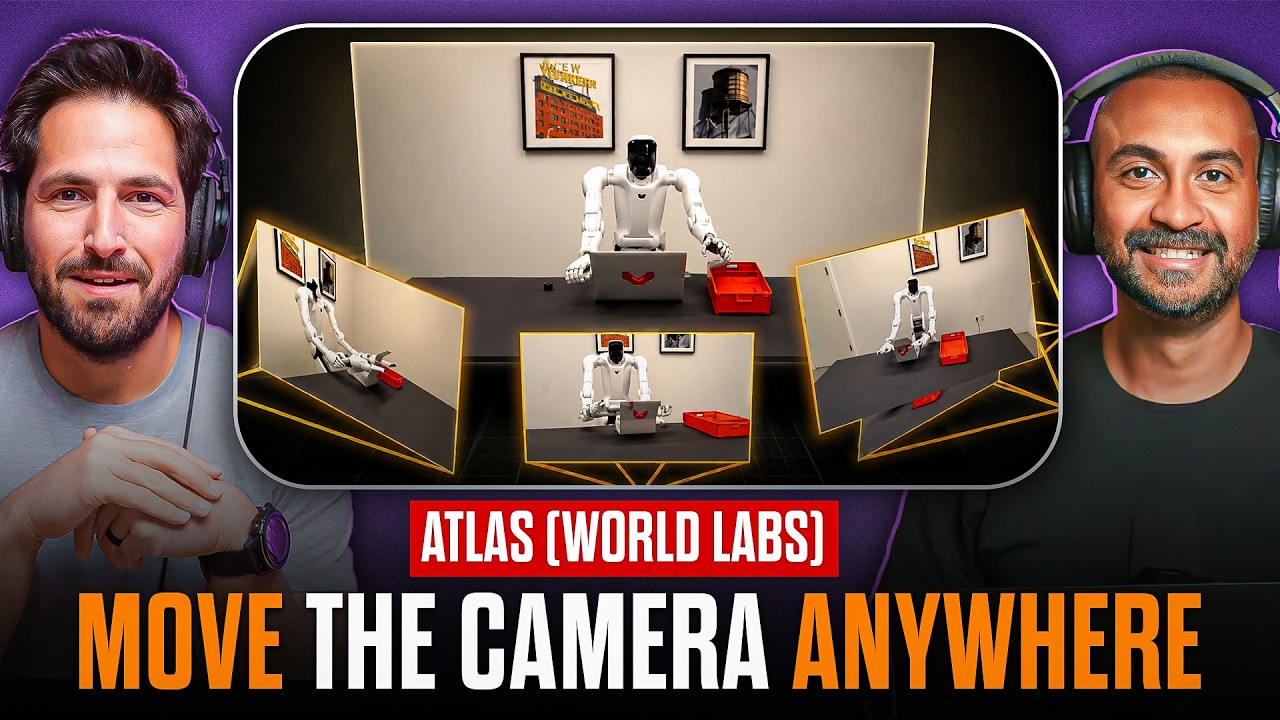
Martini is a canvas-based AI filmmaking platform that runs all the major image and video models inside one workspace, with a built-in timeline that exports to your NLE. The unique feature is the angle editor: feed it a frame, the system analyzes the people in it, Gaussian splats the scene, and gives you a 3D space to reposition the camera in.

What stood out:

  • Canvas, not nodes for laying out shots

  • Multi-user collaboration in the same workspace

  • Built-in timeline for rough edits and NLE export

  • Angle editor that turns a single 2D frame into a navigable 3D scene

  • Camera control beyond text prompts including over-the-shoulder repositions

Joey's note: "Some of the best camera control that I've seen."

We covered Martini's launch when the Y Combinator-backed team came out of the W26 batch with a "Figma for generative film" pitch. The angle editor is the piece that turns it from another model aggregator into something cinematographers can actually direct.

The combo question: Addy floated it directly. "Imagine tying a Vcam like a Lightcraft Spark to this system. In real time you have some level of interactivity. Now you're really getting somewhere with cinematography." Either Lightcraft adds 3D scene reconstruction or Martini adds physical camera input. Whichever side closes the gap first owns a workflow no single tool currently delivers.

What We Debated: Claude in Adobe and Blender

Anthropic spent the gap between our episodes announcing creative-tool integrations. Two are worth tracking.

Claude in Adobe Creative Cloud. Claude can now talk to Photoshop, Premiere, and the rest of the Creative Cloud stack. Addy's read on why this happened fast: "Adobe Creative Suite has a very robust API for third-party plugins. The connections already exist." The current limitation is one-way. Joey tested similar Claude integrations in DaVinci Resolve and the model cannot see what it is doing inside the project. As Addy framed it: "It's more of like a one-way street where Claude is just instructing the DCC, but it's not really feeding back." Useful for tedious batch work and project setup. Not yet useful for iterative real-time editing.

Claude Meets Blender. Anthropic announced a Blender Connector plus an enterprise-tier donation reportedly worth around €240,000 annually. The connector lets Claude build scenes, gray-box environments, and manage assets inside Blender via prompts.

Then the backlash hit. The Blender community pushed back hard enough that Blender said it would accept the donation once but not as a recurring annual contribution.

Joey's argument: The €240,000 represented roughly the cost of four full-time developers. Blender is free and open source because of donations like this. Anthropic was not asking for code changes, only sponsoring development.

Addy's read: "This is a big setback for Blender not taking that money, in my opinion."

The Blender use case for AI workflows:

  • Build gray-boxed 3D scenes as motion base layers

  • Feed those layers into Kling or Seedance for style transfer

  • Hand off tedious tasks like importing assets and managing the outliner

  • Stay relevant in a world where some 3D pipelines collapse into pure AI generation

  • The pattern with both Adobe and Blender is the same. Claude is becoming a connective layer across creative software. The technical work is there. The community acceptance is uneven.

What We Questioned: Kling 4K and the Oscars Rule

Kling AI now supports native 4K output for its Video 3.0 series. Most other video models still rely on an upscale pass. Native 4K matters even if the final delivery is HD, because down-resing a 4K render gets you sharper details on skin, hair, and edges. The open question is wide shots, where AI video still struggles with pixel density. As Joey put it: "I'd be curious how this 4K works with wide crowd shots. Wide shots where those are still the trickiest with AI. There's not enough pixels, the details fall apart." We covered the Kling 3.0 launch including the native 4K capability and built-in audio generation.

The Academy formalized its AI rule. Only roles "demonstrably performed by humans with their consent" are eligible for Oscar nominations. Joey's read: this is a clarification, not a sweeping ban. AI as a tool inside a workflow remains fine. AI as the credited author or performer is out. Addy's broader frame: "AI is a tool for the creatives, and the creative is going to combine AI with traditional tools to make the thing that they make."

Joey's running joke that has a point: "The more important question is, will AI qualify for the Razzies?"

Bottom Line: The Connective Tissue Year

The throughline across this episode is how tools connect to each other. The standalone AI model race is leveling off. The next race is integration.

  • Lightcraft Spark moves Vcam workflows out of Unreal and into the browser, with a clear handoff to AI video pipelines.

  • Selects by Cutback builds an MCP highway between an NLE and Claude, betting on the agent-editor pattern.

  • Martini's angle editor adds 3D camera control on top of 2D AI frames, opening a slot for physical camera input from tools like Spark.

  • Claude in Adobe and Blender turns a chat model into a one-way controller for Photoshop, Premiere, and 3D scenes. Community acceptance is the bottleneck, not capability.

  • Kling 4K raises the floor on AI video resolution, with wide shots as the remaining stress test.

  • The Academy rule clarifies that AI in a workflow is fine, AI as a credited author or performer is not.

The combo that did not exist at NAB but should exist soon: a browser Vcam feeding a 3D-aware AI canvas, with an LLM running cleanup and assembly downstream. Spark plus Martini plus a Claude-aware NLE is the workflow worth building toward.

Tools & Platforms:

  • Lightcraft Spark: VP Land coverage of the browser-based virtual camera and previs platform

  • Martini: VP Land coverage of the canvas-based AI filmmaking workspace

  • Selects by Cutback: AI-assisted editing with Claude and MCP integration

  • Shade: cloud media asset manager with built-in AI search

News & Analysis:

Channels:

  • Theoretico: AI YouTube channel running historical-period POV vlogs

Reply

Avatar

or to participate

Keep Reading