How GaussianGPT Works
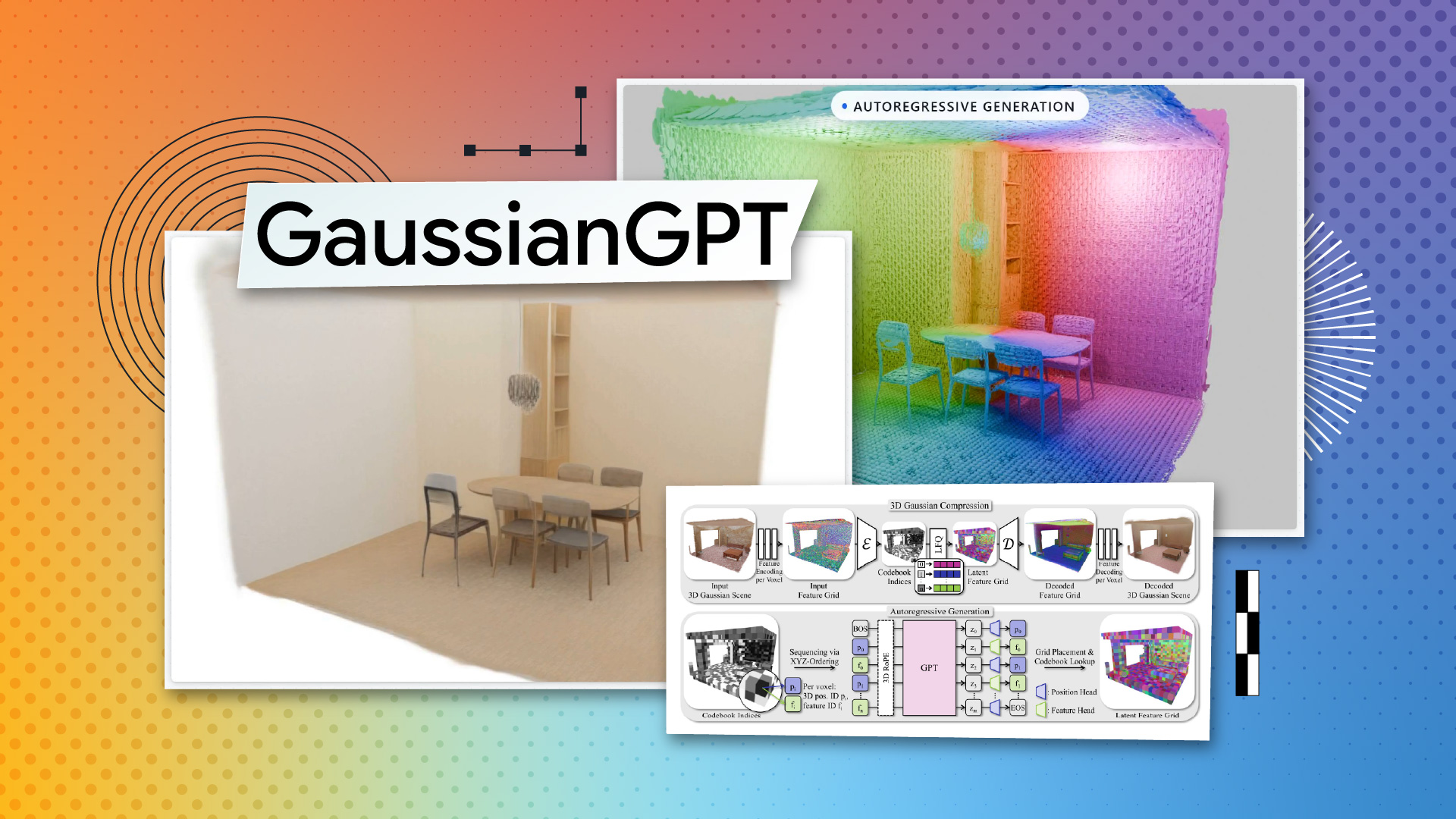
The system operates in two stages. First, a sparse 3D convolutional autoencoder compresses Gaussian scene data into discrete tokens on a voxel grid. Each voxel's Gaussian attributes (position offset, color, opacity, size, rotation) are encoded, concatenated, and quantized into a codebook of 4,096 entries using lookup-free quantization. The result is a compact, discrete representation of the scene.
Second, the voxel grid is serialized into a 1D token sequence following a fixed spatial traversal order. A GPT-2 class transformer then learns to predict the next token in this sequence, as detailed in the paper. The architecture uses 3D rotary positional embeddings, which encode actual spatial coordinates rather than sequence positions. This means the model reasons about where things are in 3D space, not just where they fall in the token stream.
The token vocabulary is split into two types: position tokens (which voxel comes next) and feature tokens (what that voxel contains). This alternating structure lets the model first decide where to place geometry, then decide what that geometry looks like.
What Sets It Apart from Diffusion
Most recent 3D generation research leans on diffusion or flow-matching approaches that refine an entire scene simultaneously through iterative denoising. GaussianGPT takes a fundamentally different path. Because it builds scenes sequentially, it can condition on any prefix. Hand it a partial scene as context and it continues from there, with each new token informed by everything generated before it.
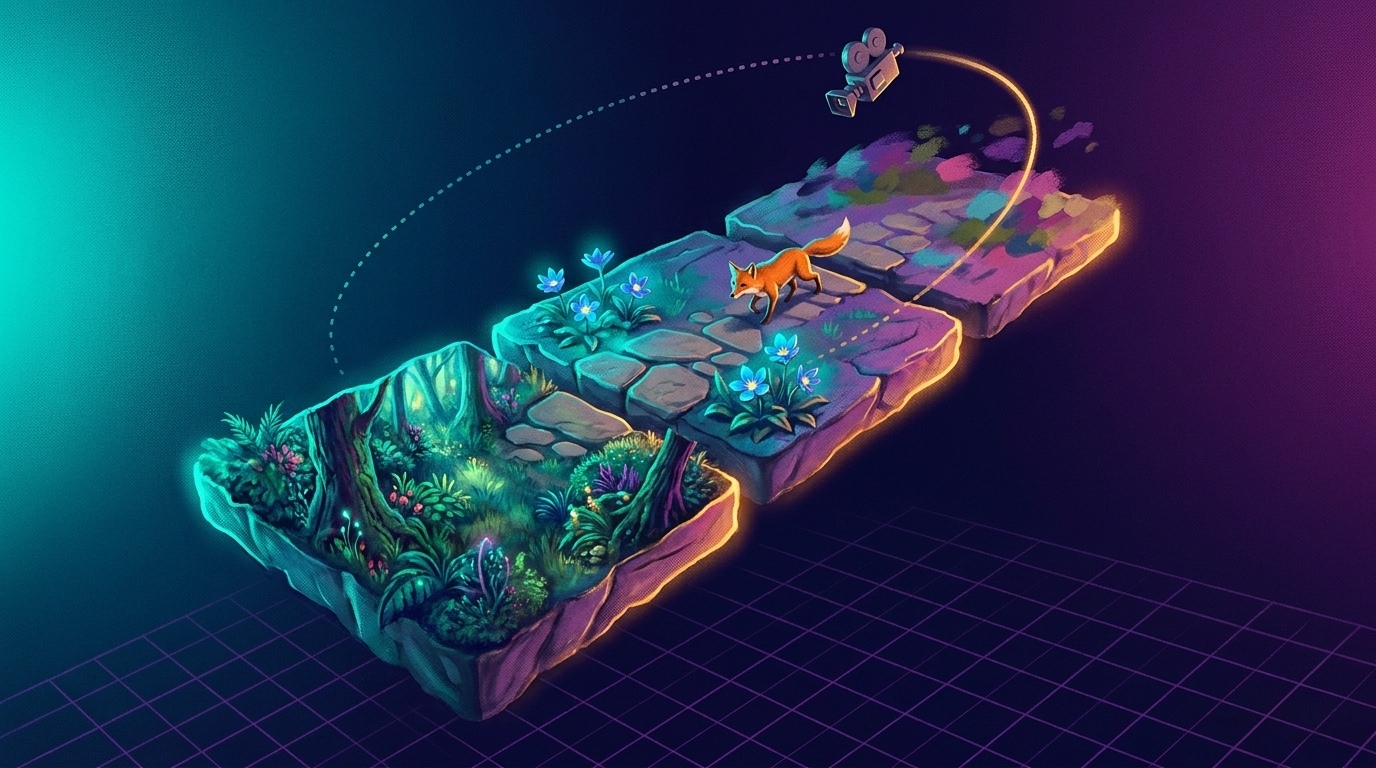
This sequential construction also enables outpainting through a sliding window mechanism. The model generates a chunk, shifts its context window forward, and generates the next chunk, using overlap to maintain spatial coherence. The researchers demonstrated this on 12-meter-by-12-meter indoor environments, extending scenes across multiple rooms with consistent floor planes and plausible room layouts.
On the PhotoShape chair benchmark, GaussianGPT achieved an FID score of 5.68, outperforming prior methods L3DG (8.49) and DiffRF (15.95). Coverage scores followed the same pattern at 67.4%, indicating the model produces diverse outputs rather than collapsing to a narrow set of shapes.
The Practical Constraints
Generation speed is the obvious bottleneck. Autoregressive generation is inherently sequential. A 12-meter-by-12-meter scene takes roughly 100 minutes on a high-end GPU. That rules out interactive use for large environments, though single-room generation is considerably faster.
The autoencoder also loses high-frequency detail during compression. Fine geometric features and subtle color variation can wash out, particularly on real-world scan data where incomplete observations compound the problem. The system was trained on synthetic indoor datasets (Aria Synthetic Environments, 3D-FRONT) and shows stronger results there than on real-world captures from ScanNet++. The code is available on GitHub.
The context window caps at 16,384 tokens per generation pass. While the sliding window approach works around this for outpainting, it introduces potential coherence artifacts at chunk boundaries.
Why This Matters for Virtual Production
The significance here is architectural, not just incremental. Applying autoregressive modeling to 3D Gaussian scenes opens a path toward treating environment generation with the same prompt-and-complete paradigm that has proven effective for text, code, and images. Scene completion from partial inputs maps directly to previs workflows where a rough blockout could seed detailed environment generation. Outpainting maps to the perpetual demand for extending digital backlot environments beyond their original boundaries.
The output format matters too. Gaussian splats render in real time and integrate with existing real-time engines — including Unreal Engine 5 via plugins like Volinga's. Generated scenes do not require a separate mesh extraction or baking step before they are useful on set or in a review session.
GaussianGPT is a research prototype, not a production tool. But the framework it establishes, treating 3D scenes as sequences of discrete tokens and generating them with a standard transformer, is a pattern worth tracking. If the speed and fidelity constraints yield to scale (as they have in language and image generation), the implications for automated environment creation are substantial.