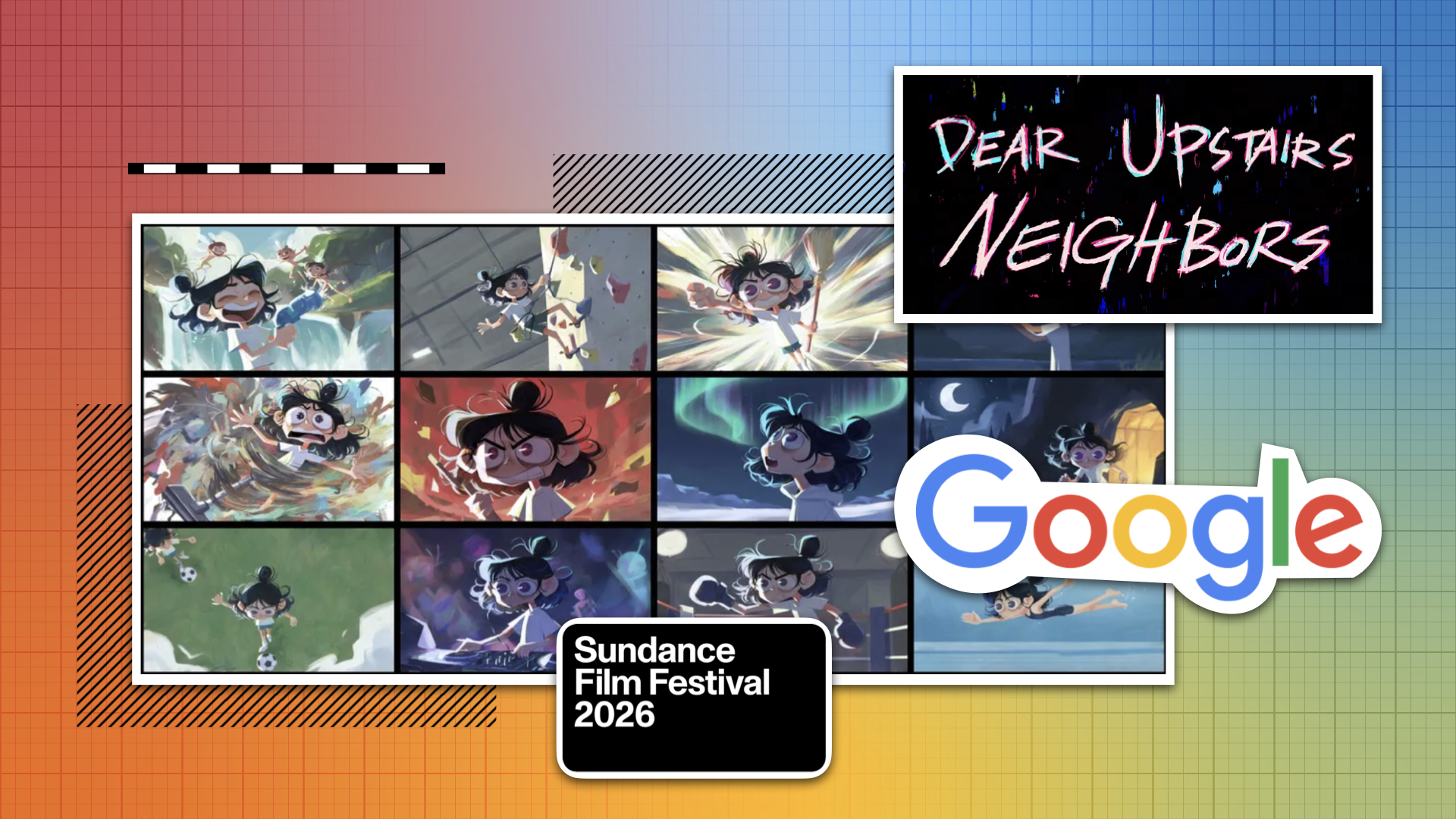
Google DeepMind premiered Dear Upstairs Neighbors at the 2026 Sundance Film Festival, a 6-minute animated short directed by Pixar story artist Connie He. The film follows Ada, a sleep-deprived woman whose noisy neighbors trigger increasingly unhinged hallucinations, rendered through fine-tuned versions of Veo and Imagen. that maintain artistic control while scaling hand-crafted animation.

A 45-person crew developed entirely new AI capabilities for this project. The result challenges assumptions about AI's role in creative work by positioning generative tools as a stylization layer rather than a replacement for human artistry.

The Core Challenge: Unique Styles That Off-the-Shelf AI Couldn't Deliver

The expressionistic visual styles director Connie He envisioned were central to the storytelling but extremely difficult to achieve in traditional animation. Her storyboards called for a series of hallucinations that shift through multiple painterly styles as Ada's night progresses, from muted bedroom tones to neon expressionism.

The team quickly discovered their vision was too specific for existing tools. Production designer Yingzong Xin (character designer on Turning Red, Soul; director of Nini) created concept art with extruded proportions and angular shape language that required the AI to learn deep artistic concepts, not just surface-level style transfer.

We didn't type this film into existence. We crafted it with a team of 45 people and brought it to life with this new technology.

Connie He, Director

Google's researchers built tools allowing artists to fine-tune custom Veo and Imagen models on their artwork, teaching the models new visual concepts from just a few example images. What the AI learned surprised the team: not just superficial details like color and texture, but principles like two-point perspective and how to maintain character silhouettes that follow 2D animation rules even as forms rotate in 3D space.

Video-to-Video: Show, Don't Type

Text prompting alone couldn't control the rhythm of Ada's sleepy fingers typing, the comedic timing of her facial expressions, or the exact framing of a camera reveal. Using text-to-video with the fine-tuned Veo model produced scenes that looked like Ada, but their movement was random, uncontrolled, and often bizarre.

The solution was video-to-video workflows inspired by how animators naturally communicate: by drawing or acting out scenes. Animators created rough animation in their preferred tools, which AI then transformed into fully stylized video with an adjustable balance between firm control and improvisation.

This approach kept motion and timing in human hands while offloading the labor-intensive stylization process to AI.

Multiple Pipelines, Same Philosophy

Different animators used different tools, all feeding into the same AI transformation process:

  • Maya to Veo - Animator Ben Knight created rough 3D animation, and researcher Andy Coenen used fine-tuned Veo models to transform it into the final painterly look.
  • TVPaint to Imagen - Animator Mattias Breitholtz created rough 2D animation in TVPaint, and researcher Forrester Cole transformed it frame-by-frame using fine-tuned Imagen in a custom ComfyUI workflow.

  • Maya effects to expressionist style - Animator Steven Chao animated Ada and created dynamic low-poly effects in Maya. Researcher Ellen Jiang and director Connie He used fine-tuned Veo and Imagen to transform these elements into expressionist visuals. The staccato rhythm of changing paint texture added intensity to the action.

  • Concept art to motion - For Ada's hallucination of a howling dog, the team started with a concept painting by Yingzong Xin and used Veo image-to-video to bring it to life.

The workflow allowed switching freely between Veo and traditional tools like Premiere during iteration, treating AI as one tool among many rather than an all-or-nothing approach.

Dailies and Localized Refinement: No One-Click Generations

No final shots were "one-click" generations. Like any film production, the team critiqued each shot in dailies reviews, going through several rounds of feedback.

To iterate without regenerating from scratch every time, researchers built tools for localized refinement. When Ada's hair silhouette didn't work in one scene, researcher Erika Lu added a rough mask indicating where more hair was needed, and Veo improvised an extra tuft that fit seamlessly into the rest of the shot.

This mirrors the note-based revision process familiar to anyone who's worked in animation production, just with AI handling the execution of adjustments to specific regions rather than requiring manual rework.

Veo upscaled final shots to 4K resolution while preserving stylistic nuances. This upscaling tool is currently available in Flow and will be included in Google AI Studio and Vertex AI.

The Team Behind the Film

The production brought together animation industry veterans and Google DeepMind researchers:

  • Connie He - Director. Pixar story artist on Inside Out 2 and Dream Productions. Her viral short "Watermelon: A Cautionary Tale" has over 200 million views.

  • Yingzong Xin - Production designer. Character designer on Turning Red, Soul, and Elio; director of Nini.

  • Cassidy Curtis - Supervising animator. Previously worked on Oscar-winning animated films.

  • Sarah Rumbley - VFX supervisor.

  • Marcia Mayer - Producer.

  • Yung Spielburg - Composer.

The animation team included Ben Knight, Mattias Breitholtz, and Steven Chao. Google DeepMind researchers Andy Coenen, Forrester Cole, Ellen Jiang, and Erika Lu developed the technical workflows.

Google's $2 Million AI Education Initiative

Alongside the film premiere, Google.org announced $2 million in funding for an AI Literacy Initiative to train over 100,000 artists through Sundance Collab. The initiative establishes an AI Literacy Alliance in collaboration with The Gotham and Film Independent.

The funding will support:

  • Free online curriculum developed through Sundance Collab to bridge the gap between creative curiosity and technical application

  • Scholarships for Google courses like AI Essentials, expanding professional development access to independent filmmakers without corporate training budgets

  • AI Creators Fellowship for technical experimentation and development of shared case studies

  • Community conversations to develop industry-led standards and ethics that protect human creativity

The timing is strategic. According to Google, only 25% of media companies are currently investing in AI training, creating a skills gap as tools advance faster than workforce capabilities. By funding education through established film institutions, Google positions itself as enabling creators rather than replacing them.

What This Means for Filmmakers: A Template for Artist-Controlled AI

The "Dear Upstairs Neighbors" workflow offers a template that sidesteps many current AI filmmaking concerns:

  • Artist control preserved - Motion, timing, and performance remain in animator hands

  • AI as stylization layer - Rendering and style transfer rather than full generation

  • Fine-tuning for consistency - Custom models trained on specific visual targets from a few example images

  • Traditional skills required - You need to know animation before you can use AI to style it

  • Iterative, not generative - Dailies reviews and localized edits, not one-click outputs

This contrasts with text-to-video approaches where prompts drive generation from scratch. We've previously covered how Flow consolidates Google's AI filmmaking tools, and how Veo 3.1 added more control features for production workflows. "Dear Upstairs Neighbors" demonstrates these capabilities applied to a complete short film with a professional animation team.

The model also builds on Google's collaboration-first approach. Their partnership with Darren Aronofsky's Primordial Soup on Ancestra forced their generative models to solve real-world production hurdles, developing advanced capabilities like personalized video for character consistency and motion matching to replicate complex 3D camera paths.

Looking Ahead: The Practical Takeaway

The "Dear Upstairs Neighbors" workflow won't work for every project. It requires substantial animation expertise, access to fine-tuning capabilities not yet publicly available, and a team large enough to handle both traditional animation and AI iteration.

But it establishes a proof of concept for AI as amplifier rather than replacement. Hand-painted frames of this complexity would require thousands of artist-hours; the AI stylization pipeline scaled the visual ambition without sacrificing directorial control.

For filmmakers watching AI tools evolve, the practical question is whether similar workflows will become accessible. Google's Veo 4K upscaling is already available in Flow, with broader availability coming to Google AI Studio and Vertex AI. The fine-tuning tools demonstrated in "Dear Upstairs Neighbors" represent the next frontier, currently limited to research partnerships but likely to expand as the technology matures.

The film will be released publicly following its Sundance premiere. Watch the trailer and behind-the-scenes on Google DeepMind's YouTube channel.

Reply

or to participate

Keep Reading

No posts found