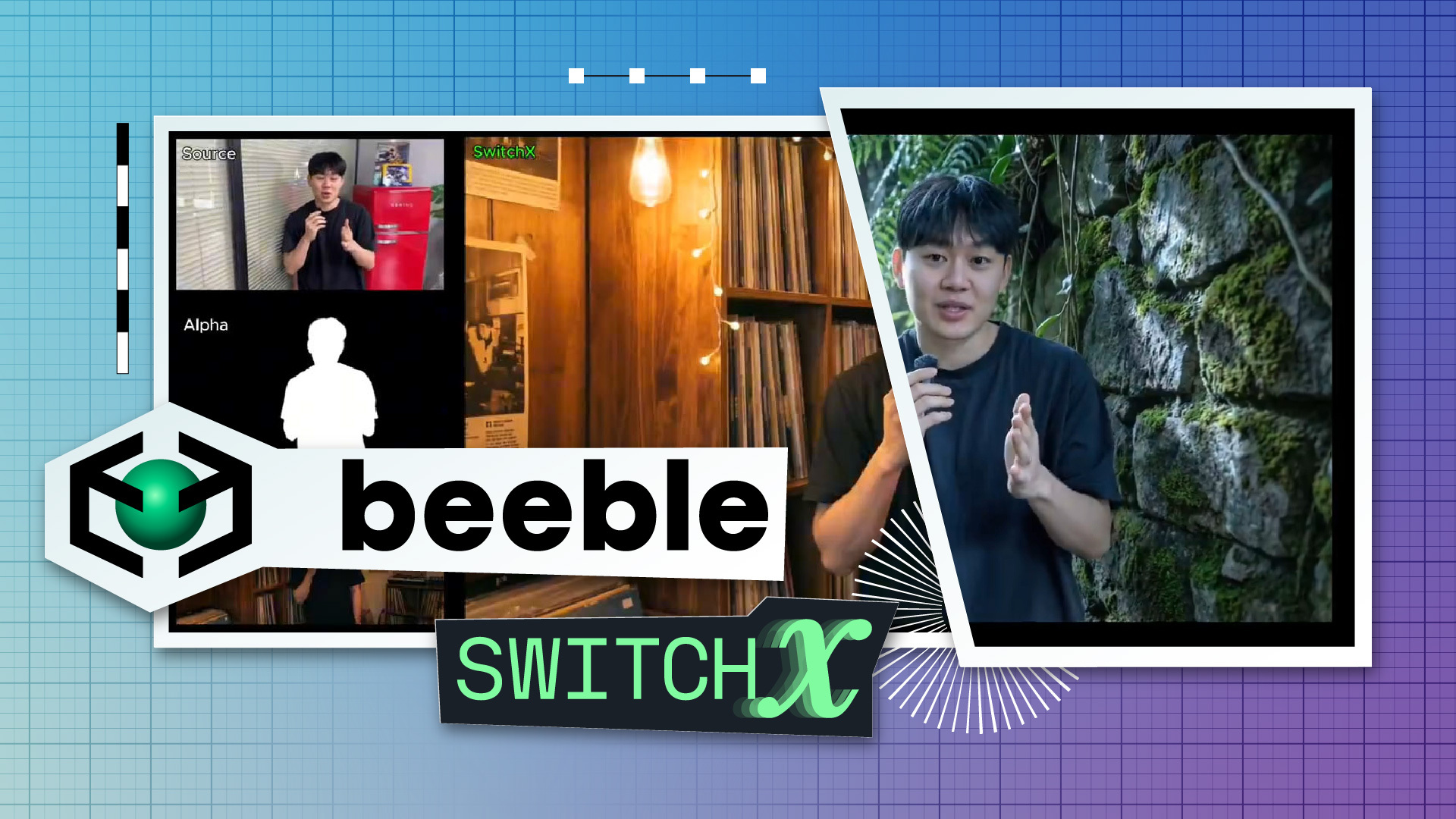
SwitchX takes a different approach. Rather than generating PBR passes for relighting workflows, it transforms video directly. The demo footage shows source video with an alpha mask and reference image producing a completely restyled output set in a jazz club environment.
Pixel-Level Guidance
The technical differentiator Beeble emphasizes for SwitchX.
Most video-to-video tools struggle with maintaining subject consistency across frames. Beeble's solution uses the source footage itself as pixel-level guidance for the transformation process. This means the model doesn't just reference the original video; it's constrained by it.
The practical implications for filmmakers:
Identity preservation — Faces, body movements, and fine details remain consistent with the source
Performance grounding — The original acting performance carries through the transformation
Controllable output — Results stay anchored to what was actually shot rather than hallucinating new content
This approach addresses one of the persistent challenges in AI video transformation: the tendency for generative models to drift from the source material, introducing artifacts or inconsistencies that require manual cleanup.
Selective Control Through Masking
SwitchX offers granular control over what gets transformed.
Users aren't limited to all-or-nothing transformations. The masking capability allows selective modification of specific elements within a frame. Want to change the background while keeping the foreground subject untouched? Apply a mask. Need to reimagine props while preserving the actor? Mask accordingly.
This selective approach opens workflow possibilities:
Relight specific areas of a scene independently
Swap environments while maintaining foreground elements
Modify set dressing without affecting talent
Apply different style treatments to different parts of the frame
Where SwitchX Fits in the AI Video Landscape
A tool for transformation, not generation.
SwitchX enters a crowded field of AI video tools, but it occupies a specific niche. Unlike text-to-video generators such as Runway, Pika, or Kling that create footage from prompts, SwitchX transforms existing footage. It's a post-production tool rather than a production replacement.
This positioning makes sense given Beeble's history. The company has consistently focused on tools that enhance existing footage rather than generate new content from scratch. SwitchLight helps filmmakers fix lighting problems after the fact. SwitchX extends that philosophy to broader visual transformation.
For virtual production workflows, where matching practical footage with digital environments remains challenging, SwitchX could provide another option for achieving visual consistency without reshoots.
Free Beta, Browser-Based Access
Low barrier to entry for testing.
The SwitchX beta is available at no cost through the Beeble web app. This follows Beeble's established pattern of launching new features in free beta before moving to paid tiers.
Beeble's cloud platform runs processing on their servers, eliminating local hardware requirements. For users who need local processing, Beeble also offers Beeble Studio, a desktop application that runs SwitchLight 3.0 on local GPUs with 4K support and unlimited processing. Whether SwitchX will eventually come to the desktop app remains to be seen.
The Transformation Toolkit Expands
SwitchX adds generative capabilities to Beeble's post-production suite.
SwitchX represents Beeble's first step into generative video transformation. The company's existing tools analyze and decompose footage; SwitchX synthesizes new visual content guided by that footage.
For filmmakers who've used SwitchLight for relighting workflows, SwitchX offers a complementary capability: instead of just changing how light falls on a scene, you can now change what the scene looks like entirely while maintaining the core performance.
The free beta provides an opportunity to test whether SwitchX's pixel-level guidance approach delivers on its promise of controllable, identity-preserving video transformation. For productions dealing with environment changes, style modifications, or visual effects that need to respect existing footage, it's worth exploring.