Nuke integration publishes workflows as versioned gizmos
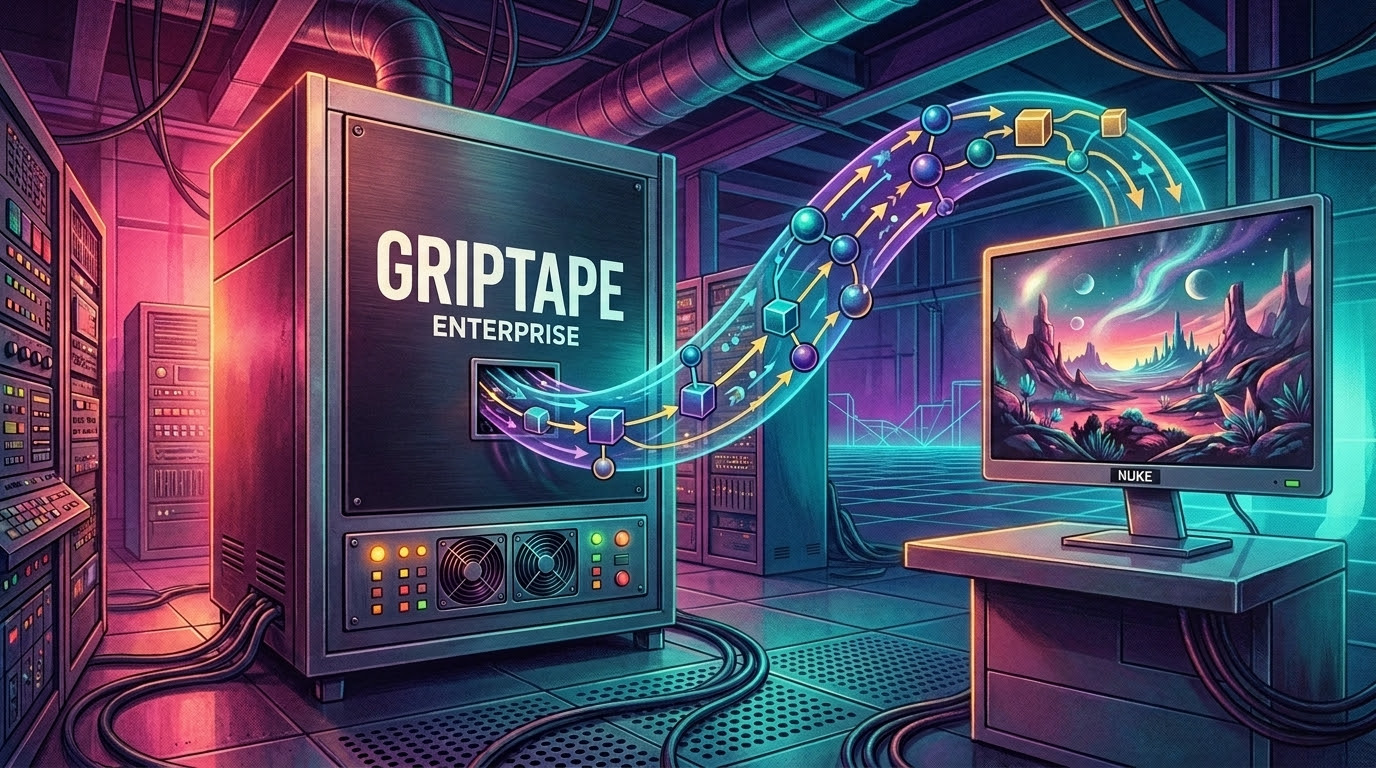
Griptape Enterprise connects directly to Nuke. Artists can publish workflows as versioned gizmos and run scripts headlessly, which pushes generative steps into the same versioned, repeatable structure compositors already use for the rest of a shot.
The tier also adds agentic automation with a choice of local or cloud LLMs, and it ships an MCP server that lets AI agents pilot Griptape at scale. We previously detailed how Foundry brought Griptape agents into Nuke, Blender, and Maya through MCP, the same protocol underneath this release.
Modular diffusion pipelines run open models on studio GPUs
The generative core is a set of modular diffusion pipelines that support FLUX, Stable Diffusion XL, LTX, and WAN models running locally on studio GPUs. Keeping inference on local hardware matters for facilities that cannot send frames to an outside API for legal, security, or client-confidentiality reasons.
That local-first design lines up with Foundry's broader push to fold machine learning into its compositor, which we saw in Nuke 17.0 and its expanded machine-learning toolset.
Kyle Roche moves from Griptape CEO to Foundry Chief AI Officer
Kyle Roche, Griptape co-founder and its former CEO, has been named Foundry's Chief AI Officer. He joined the company in February 2026 when the acquisition completed.
Roche framed the enterprise tier as a way to move studios into AI production without the one-off workarounds many have assembled on their own:
Foundry has been a trusted technology partner to visual effects and animation studios for over 30 years. With the new Griptape Enterprise license tier, Foundry is shepherding high-end creative teams into AI-enhanced production in a safe and secure way, with artistry and craft at its core. While studios are navigating how best to integrate AI models with bespoke platforms and workarounds, we're pleased to offer Griptape as a highly customizable and safe off-the-shelf alternative.
Kyle Roche, Co-founder and Chief AI Officer
What governed, off-the-shelf AI means for studio pipelines
For facilities weighing generative tools, the constraint has rarely been model quality. It has been control: where the data lives, who holds the license, and whether an AI step can slot into a versioned pipeline without breaking review and audit trails. Griptape Enterprise answers those questions by keeping deployment, models, and color management inside the studio's own walls, and by wiring the whole thing into Nuke's existing gizmo and scripting workflow.
Whether high-end studios adopt a packaged orchestration layer over their own internal tooling is the open question. With FLUX, Stable Diffusion XL, LTX, and WAN all running locally and Nuke as the front end, Foundry is betting that the facilities most cautious about AI are the ones most likely to pay for a governed way in.