Gemini 4 Carbon Is Google's New Frontier Model for Long-Horizon Agent Work, at an Introductory $2 per Million Input Tokens
VP Land
Nov 10, 2026 · 4 min read
Google has released Gemini 4 Carbon, its new frontier model for long-horizon agent work, to paying developers, enterprises and Google AI Ultra subscribers, alongside a /swarm preview that turns one prompt into a coordinated team of agents. In Google's demos, Carbon modeled 3D assets in Blender and built Three.js scenes that render in the browser.
/swarm turns one prompt into an agent team. Developers can assign Carbon to architectural design, coordination and auditing while faster, lighter models work in parallel, and they can track the agents in real time.
Same introductory price as Argon. Carbon launches at $2 per million input tokens and $10 per million output tokens, matching Gemini 4 Argon, though that rate is introductory.
Benchmark claims lean on cost. Google says Carbon ranks #1 on three independent workflow benchmarks at more than 2X lower cost per task than the next best external model.
Rolling out to Ultra subscribers. Carbon is rolling out to Google AI Ultra subscribers in Google Antigravity, the Gemini app and AI Mode in Search.
In Google's demos, Carbon modeled in Blender and rendered 3D scenes in the browser
The /swarm preview runs in Google Antigravity, where lighter models work in parallel isolated workspaces and adversarial verifiers test every change. Google says Carbon also runs build-and-verify loops on web apps, recovers from errors, and checks both its code and the rendered UI.
Google published these demo projects:
Underwater Atlantis. Starting from a video reference generated with Gemini Omni, the pipeline modeled procedural ruins, volumetric caustic lighting and water simulation in Blender, then converted the environment to Three.js for real-time browser rendering.
Pelican campus game. Using /swarm, subagents modeled 3D assets in Blender from Omni and Nano Banana references and built an open-world browser game of Google's Mountain View campus in Three.js with WebGL shaders, procedural Web Audio effects and Lyria music.
Office reconstruction. Seven public City Council planning PDFs, with 206 extracted engineering drawing views, became a 906K-triangle Three.js model of Google's Platform 37 office over 10 overnight loops.
Store redesign. In two prompts, Carbon proposed five art direction concepts for the Google Merchandise Store and generated new product imagery with Nano Banana 2.1.
Carbon matches Argon's launch price but spends more tokens on the hardest tasks
Koray Kavukcuoglu, SVP of Google DeepMind, wrote that Carbon is built for "tasks that test the limits of a model's intelligence," such as complex multi-step coding and debugging and open-ended research. Because Carbon uses more tokens than Argon, the same per-token rate can still produce a higher cost per task.
Paying developers and enterprises can call Carbon through the API in Google AI Studio.
Enterprises can also reach it in Gemini for business via the API or the model drop-down.
The introductory price is available until November 30, 2026. After that deadline, the public Carbon model costs $4 per million input tokens and $20 per million output tokens.
Google says Carbon's #1 rankings include CursorBench 4.0, a coding-agent benchmark tracked by Epoch AI.
The third is Zapier's AutomationBench, which scores models on end-to-end workflow execution across real tools.
Google also partnered with Artificial Analysis on a new Multimodal Knowledge Agent (MKA) benchmark for agents reasoning over dense files with charts, images, blueprints, schematics and tables. Google says Carbon ranks #2 there at more than 6X lower average cost per task than the top model.
Google's free six-month Antigravity program for scientists, which opened applications for 10,000 researchers with Argon, now extends to Carbon, subject to eligibility, capacity and selection.
Cyber defenders got Carbon first, and Google reports lower breach rates than Argon
Google first released Carbon to cybersecurity defenders through its Fairwind Program, where Google says the cyber version leads on SEC-bench Pro, ExploitGym and CWE-bench v1. In Google's Project Fortify, Carbon hit 100% recall on scanning and 95% precision on triage on an internal benchmark.
Google's reported safety numbers:
Attack testing. In simulated cyberattack testing, Carbon blocked 99% of attack trajectories from an adaptive red-teaming agent, with a per-attempt breach rate of 0.8% versus 3.1% on Argon.
Honesty. On a 375-task agentic honesty benchmark, Carbon passed 92% of tasks compared to 70% for Argon.
Prompt injection. Carbon recorded a 0% attack success rate on the Gray Swan IPI benchmark, though Google says prompt injection robustness still needs improvement.
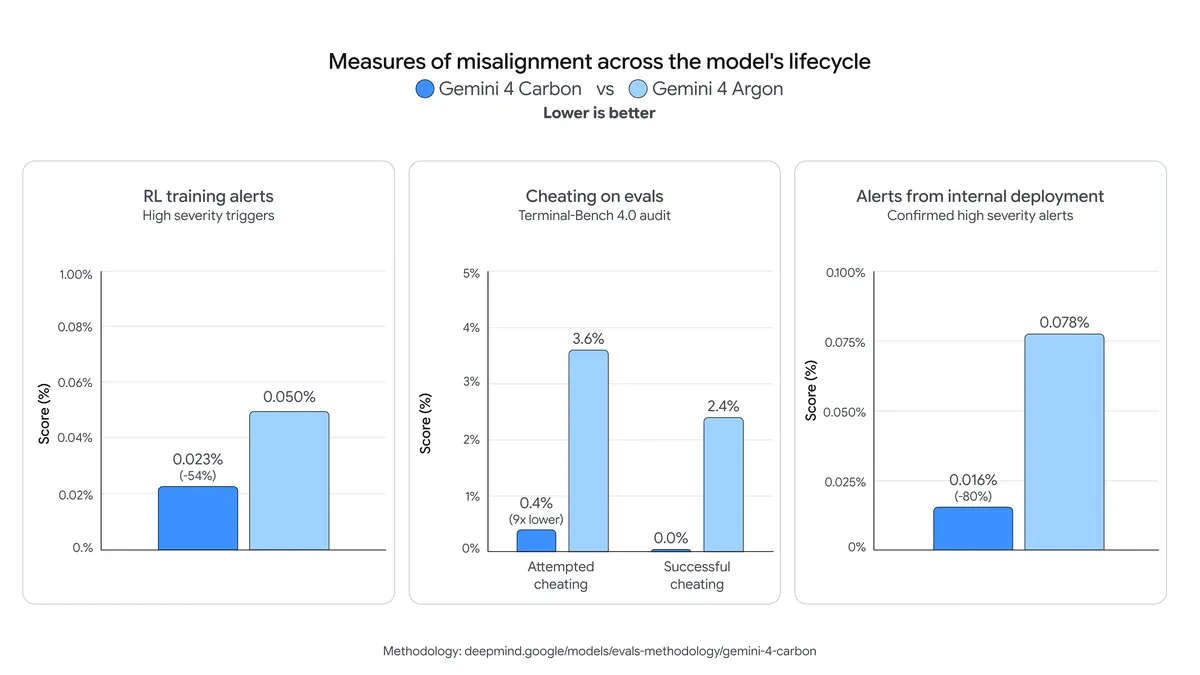
Alignment. Google reports improved alignment, measured by monitor flag rates across the model's lifecycle, along with reduced data fabrication.
Google's comparison of misalignment measures across the lifecycle of Gemini 4 Carbon and Gemini 4 Argon. Image: Google
MiniMax released H3-Image, an open-weight model that generates 16-megapixel images and edits from up to 16 reference images, claiming 4K generations in 10 seconds in its launch post on X. High-resolution stills and re…
Adobe added the Generative Media Tool to Premiere, generating video, sound effects, soundscapes and music directly in the timeline from Adobe Firefly or partner models from Google, Kling, Runway and Luma, according to…
Google rolled out Gemini Omni 1.2 Flash in Google Flow, extending continuous shots to 15 seconds for Google AI subscribers and introducing per-second pricing for Omni 1.2 Flash generations, according to the Flow team'…