How 'Backrooms' Turned Kane Parsons' Blender World Into 30,000 Square Feet of Sets and CG Extensions
VP Land
Nov 28, 2026 · 4 min read
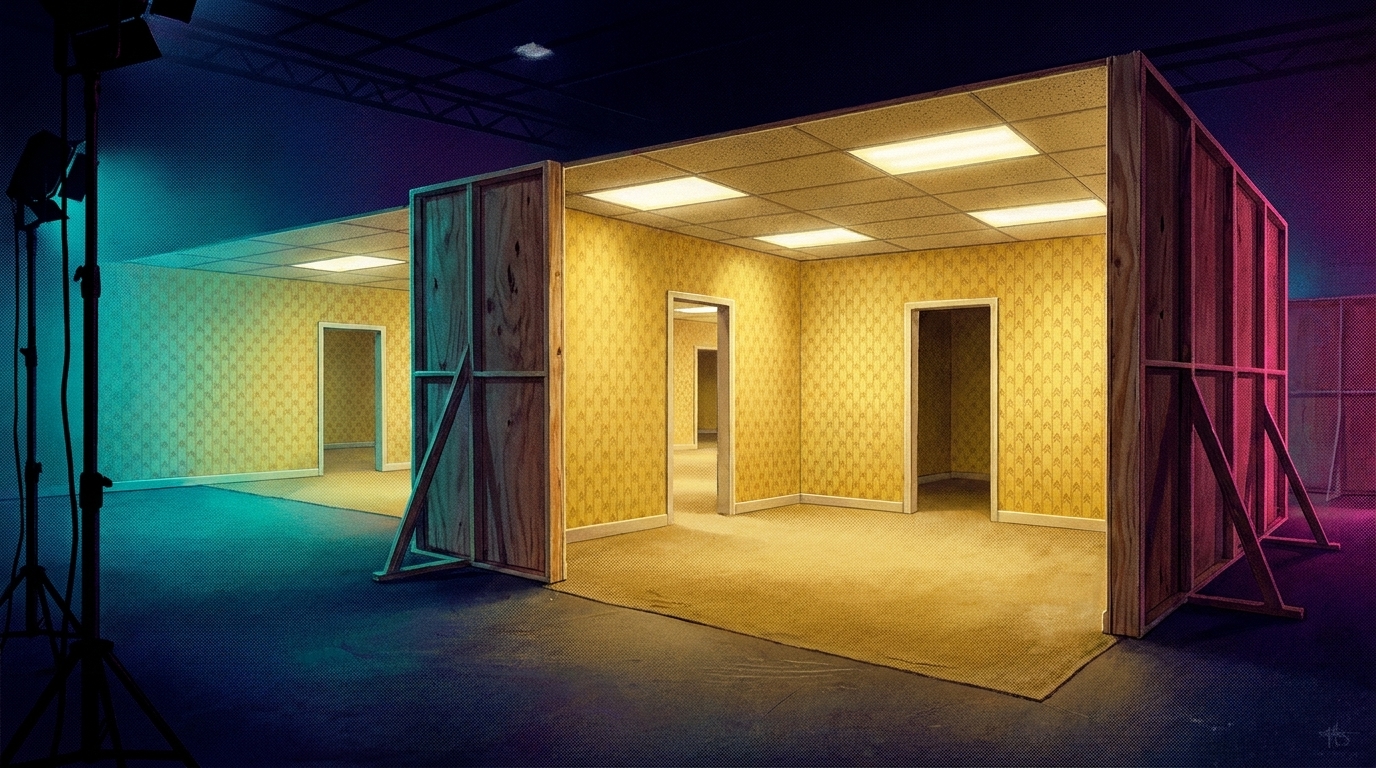
"Backrooms" merged director Kane Parsons' Blender workflow with a traditional film VFX pipeline, VFX supervisor Ed Douglas told Variety, while production designer Danny Vermette's practical sets covered more than 30,000 square feet across four stages. CG extended those builds, which gave actors real rooms and gave the VFX team a physical model to match for digital extensions and wall-clipping shots.
Parsons' own Blender files fed the pipeline. Some shots started from scenes the director built himself, upgraded to cinematic quality before moving into production.
The digital design outgrew the stages. Parsons designed roughly 100,000 square feet of the Backrooms digitally, far more than the production could build, Douglas says.
Anything actors touched got built. Vermette's rule was to take the practical world as far as budget and square footage allowed, then extend and enhance in VFX.
CG shadows sold the clipping. Douglas says shadows projected from animation made characters passing through walls convincing.
Kane Parsons' teenage Blender world became the starting point for the VFX pipeline
Before "Backrooms" became a $400 million global box office hit for studio A24, it was Parsons' YouTube series of 22 episodes running two to 45 minutes each.
Douglas recalls his first response: "Is this real? Is this CG? What is this going to be?" A call with Parsons revealed the world had been built in the 3D software Blender, which started a conversation about process.
"Would this be a very traditional, film VFX process or would we bring in a hybrid process with the Kane Parsons Blender workflow? It was that combined process that we built."
At certain moments, Douglas says, the team was "literally taking the Blender file he built when he was 16 and working off it, enhancing it, getting it ready for cinematic quality and then moving it into a production pipeline."
Parsons designed these spaces himself in Blender, a different route from AI world models like Genie 4, which we've seen build explorable worlds from a single photo.
Practical sets covered what actors touched, and CG extended everything else
Set in 1991, the film, directed by Kane Parsons, stars Chiwetel Ejiofor as Clark, a furniture emporium owner who finds a portal in his store's basement leading to endless rooms of carpet and yellow wallpaper.
Douglas told Meet Me at Crafty that Parsons designed the world in Blender, then handed it to Vermette and asked, "Can you build this?" The full design was "beyond any footprint we could have," Douglas said.
Vermette worked to those limits. "The more we're grounded in the reality, the more the visual effects will work, will sell," he says. "Let's take the practical world as far as we can, and then extend and enhance."
The builds doubled as a reference model for CG. Building the sets for real, Vermette says, let the team match "exactly how the wallpaper works, how the ceilings work, how the light works."
A blue-screen wall on set, replaced with endless yellow rooms in the finished shot. Image: Variety
For the Vertigo Room, which Mary (Renate Reinsve) discovers while fleeing Pirate Clark, the production hollowed out a bank-owned skyscraper in downtown Vancouver and added blue screen. Everything Reinsve interacts with was built physically, down to the real tiles on the staircase and trap door she climbs through.
The line between the two is deliberately blurry. Some key images are full CG, and some shots that look like Parsons' Blender world are actually sets, Douglas says.
Clipping relied on CG shadows, while the Still Lifes stayed practical
Clark's basement set sat right next to the first backroom, so actors could walk, and the camera could pass, straight from one to the other. "We put blue screens up on either side as we were filming these, and then in VFX post-production, we would add the walls back in," Douglas says.
He describes the look as plain geometry, with "no sparkles, distortion or ripples. It was two computerized objects sliding straight through each other, so there's nowhere to hide."
Mr. Wolf VFX handled much of the set-extension work, including some of the clipping, according to VFX Voice. Douglas told the outlet the clipping mixed rotomation, intersection and hand rotoscoping, and he credits the shadows with selling it: "All the shadows you're seeing on the walls are CG shadows projected from animation."
A clipping shot before and after VFX restored the wall around the actor. Image: Variety
The practical-first rule reached the creatures too. Douglas told Meet Me at Crafty that the Still Lifes, including the striped-shirt man and the redheaded woman, were almost entirely practical effects from makeup effects supervisor Werner Pretorius and Amazing Ape Productions, with VFX touch-ups on eyes and blinks.
Unreal Engine 6, Early Access included, will ship without Blueprints or the Actor gameplay framework, according to Epic's update on Blueprints, so gameplay moves to Verse on the new Scene Graph framework. Any UE5 proj…
Netflix is investigating Gaussian splats as a future streaming format for TVs, streaming sticks, phones and laptops, according to Lowpass's reporting on a Netflix job listing. On the production side, native splat supp…
DNEG has partnered with Meta to convert a catalog of films into stereo 3D for Meta VR Glasses, and its Stereo team is already in production on several titles, including The Hunger Games: Sunrise on the Reaping, accord…