How Chris Nichols Burned Down a Relightable Splat of a Real House on an LED Wall
VP Land
Sep 11, 2026 · 8 min read
Chris Nichols captured a crumbling, abandoned house in Northern California's Gold Rush country on an Alexa 35, rebuilt it as a relightable Gaussian splat, added a second story it never had, and set the whole thing on fire on an LED wall. The splat and the polygons he dropped in around it shared one ray-traced world, lit by the same sources and blended in-camera with the practical set his actors performed on.
Nichols is Director of Special Projects at the Chaos Innovation Lab. He built the sequence for June July, a revenge Western he is producing through his own company, Monstrous Moonshine, and he walked us through the full scene step by step, from capture to final grade. Parts of the toolchain were two days old when he shot.
Key takeaways:
Relightable, ray-traced splats. Splats and polygons live in one Chaos Vantage and Arena world, lit by the same sources, so Nichols could place lights inside the captured house and burn it down with self-illuminating fire sprites.
Splats load natively. A PLY file opens directly in Vantage with no plugin or conversion, and an XGRIDS scan opens straight into Arena or Vantage.
Cinema-camera capture for day-for-night. Phone and XGRIDS splats are 8-bit, so Nichols built his from Alexa 35 EXRs to hold an extreme day-for-night LUT.
$6,000 a day, and the art department went straight to the wall. He shot on the small LED stage at Independent Studio Services and sent his Rhino and V-Ray artists to the wall without a separate virtual art department.
The colorist couldn't tell. Photochem's color chief mistook the virtual production shots for live-action plates.
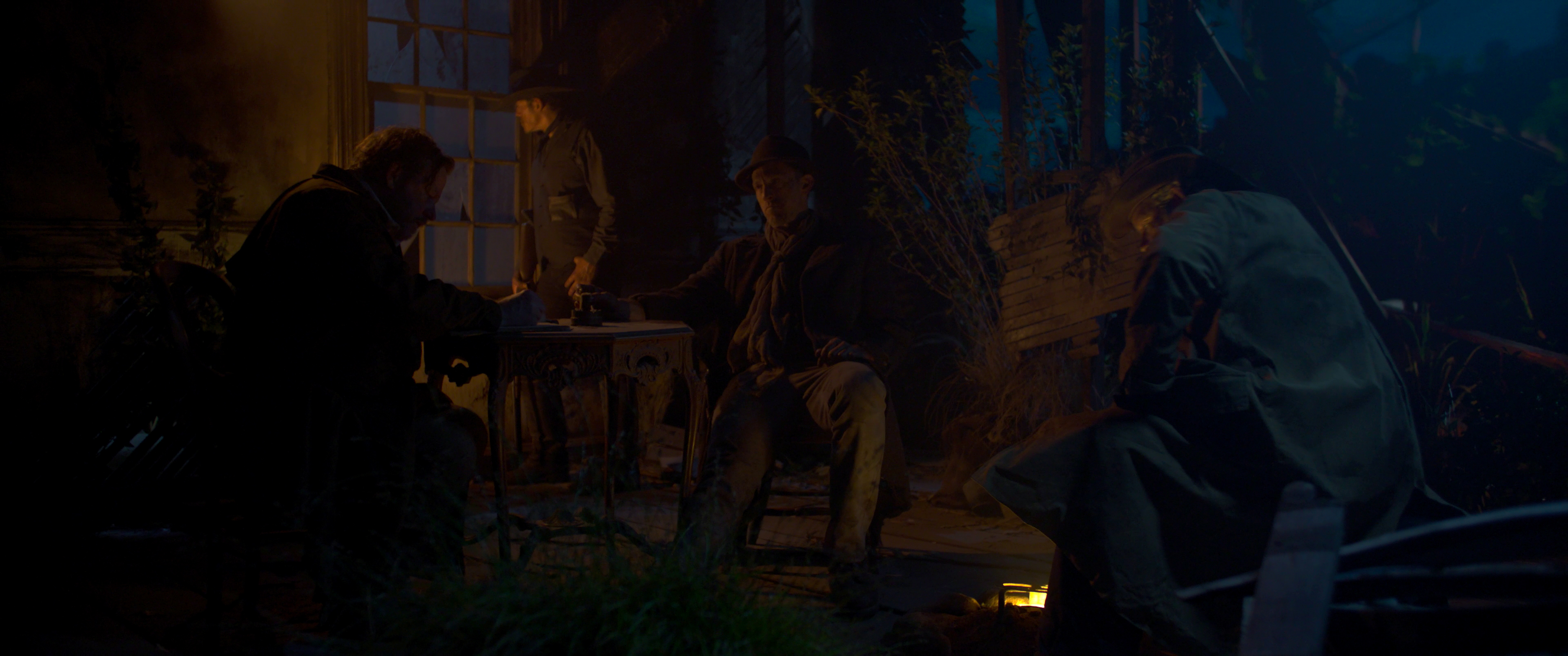
Men in 19th-century frontier costume gather by a small lantern around a table in a nighttime scene from June July. Image: Monstrous Moonshine
Splats and polygons burned in the same ray-traced world
The core of the setup is relighting. Nichols brought relightable Gaussian splats into Chaos Vantage, a real-time ray tracer, and lit them from sources he placed by hand instead of living with the lighting baked into a scan. The splats are, as he put it, "fully ray traced."
Vantage renders in real time; Arena, the server system Chaos built to push those renders onto an LED wall, is what put the burning house in front of the camera.
Because the splats and added polygons ray trace together, they are "actually lit by the same light source," Nichols says, so "you have polygons and splats living in the same world." He cut the splat and added a second floor for framing, dropped in a crumbling façade as polygons, and moved trees behind it, all reacting to one light rig.
Nichols describes how he set the splat on fire:
I created these sprites for all the windows from fire elements, and I just put them on there, and they were self-illuminating, so they lit up the whole thing. So I got the whole building to be on fire from a splat.
He never modeled the house, and he did not have to. The capability is native to the tool now: "you can literally just load a PLY file directly into it," Nichols says, with no plugin and no conversion step. An XGRIDS scan opens the same way, straight into Arena or Vantage.
A workstation displays the photoreal render of the captured house, its windowed stone exterior, wooden chairs, and climbing plants. Image: Chaos Innovation Lab
An Alexa 35 splat solved a day-for-night problem phones couldn't
Nichols wanted a hard day-for-night look, and that ruled out a quick phone or XGRIDS capture. Those are "8-bit compressed color," he says, too thin for the grade he had in mind.
So he walked the location with an Alexa 35, shooting the building like plates, and built the splat from raw EXRs in Postshot. He still ran an XGRIDS scan for more accurate geometry, then used the Alexa data for color. He skipped a photogrammetry pass and went straight to splats.
The grade created its own trap. Nichols first planned to keep the splat linear and apply the day-for-night LUT in real time, until the fire broke it.
This LUT was so extreme that if I put things on fire, there was hardly any red left in the LUT, so you couldn't do it. So it was better to bake the light in first and then apply the light later.
One more constraint shaped the shoot. Relighting a splat is additive, so "you can't unlight it," Nichols says, and a hard shadow stays baked in. The location happened to be captured on a cloudy day, and that diffuse light is what let him relight it cleanly.
A crew member adjusts a barn-door light as a practical fire burns behind a wooden structure on the night location. Image: Monstrous Moonshine
In-camera optics beat a layered comp
Nichols shot the interior on a mix of practical set and LED wall, with vintage Panavision lenses, and let the glass do work a compositor would otherwise fake. The interior scene features an actor who also appears in The Odyssey. One shot uses a split diopter to hold an actor's whiskers and the background at once, with half-moon lens flares off a swinging lantern.
Not every shot needed the wall. For an exterior door, Nichols used a matte painting rather than reorienting the whole set, and that shot features actor Dallas Roberts.
Arena's defocus compensation handled the rest. Rather than blurring the whole wall evenly, "it'll actually add an extra defocus based on the distance after the wall," he says, so a background that sits close to the talent still reads as far away. Nichols weighs that against the usual compositing route:
To make a comp of this the way you would normally do it, you'd shoot each thing separately and try to bring it together and comp it and try to make it feel perfect. [You'd] never get that level of complexity and layering that you're getting from this.
The proof came in the grade. Nichols says Photochem's color chief asked to see what the team had done with the LUTs, then admitted "all I saw was live-action plates," and, told the shots were virtual production, said he "couldn't tell."
An ARRI cinema camera fitted with a vintage Panavision 75mm T1.6 lens rolls on a slider rig with the record indicator lit. Image: Monstrous Moonshine
A $6,000 stage, and the Rhino artists went straight to the wall
Nichols is blunt about cost, because he thinks the "too expensive" reputation is what keeps indie productions away from virtual production.
I really strongly believe that this is going to be an important thing for filmmakers, especially indie filmmakers, because as I'm sure you're aware, people have this perception that virtual production is too expensive for your film. And I strongly believe that people should look at virtual production as a tool that is very accessible and cheap and affordable.
The stage at Independent Studio Services ran "$6,000 a day," Nichols says, and the facility let his crew build the physical set walls on site using its own saws, then keep the pieces afterward in exchange.
He also cut a role most LED shoots budget for. His art department already worked in Rhino, so he handed them V-Ray for Rhino and sent their scenes straight to Vantage. "Just let the Rhino guys go right to the wall," he says, skipping the separate virtual art department that normally processes data before it reaches the LED.
His splat capture is what makes location work that cheap. It is "simpler than photogrammetry," Nichols says, with nothing to process. He credits planning over kit: "Just plan it correctly and you'll save a lot of money. You've got a bunch of people on set, so know what you're loading and know what you're doing."
AI sits in the pipeline where it is useful rather than as the point. Chaos's texture tool derives PBR maps, including normal and roughness, from a single photograph, and the DLSS denoiser cleans the ray tracing. "I don't want to avoid AI and I don't want to only use AI," he says. "I want to use the tools that are appropriate for what I need to do."
The small LED stage at Independent Studio Services, with a cinema camera on a dolly against the painted brick wall. Image: Monstrous Moonshine
One pipeline carried the asset from previs to final frame
The whole exercise was about not rebuilding the same asset at every stage. Nichols previs'd the scene with VidViz, Chaos's blue-screen previs approach that uses real actors and a tracked camera, then carried the same assets forward instead of throwing them out for the game engine and again for post.
Now we have to rebuild it for previs, now I have to do it completely stuffing it in the game engine, I have to throw all that away and do it again for post-production. Just work with a continuous pipeline of some kind.
The plan he is selling is a simple division of labor. Grab establishing shots on location with a tiny second unit, scan them, and shoot the dialogue-heavy work on the stage with full control. He is candid that the finished scene doubles as a fundraising tool. When he pitches June July, he can show a full scene, from VidViz blocking to the final graded frame, rather than a script and a promise.
A June July slate marks a take on the darkened set during the production. Image: Monstrous Moonshine
He used his own production as a proving ground for tools he would not yet hand a client, shooting on a build of Vantage that was two days old and taking that risk on his own company instead of someone else's schedule. The result is his argument that the world they shot in Angels Camp and the world they shot on the stage are, to anyone watching, the same place.
For working filmmakers, the useful shift is that a splat capture cheap enough to grab on a weekend location shoot can now be lit, ray traced, and burned on an LED wall alongside polygon set extensions, with no virtual art department in the middle. Nichols built a single sequence to test whether that holds up on a real production, and his colorist could not find the seam.
Prime Video introduced Prime 360, an AI-powered virtual camera system that reconstructs recorded basketball action as a 3D scene and shows replays from angles its physical broadcast cameras can't capture. Virtual view…
Volinga has added 4D Gaussian Splatting support to its Unreal Engine workflow, letting animated splat captures play back in real time inside the engine.
The American Society of Cinematographers is releasing StEM3-VP , a set of open reference assets built to evaluate and calibrate in-camera visual effects stages, and the material is joining the Ac