LTX Releases Open-Weights SDR-to-HDR Model That Turns 8-Bit Video Into 16-Bit EXR
VP Land
Nov 10, 2026 · 3 min read
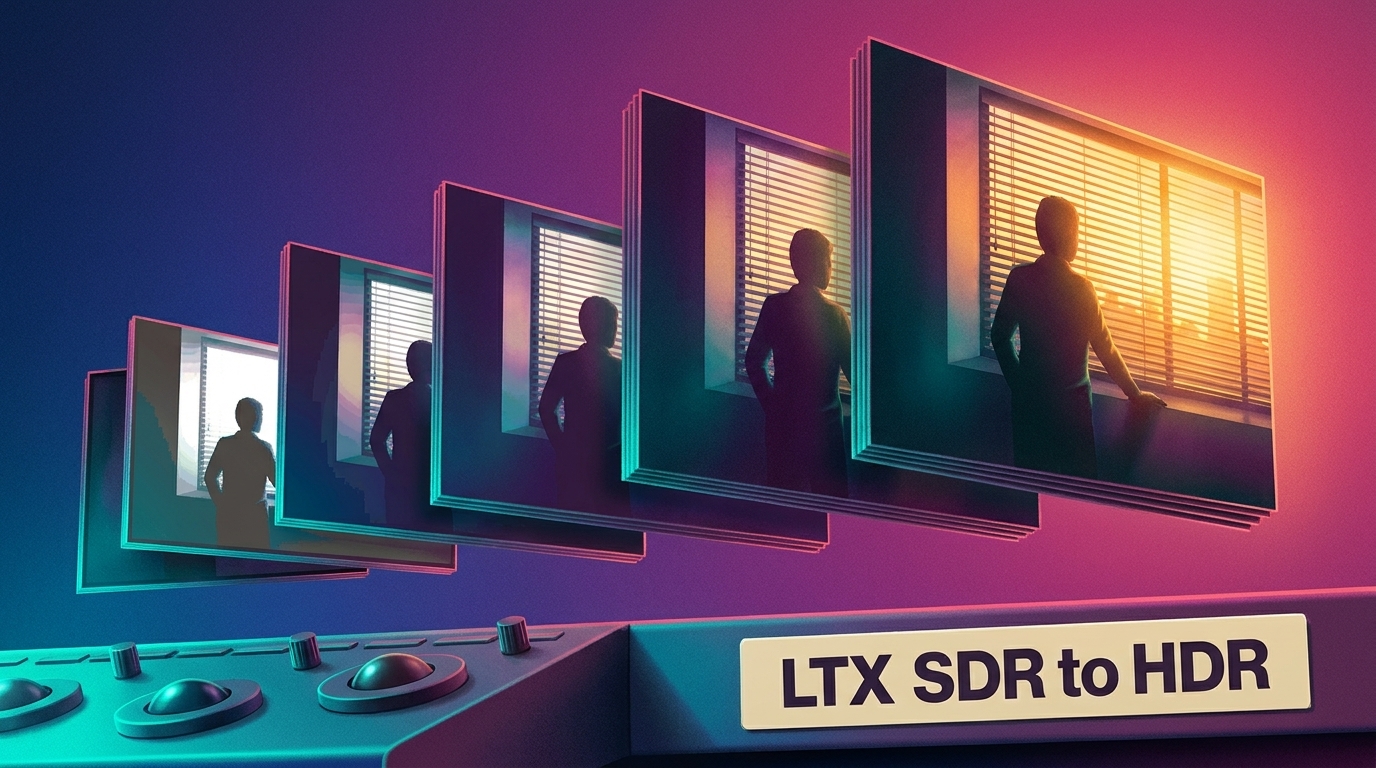
LTX released its SDR to HDR model, which converts 8-bit SDR video into 16-bit HDR through open model weights or an API, according to a post on X. The output is scene-linear ACEScg EXR frames, so finished SDR footage can enter a color-managed grading or finishing pipeline as HDR material.
Open weights or API. The model is an IC-LoRA adapter for LTX-2.5 22B, and its weights sit in a gated Hugging Face repository that requires sharing your account information.
EXR for grading, HLG for review. The main output is a 16-bit EXR sequence in ACEScg, with an HLG MP4 written alongside so you can check results without a finishing setup.
No prompt needed. The SDR clip itself is the control signal, aligned frame for frame with the output, and the conversion applies to the whole frame.
Up to 8K on one GPU. LTX says its tiled workflow reaches 8K on a single GPU, with longer processing times at higher resolutions.
Part of a wider post-production release. LTX lists the upgraded SDR to HDR next to HDR Native, which takes 16-bit EXR in and returns 16-bit EXR out through an ACES workflow.
The SDR clip drives the conversion frame for frame, with no prompt
Per the model card on Hugging Face, the pipeline encodes the SDR clip and appends it as a frozen reference. The HDR frames start from noise and take their direction from that reference in eight distilled denoising steps.
At each segment border, the pipeline pairs a generated HDR keyframe with a one-frame SDR guide held 95% locked to the source frame. LTX says that lock keeps the conversion anchored to the original content.
LTX built the model on LTX-2.5, one of LTX's open foundation models, and the model card says it uses the distilled checkpoint at inference.
The LTX logo. Image: X (formerly Twitter)
The weights are published under the Lightricks name. Lightricks is the company behind Facetune, Photoleap and Videoleap, and its site sends visitors to LTX for its AI video models.
Practical details for pipeline teams:
Inputs. An SDR MP4 or MOV, or a directory of EXR frames.
Colorspace flag. The input transform accepts sRGB gamma, sRGB, ACEScg or ACEScct.
Limits. There is no mask support, and the model was not trained for audio generation.
Local setup. Runs need LTX's dedicated HDR pipeline plus the LTX-2.5 distilled transformer and video VAE weights, with no text encoder at runtime.
The output is built for colorists rather than direct viewing
The model card describes the scene-linear ACEScg EXR frames as material for a grading or finishing pipeline, and the master written alongside them is HLG BT.2020 10-bit.
According to LTX's HDR capability page, the conversion accepts MP4, ProRes and other standard video formats, and works on filmed footage and generated clips alike.
LTX claims shadow and highlight information survives processing, giving colorists latitude for exposure adjustments and shot matching.
The company says its range expansion works by "synthesizing detail to create the dynamic range your HDR master needs," and the model card notes its examples are best viewed on an HDR display, where the recovered highlight range is visible.
In its post-production release notes, LTX groups SDR to HDR with HDR Native under color and dynamic range, alongside compositing tools like Alpha Gen and resolution tools like Native Resolution.
LTX also published a blog conversation with compositor Doug Hogan that walks through how the VFX updates fit into real production workflows.
LTX lists these target users for its HDR workflows:
Broadcast and commercial teams. Groups with SDR libraries that need to meet an HDR delivery spec.
Colorists and finishing teams. People handling SDR archive material or footage delivered without HDR masters.
VFX artists. Compositors combining live action, CG renders and AI-processed footage.
Virtual production teams. Crews expanding SDR assets for LED walls.
Runway Ruby handles the same conversion as a hosted product
According to Ruby's product page, it keeps source pixels and audio intact and delivers HDR10, HLG, ProRes or EXR masters inside Runway or through its API.
The deliverables differ: Ruby lists HDR10, HLG and ProRes masters alongside EXR, while LTX's model writes scene-linear ACEScg EXR frames meant for further grading, with an HLG MP4 that LTX describes as a sidecar for review. LTX offers the conversion through its API as well, and its published weights let pipeline teams run it on their own GPUs.
Google rolled out Gemini Omni 1.2 Flash in Google Flow, extending continuous shots to 15 seconds for Google AI subscribers and introducing per-second pricing for Omni 1.2 Flash generations, according to the Flow team'…
ComfyUI released v0.44.0, a core update that adds ProRes video saving with chroma subsampling settings and local support for MiniMax's H3 omni-modal generation model, including context windows and a latent upscaler, a…
Lightricks released open weights for LTX-2.5, its video and audio generation model, so studios can train LoRAs on their own characters, settings and visual styles. Productions can fine-tune and self-host the model on…