Pokémon Anime Studio OLM's AI Coloring Tool Learns a Show's Look From Three Hand-Painted Frames
VP Land
Nov 10, 2026 · 4 min read
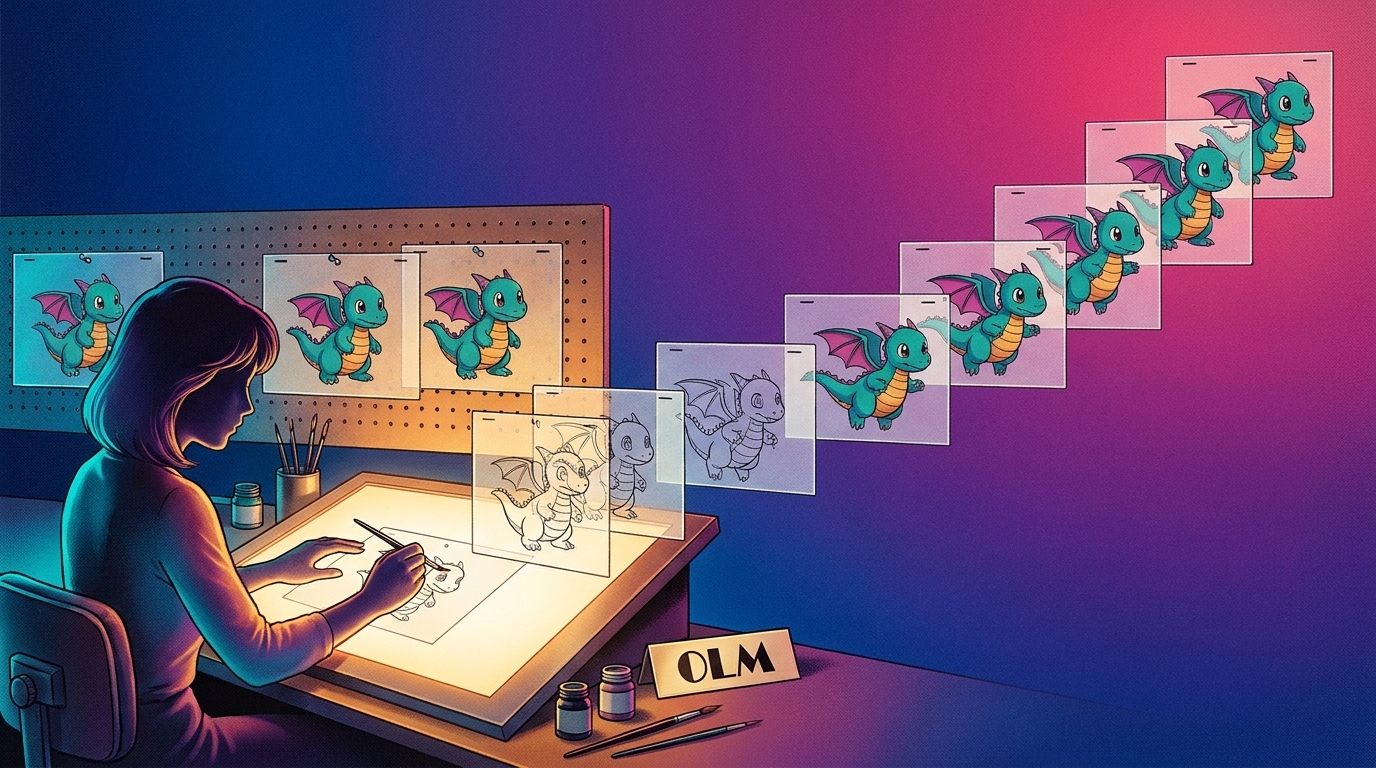
OLM, the Japanese animation group behind the Pokémon anime, has developed an AI coloring tool that learns a show's line shapes and color palette from three frames an artist paints by hand, Variety reports. The system trains on a production's own frames in about 90 seconds and then colors each remaining frame in around 15 seconds, so it does not depend on a large training dataset.
Three frames, about 90 seconds of training. An artist colors three frames, the tool learns that show's look on the spot, and accuracy improves as more hand-painted frames are added.
Around 30% less painting in tests. OLM Digital board director Yotsukura Tatsuo estimated the proof of concept cut painting workload by about 30%, though checkers reviewing each colored frame have somewhat more to do.
Trained only on the show's own material. Yotsukura said this means no other works are harmed, adding, "Strictly speaking, it isn't generative AI."
Built in a government-backed research project. The tool came out of ANIMINS, a 15-month project under Japan's GENIAC program.
Toon Boom is working on the same bottleneck. Toon Boom's Ember AI suite has a coloring tool in beta, with in-betweening slated for beta next.
OLM's tool trains on a show's own frames and fits existing anime workflows
Yotsukura led the ANIMINS research project, which studied how anime creators could put AI to use under GENIAC, a generative AI program overseen by Japan's Ministry of Economy, Trade and Industry.
AI models usually need vast amounts of training data that studios struggle to assemble, so OLM took the opposite approach. Yotsukura said the tool can adapt immediately when a new character or creature, such as a dragon, appears.
The point OLM most wanted to stress, he said, is that the tool fits into existing anime workflows without disrupting them. GENIAC's overview of OLM Digital's project describes the technology as a creative support tool, OtakuKart reports.
The tool is at proof-of-concept stage, and no use on a Pokémon episode or film, commercial release, price or adoption date has been confirmed, as Brazilian outlet Teoria Geek notes.
Around 600 staff work for the OLM group across Japan, Malaysia, Thailand and the U.S., on a slate that also includes "Beyblade," "Hanakappa" and "The Apothecary Diaries."
Toon Boom says Ember's coloring beta cut one studio's 15-hour paint job to two or three hours
Toon Boom Animation, the Canadian maker of the animation software Harmony and Storyboard Pro, is tackling the same coloring step.
Product marketing director Harry Ravelomanantsoa said Ember, the company's AI suite, has a coloring tool in beta, with in-betweening slated to follow. He said one Manila studio that tested the coloring tool cut painting time on a 90-second to two-minute scene from 15 hours to two or three.
"The creative stays with the artist, and the mechanical time goes to AI, to Ember," Ravelomanantsoa said on a Taiwan Creative Content Fest panel with Yotsukura, who said he agreed almost entirely with that split.
Panelists at TCCF's "The AI-Driven Wave in Animation" session. Image: Variety
OLM sees the 80%-to-100% gap as the hard part and looks to AI agents next
Yotsukura likened the gap between AI demos and production reality to gacha capsule-toy machines, where each JPY500 ($3.30) turn may or may not yield the prize you want, roughly what an AI generation credit costs. AI gets close enough to 80% to raise expectations.
"Raising it from there to 90 or 100% turns into work so hard it can make you heartsick," he said.
Direction has to land every time. Hobbyists may accept 80%, he said, but professional animators need tools that return their direction 100% of the time and let them make corrections.
Color values can drift. Anime is highly sensitive to color, and AI tools that edit an image can shift its RGB values even when the result looks fine.
OLM is also experimenting with AI for in-betweening, but Yotsukura said bigger gains may come from indirect uses on productions with more than 100 staff.
With a startup partner from the GENIAC program, OLM is exploring anime-specific AI agents that could help new directors or production managers joining a long-running series, for instance by recalling what a director intended for a given cut.
Agents could also speed up approvals and license management for secondary uses of OLM's titles, which Yotsukura called the most revenue-critical part of the business. Because those areas are sensitive, he said, OLM is proceeding with care.
OLM is brought in after a budget is fixed, so Yotsukura said the studio sees AI as a way to gain more creative freedom within that budget rather than to shrink it.
Google rolled out Gemini Omni 1.2 Flash in Google Flow, extending continuous shots to 15 seconds for Google AI subscribers and introducing per-second pricing for Omni 1.2 Flash generations, according to the Flow team'…
ComfyUI released v0.44.0, a core update that adds ProRes video saving with chroma subsampling settings and local support for MiniMax's H3 omni-modal generation model, including context windows and a latent upscaler, a…
Lightricks released open weights for LTX-2.5, its video and audio generation model, so studios can train LoRAs on their own characters, settings and visual styles. Productions can fine-tune and self-host the model on…