
About Amazon Polly
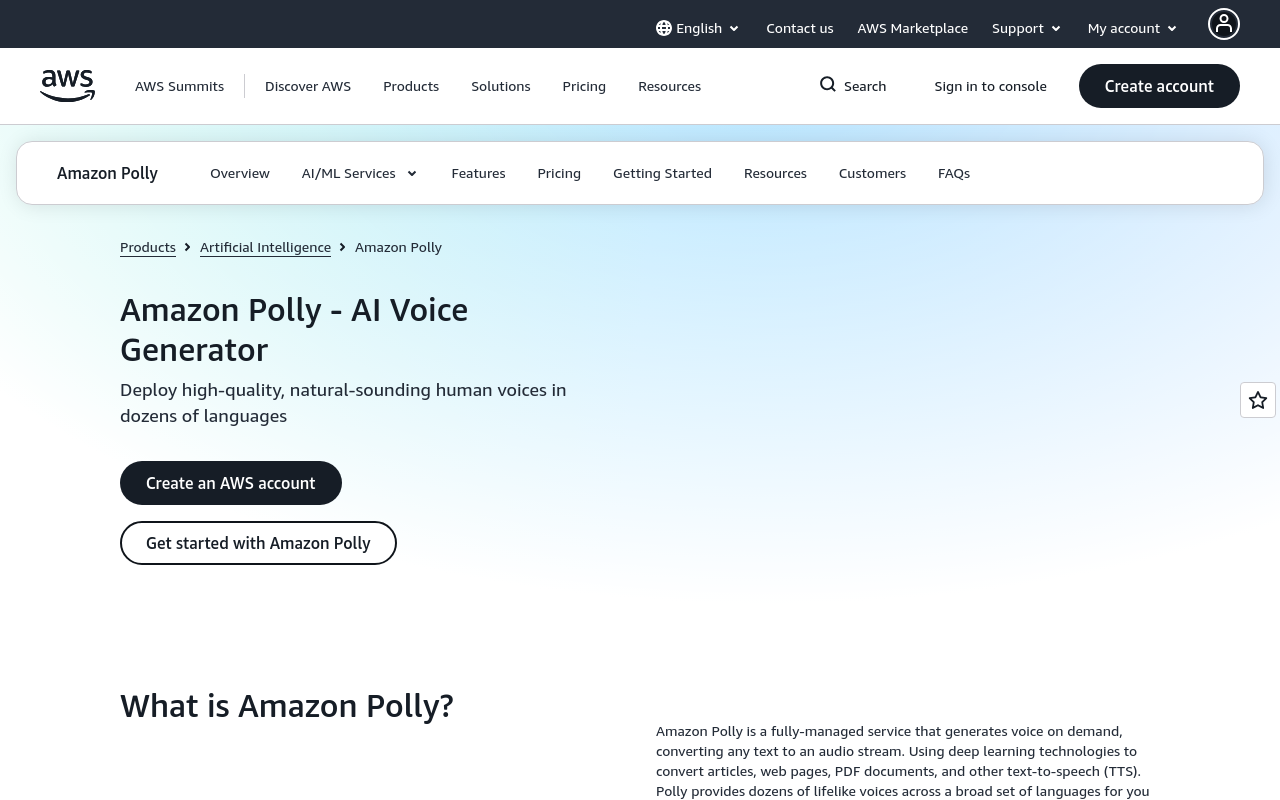
Amazon Polly is AWS's managed text-to-speech service that transforms written text into lifelike spoken audio. As a cloud-native solution, it handles the heavy lifting of speech synthesis without requiring on-premises infrastructure or specialized audio expertise.
The service works by accepting text input (via API or console) and generating audio output in various formats and languages. Polly uses neural and standard voice models to produce speech that can range from natural conversational tones to specialized applications. The output can be streamed in real-time or saved as audio files for integration into larger workflows—making it suitable for adding voeovers to video projects, creating narration tracks, building interactive voice applications, or generating accessibility features.
Who it's for: Video professionals adding narration or localized audio to projects; app developers building voice interfaces; content creators needing scalable speech synthesis; studios localizing content to multiple languages; and accessibility specialists adding audio descriptions. It's particularly valuable for teams that need flexible, on-demand speech generation without maintaining custom TTS infrastructure.
What it's good at: Polly excels at high-volume, consistent speech generation with minimal setup. The pay-as-you-go pricing model means you only pay for characters processed, making it cost-effective for variable workloads. Multi-language support and neural voice options provide quality suitable for professional video and broadcast use. Integration with the broader AWS ecosystem (S3, Lambda, etc.) enables automated workflows. The service is mature, reliable, and battle-tested at enterprise scale.
Limitations: Polly is a pure speech-synthesis tool—it doesn't handle video editing, motion graphics, or visual production. Output is audio-only; any video integration requires separate compositing. While voice quality is high, it remains synthetic and may not match hand-performed voice acting for dramatic or highly expressive content. Real-time lip-sync integration is not a native feature.
