NantStudios' Dynamic Volume System Breaks the LED Wall Into Pods You Rent by the Day
VP Land
Sep 2, 2026 · 4 min read
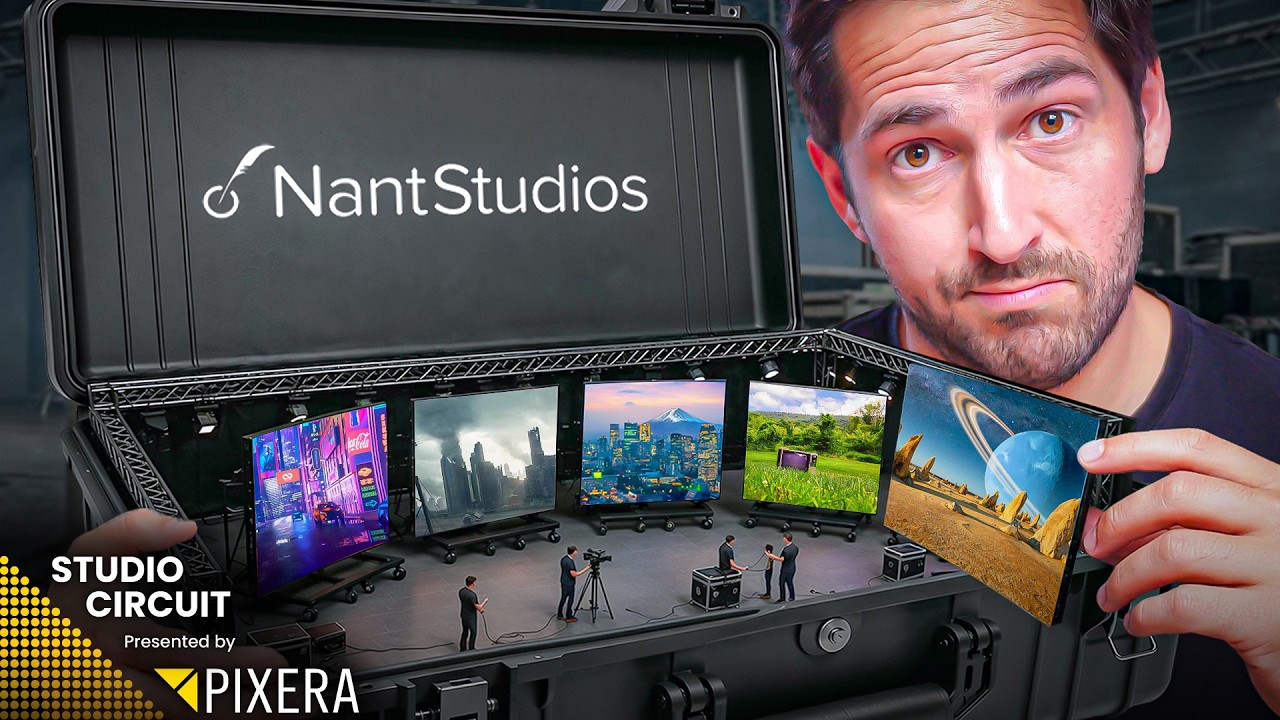
We toured NantStudios' El Segundo campus to see the Dynamic Volume System, an LED volume that trades one fixed wall for modular "wall pods" that snap into different shapes. The stage can become a long arc, a tight curve, floating panels, or two separate volumes shooting at the same time. The wall reconfigures to the shoot instead of the shoot bending around the wall.
The payoff Nant is chasing is flexibility plus a pricing model where you pay for the pods you use, not the whole room.
The wall is now puzzle pieces. Flat and curved wall pods connect in different orders to build a 100-plus-foot arc, a tight travel curve, or two independent volumes.
Airbags hold the seams to a millimeter. The 1.5mm pitch pods float on airbags that adjust roll, pitch, and yaw, then clamp together so no seam shows across an uneven floor.
Tracking gets rebuilt on every reshape. Moving the walls means rescanning them and redefining the motion-capture origin point each time.
You rent per pod. Book one pod, two, or the whole setup, and change the count day to day.
One stage, several shoots. A mobile Brain Bar can split so a commercial runs on the main wall while stills or social content shoot on a side wall.
Flat and curved pods reshape the wall, and airbags keep the seams invisible
Nant's older Stage 1 volume, built as a replica of the first-season Mandalorian setup, still runs in its original shape after roughly 130 to 140 projects, from automotive spots to Westworld and Blippi. What it can't do is change. The shape and ceiling are fixed.
The Dynamic Volume System in Stage 2 answers that. It's built from wall pods in a few variations, one flat and a couple of curves. Connect them in different orders and the volume becomes a different room, from a single arc over 100 feet across the building, long enough for a 20-second walk-and-talk, to a tight curve for a driving shot, to broken-out floating sections.
The precision problem is real. These are 1.5mm pixel-pitch panels, so if two pods misalign by a millimeter, a seam shows up in the shot. We saw two medium pods butted together with no visible seam.
The fix sits underneath the pods. Each one rides on airbags that raise, lower, and adjust roll, pitch, and yaw at the millimeter level to correct for a floor that is never truly flat, then clamps to its neighbor.
The ceiling uses the same 1.5mm panels, with a cart system above the beams for maintenance and movable pick points that open a hole to rig lights directly.
A mobile Brain Bar and constant re-scans keep a shape-shifting stage usable
Because the walls move, the control setup moves too. Nant runs its Brain Bar on carts with fiber lines back to a server room, and it can split into mini Brain Bars so two wall setups run at once.
Tracking is the harder part. Motion-capture cameras ring the space to track the picture camera, but a stage that changes shape needs its tracking reconfigured to match. Every time the walls move, the team rescans them to get wall positions for content and to redefine the origin point, then redefines the mocap system against that same origin. One crew member described it as constantly rebuilding the room.
Lighting also lives in the pods. Beyond image-based lighting, Nant built an interface on top of the Pixera platform using Lua scripting that turns on shapes in different colors to create light sources in seconds.
Per-pod pricing opened the volume to ads, live events, and microdramas
The business change is per-section pricing. Instead of paying for a whole static volume, clients rent one pod, two pods, or the full setup, and can vary the count day to day.
Nant said the model is pulling in work that used to skip virtual production on cost. One athletic brand new to the technique got through three to four days of coverage in a single day, cycling through a warehouse, a trail, a city street, and a beach.
The team told us it had already shot more this year than across the entire previous year, helped by repeat customers and by running a commercial on the main wall while stills or social content shoot on a side wall.
The flexibility stretches past film. Nant hosted Battlefield 6's release-date reveal as a multi-day event, reorienting the room 90 degrees into a 200-seat keynote space. The team also pitched vertical microdramas as a fit. Set up a pod in each corner, run four shows at once, and share one round of makeup, costume, and props.
AI magnifies every flaw at wall scale, so Nant leans on green Gaussian splats
On AI, Nant framed it as an efficiency play, with a caveat we heard clearly. Blow an image up to wall scale and every imperfection blows up with it. The team described shoots built mostly on green Gaussian splatting, including a series that used historical material to recreate scenes from the past in detail.
Modular pods won't fit every shoot, and the constant re-scanning adds a step a fixed volume never needs. But splitting the wall into rentable pieces answers the two complaints that follow LED volumes everywhere. They cost too much and they can't change shape. For the pod alignment and ceiling access up close, watch the full tour.
A Yoruba-language sci-fi feature reached completion using AI for roughly 80% of its visuals, with human direction and live-action performance covering the rest. The result is a finished, more-than-three-hour hybrid-AI…
Michael Caine's Licensed AI Voice Narrates ElevenLabs' 13-Hour 'Odyssey' Audiobook June 23, 2026 ElevenLabs has released a roughly 13-hour AI-generated audiobook of Homer's The Odyssey through its ElevenReader app, narrated by a licensed AI replica of Michael
Inside Door G's Brand-First Virtual Production Pipeline: AI in Pre and Post, Not on the Wall May 13, 2026 A virtual production studio that doubles as an AI workflow shop is pitching brands on the idea that a shoot should leave behind a reusable digital asset, not a torn-down