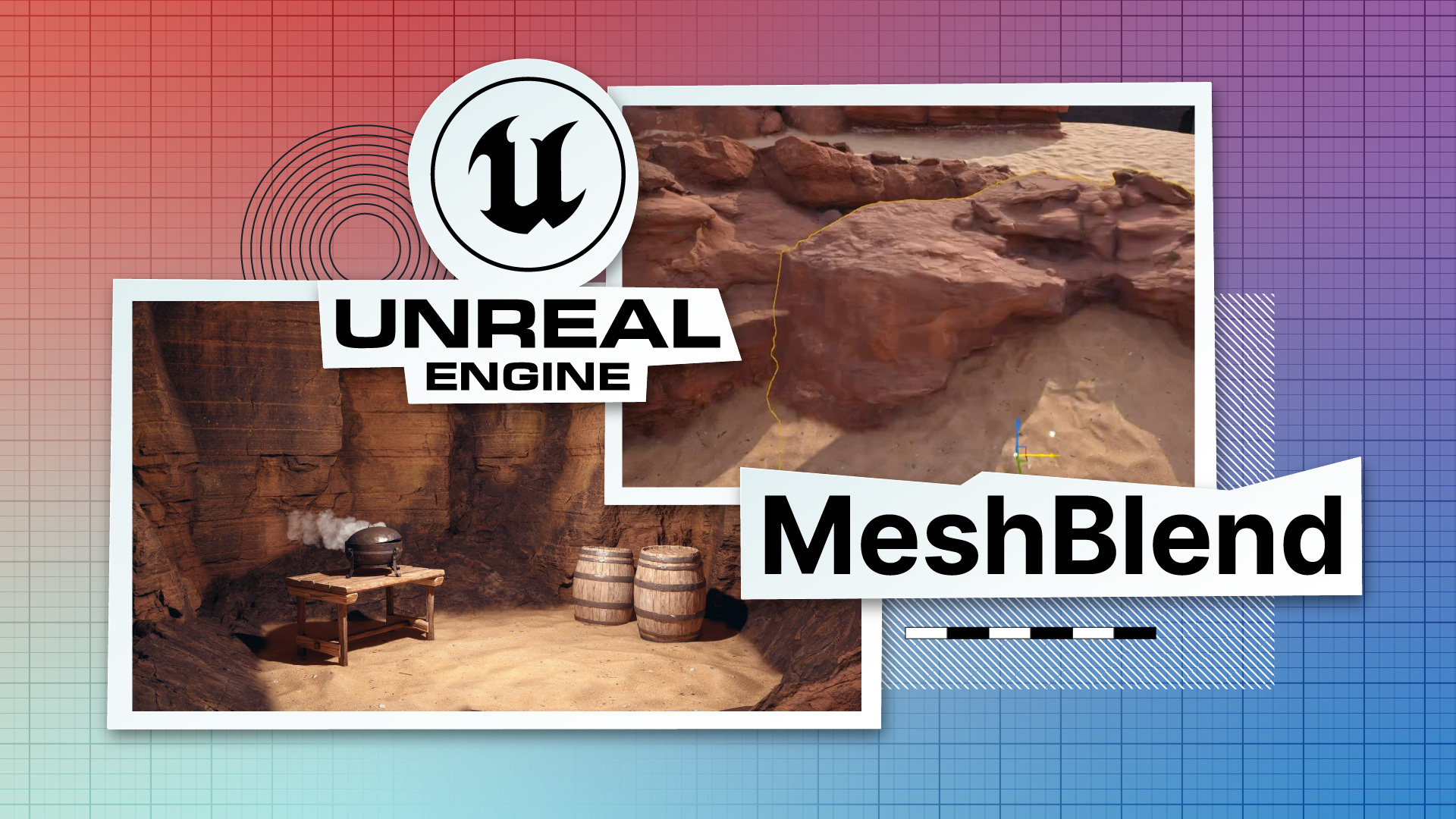
The system supports up to four blend sizes with independently adjustable parameters, giving artists fine-grained control over transition areas. Quality settings (Low, Medium, High) allow teams to balance visual fidelity with performance requirements across different hardware configurations.
Location Scouting Made Digital: Dynamic blending supports both static environments and real-time object spawning for interactive set pieces.
Virtual production teams often need to modify environments during shoots, whether adding props to integrate with live-action elements or adjusting terrain to match changing creative needs. MeshBlend's support for dynamically spawned objects means these modifications can happen in real-time without breaking visual continuity.
The plugin works with standard surface materials, subsurface scattering, and two-sided materials. Decals and mesh decals also blend seamlessly—a feature that proves useful when adding weathering, signage, or other surface details to virtual sets during production.
Tore Lervik demonstrated the plugin's capabilities by showing how rock and terrain meshes blend naturally regardless of size or placement, creating transitions without visible seams. This real-time workflow eliminates the repetitive mesh cleanup work that traditionally slows down environmental iteration.
From Indie to Studio Scale: The first major deployment is supporting world-building for Subnautica 2.
The plugin's practical applications extend beyond traditional game development into the virtual production pipeline. Studios handling dense, procedurally generated, or highly iterated worlds—common in virtual production for film and television—benefit from MeshBlend's ability to handle heterogeneous assets efficiently.
Early community feedback on developer forums, including Unreal Engine's official channels, highlights the plugin's ease of use and the invisible quality of its transitions. This reception suggests virtual production teams can integrate MeshBlend without extensive technical training or workflow disruption.
Compared to previous solutions like vertex blending, custom intersection meshes, or Runtime Virtual Texturing (RVT), MeshBlend offers speed advantages by eliminating mesh preparation time and versatility by working across multiple asset types with minimal setup.
Technical Specifications for Production Teams: Integration requirements and compatibility considerations.
MeshBlend integrates directly into the UE5 editor workflow and supports Sequencer, making it suitable for virtual production pipelines that rely on real-time rendering for both previsualization and final pixel work. The plugin benefits from overscan capabilities, ensuring optimal visual quality in rendered sequences.
The resolution-independent approach avoids common issues found in earlier blending solutions. By performing blend effects in screen space via post-process shaders, MeshBlend maintains visual consistency regardless of view distance or mesh resolution—important factors when virtual production cameras move through environments at various scales.
Current limitations include restrictions to opaque materials and meshes that write depth, which excludes some transparent assets. Performance considerations may arise with extreme use cases or large numbers of overlapping blends on lower-end hardware, though the scalable quality settings help address these concerns.
The Final Cut: As virtual production demands faster iteration, tools like MeshBlend shift technical complexity from artists to automated processes.
MeshBlend represents the broader trend toward real-time, non-destructive workflows that virtual production teams increasingly require. As Unreal Engine 5 expands beyond gaming into film, television, and simulation work, tools that decouple blending from mesh topology become essential for maintaining production velocity.
The plugin's availability through Epic Games' FAB marketplace, combined with active community support from its developer, positions it as an accessible solution for both independent creators and major studios working in virtual production environments. For teams currently spending significant time on mesh preparation and transition work, MeshBlend offers a direct path to redirect that effort toward creative iteration and refinement.