GENERATIVE AIRunway Labs Tests Generative Video Interfaces That Recompose Scenes as Windows Resize
VP LandSep 21, 2026 · 3 min read
Runway Labs is testing responsive generative video interfaces that create a new scene composition when the viewing window changes size. The experiments show how real-time generation could let creative teams explore proportions and spatial arrangements without treating every display format as a fixed crop of one video.
- Window dimensions become model inputs. Resizing the frame triggers a composition for the available space rather than scaling the previous view.
- Objects move with the changing layout. Runway claims its model interprets scenes in three dimensions and rearranges objects within the frame.
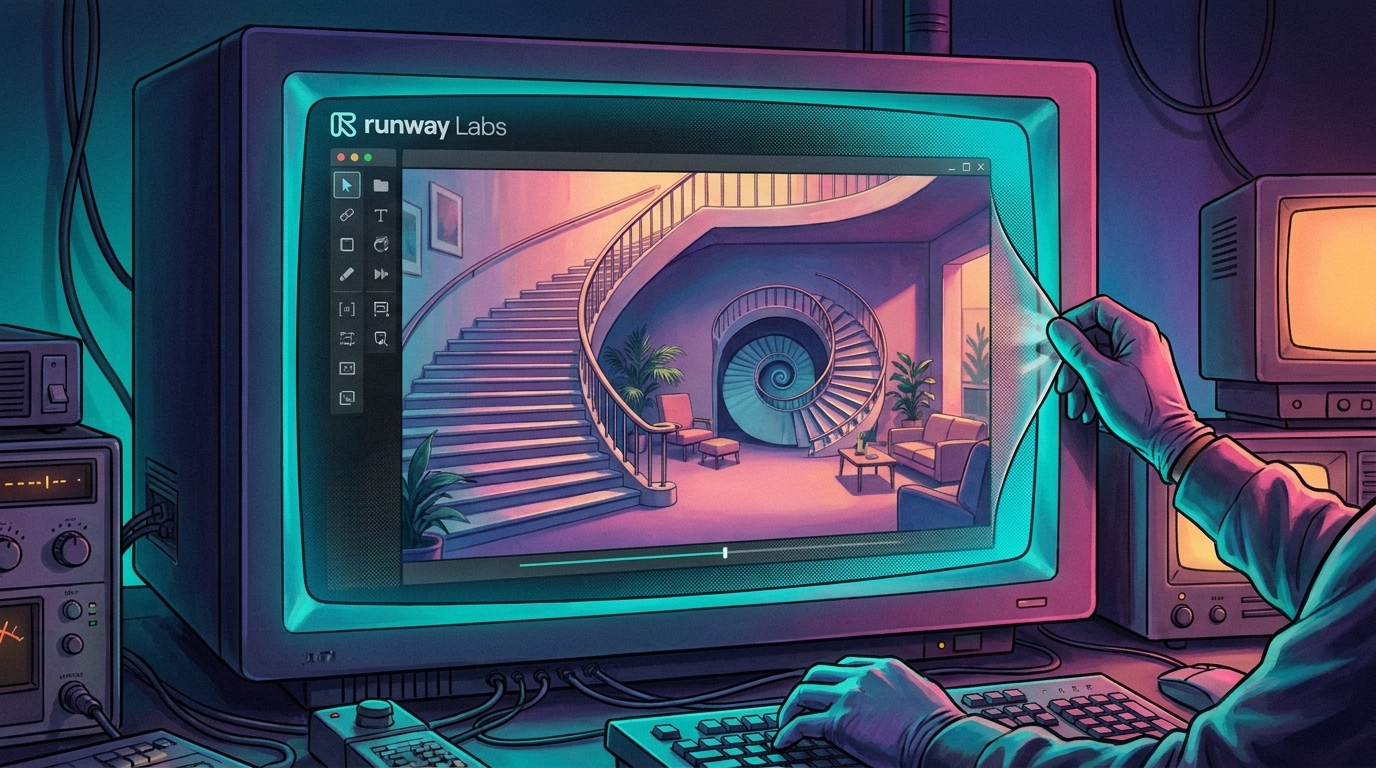
- Scene elements can change form. One example turns stairs into a spiral staircase when the view becomes narrower.
- The work remains experimental. The supplied materials provide no public access details, pricing, output specifications, or release schedule.
Window resizing generates a new composition instead of scaling the previous view
The central demonstration treats window dimensions as an input. When the viewer changes the frame’s proportions, the model generates a composition for the new space rather than scaling the previous view.
Runway defines real-time video generation as frame-by-frame synthesis that responds to live input. A completed video, by contrast, is rendered before playback and cannot alter its composition in response to an interaction.
The demonstrations show layouts changing as the viewing area shifts between wider and narrower proportions. Runway also claims the model interprets the scene in three dimensions, allowing objects to settle into the available space instead of overlapping or extending beyond the frame.
That behavior could make aspect-ratio exploration more interactive during concept development. A creator could test how a generated environment responds to wide, vertical, or unusually shaped displays without starting from one fixed master image. The supplied materials do not describe export options or whether a selected composition can be saved as a conventional video asset.
Scene elements can change form as the available space narrows
Runway’s examples extend beyond repositioning objects. One demonstration redesigns stairs as a spiral staircase when the viewing area becomes narrower, showing how the generated content can respond through its internal composition rather than through fixed interface elements.
This interaction model could support creative experiences in which a scene changes its framing, spatial arrangement, or object design as the display changes. It also offers a different interaction pattern from selecting among predefined layouts.
Google’s Project Genie provides interactive AI worlds that people can explore. Runway Labs is demonstrating a more focused interface experiment in which the dimensions of the viewing surface affect the generated video composition.
Possible applications include interactive entertainment, experiential design, and previsualization. Teams could explore alternative framing or spatial arrangements without rendering a separate completed clip for every variation, although Runway has not announced these applications as products.
Low-latency generation provides the technical foundation for responsive scenes
A responsive interface depends on the model producing frames quickly enough for an interaction and its visual result to feel connected. Runway’s instant-generation research identifies causal autoregressive generation, model distillation, streaming decoders, and reduced time to first frame as foundations for interactive video.
Runway describes Labs as an internal incubator for experimental applications of AI video and General World Models. The company has not identified the responsive-interface work as a separate named product.
The demonstrations establish the core interaction concept, but the supplied materials leave practical production questions unanswered. They provide no public access details, pricing, output specifications, or release schedule. The experiment shows how real-time generation could turn a fixed video frame into a scene that continually recomposes itself around the available display.