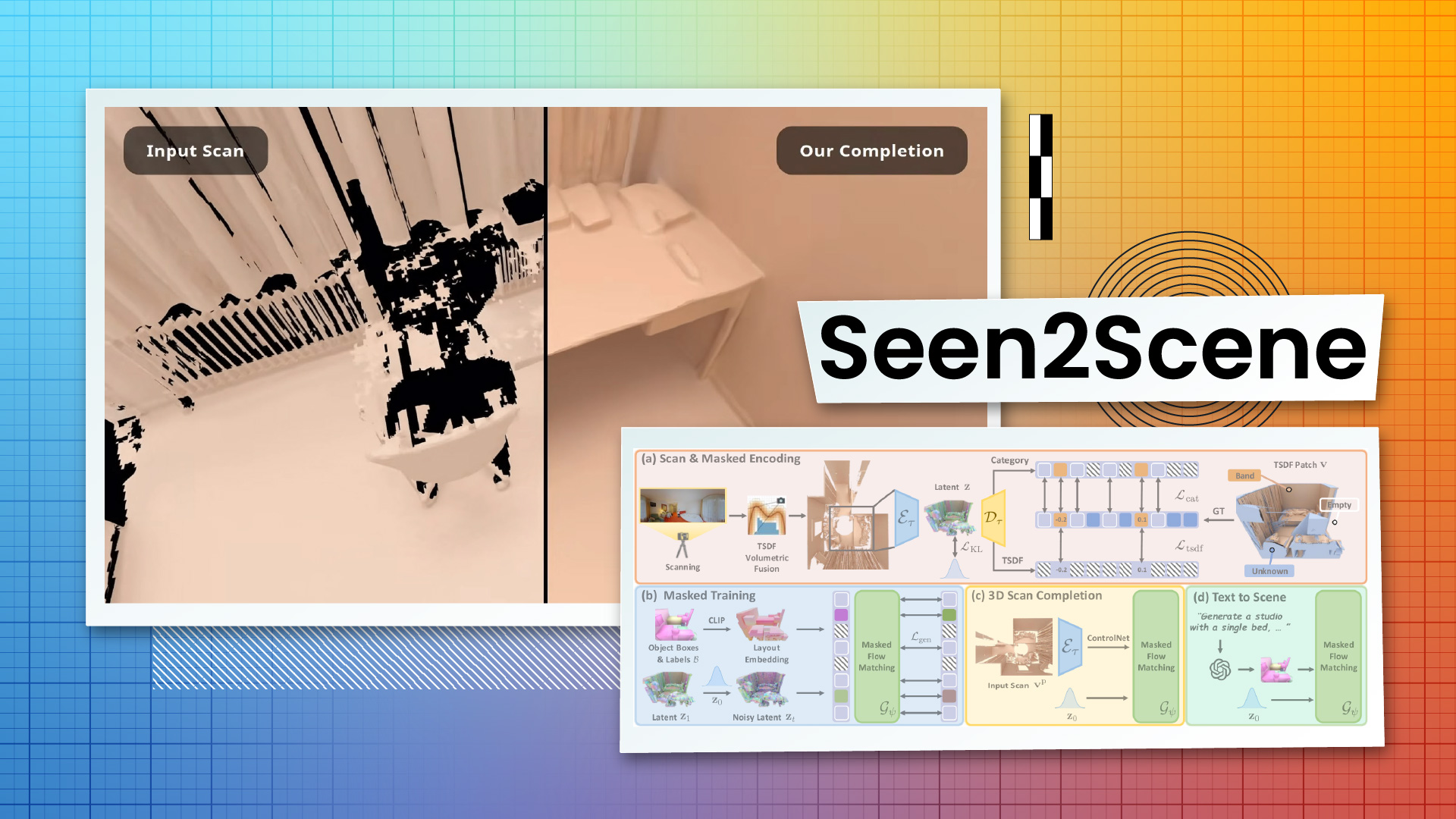
A new open-source method called Seen2Scene can now complete partial 3D scans into full, coherent scenes. The system addresses a fundamental constraint in 3D digitization: photogrammetry, LiDAR, and RGB-D captures always leave holes behind furniture, under tables, or in tight corners. Seen2Scene fills those gaps, and it does so by training directly on messy, incomplete real-world scans rather than relying on perfect synthetic data.
Why Real Data Matters
Prior approaches to 3D scene completion faced a paradox. To train a model to fill in missing geometry, you need complete ground-truth scenes for supervision. But complete real-world scans do not exist. So researchers turned to synthetic datasets like 3D-FRONT, collections of clean, computer-generated rooms that provide perfect geometry. The problem is obvious: models trained on tidy synthetic bedrooms struggle with the clutter, irregular layouts, and varied geometry of actual scanned spaces. The domain gap between synthetic training data and real-world inference has been a persistent bottleneck.
Seen2Scene breaks this cycle. The method introduces visibility-guided flow matching, a training strategy that only supervises the model on regions the scanner actually observed. Unknown areas are explicitly masked out during training rather than filled in with synthetic stand-ins. This lets the generative model learn realistic geometry distributions from partial real data without ever requiring a complete ground-truth scene. The full technical details are described in the paper on arXiv.