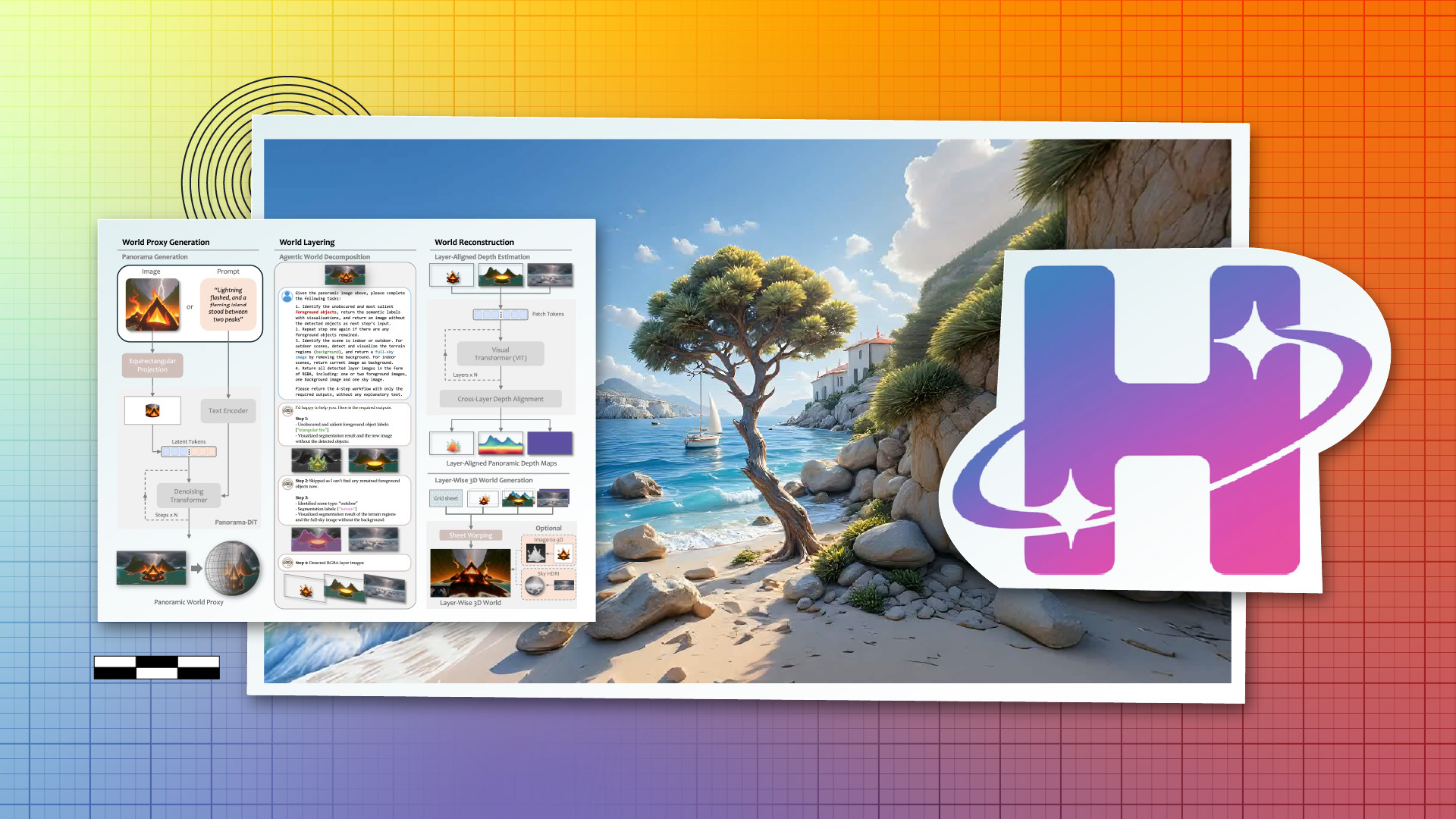
These assets export directly to industry-standard formats compatible with Unity, Unreal Engine, and other CG platforms. This removes a major friction point that has limited adoption of AI-generated 3D content in professional workflows.
For VR applications, the panoramic nature of the generated worlds provides immediate compatibility with headset-based navigation systems. Game developers can prototype entire levels rapidly, while film productions can generate virtual sets and pre-visualization environments without traditional modeling workflows.
Open Door Policy: By releasing everything publicly, Tencent is betting on community adoption over proprietary control.
Tencent's decision to open-source the complete system—including model weights and export utilities—represents a significant strategic shift in the competitive AI landscape. While companies like OpenAI, Google, and Meta have introduced text-to-3D capabilities, most remain closed-source or deliver limited functionality.
The open-source approach allows developers to modify the system, create custom plugins, and integrate it into existing pipelines without licensing restrictions. Community engagement is already active on GitHub, with developers requesting additional features like multi-view sequence support and expanded engine compatibility.
This strategy could accelerate adoption across indie game studios, VR content creators, and academic researchers who might otherwise lack access to expensive proprietary tools.
Behind the Curtain: Current limitations reveal the technology's growing pains and future potential.
Early adopters have identified several technical challenges. Some users report bugs in mesh export functionality and occasional incomplete visualizations that appear as "black views" in certain scenes. Multi-view consistency—ensuring objects look correct from different angles—remains an area for improvement.
The model sometimes struggles with complex physics or architectural details that require precise spatial relationships. These limitations are typical of emerging generative AI systems and are being addressed through community contributions and ongoing development.
Despite these issues, the quality of generated environments demonstrates impressive realism, texture fidelity, and spatial coherence. The system handles diverse environment types, from urban landscapes to natural settings, with varied atmospheric and lighting conditions.
Production Pipeline: This could reshape how studios approach world-building and asset creation workflows.
The implications extend beyond technical capabilities to fundamental changes in production economics. Game studios traditionally spend months creating environmental assets through manual modeling and texturing. This system compresses that timeline to hours or days while maintaining professional quality standards.
For film and virtual production, the tool enables rapid iteration on set designs and background environments. Directors can explore multiple visual concepts quickly, testing different atmospheric conditions or architectural styles without committing to expensive asset creation.
VR and AR applications benefit from the system's ability to generate immersive environments tailored for real-time navigation. The export compatibility ensures smooth integration into existing development pipelines.
Final Cut: As AI-generated worlds become mainstream, expect the boundary between concept and execution to blur significantly.
Tencent's HunyuanWorld 1.0 represents more than a technical achievement—it signals a shift toward democratized 3D content creation. By removing both technical complexity and cost barriers, the system empowers creators who previously lacked access to professional 3D modeling resources.
The open-source commitment suggests Tencent views community adoption as more valuable than proprietary control, potentially establishing their technology as an industry standard. As the system matures and community contributions address current limitations, we may see fundamental changes in how creative professionals approach world-building across gaming, film, and immersive media.
The technology isn't perfect yet, but its combination of accessibility, capability, and industry compatibility positions it as a significant step toward AI-assisted creative workflows becoming the norm rather than the exception.