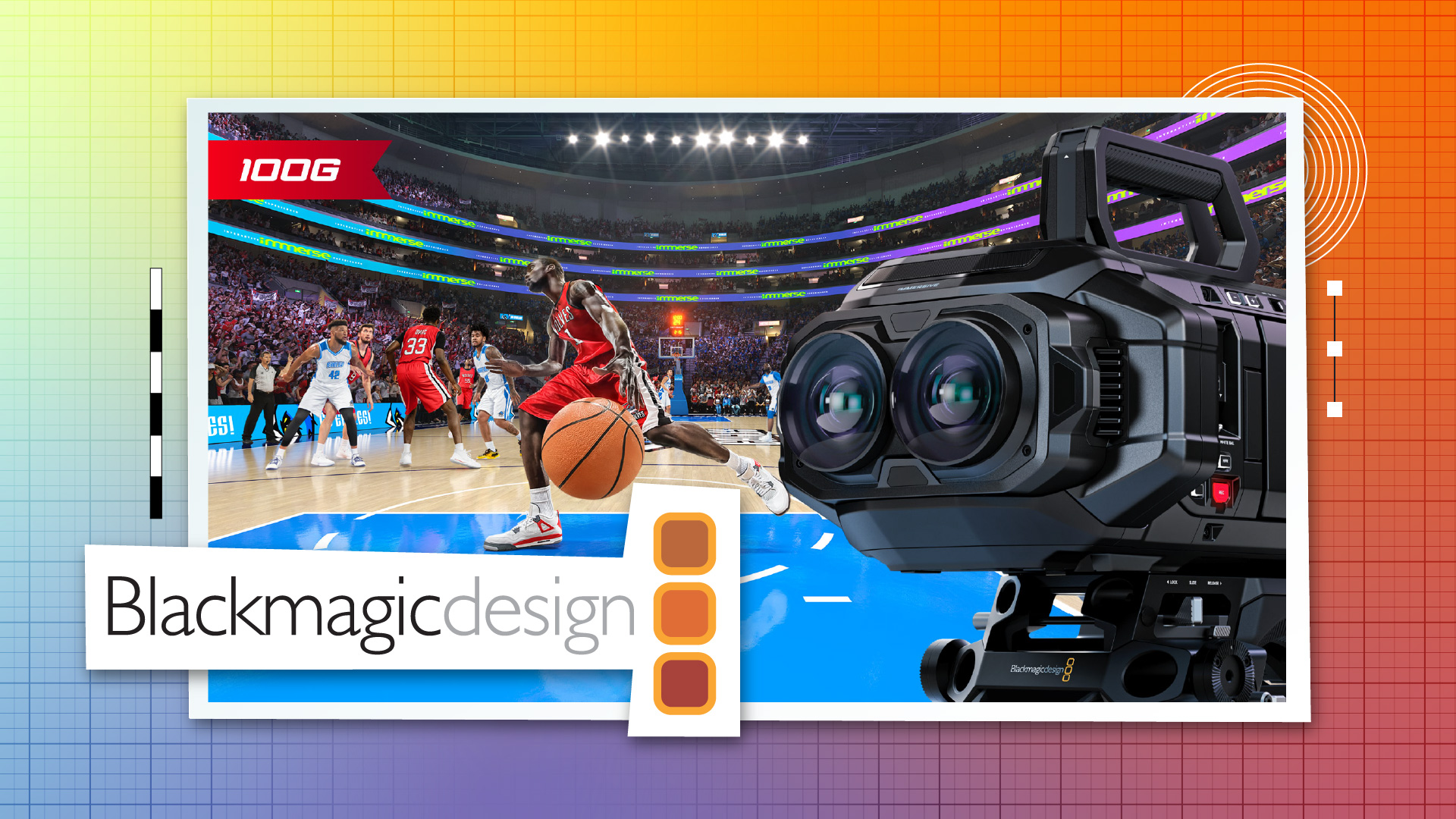
The original URSA Cine Immersive was designed for record-to-card workflows that finish in post. The 100G model takes the same imaging platform and makes it a live source, bridging the gap between immersive capture and real-time broadcast distribution.
Dual 8K Sensors at 90 fps
The imaging system captures stereoscopic 3D through dual custom lenses feeding 8K x 8K RGBW sensors with 16 stops of dynamic range. The camera shoots up to 90 fps in stereo, recording to a single Blackmagic RAW file or streaming a single ProRes 2110-22 feed. An 8TB Media Module is included for on-camera recording.
Already Broadcasting Lakers Games
The URSA Cine Immersive 100G is not launching on promises alone. The camera has been in service during the 2025-2026 NBA season for Spectrum Front Row, a live Lakers broadcast streaming in Apple Immersive on Spectrum SportsNet and the NBA app for Apple Vision Pro.
The original URSA Cine Immersive has logged its own production credits in the meantime: MotoGP Tour De Force, BBC Proms, a Real Madrid documentary, and coverage of NASA's Artemis II launch.
Grant Petty, Blackmagic Design's CEO, framed the announcement around the viewer experience:
"Live immersive production is here, and it's extraordinary. URSA Cine Immersive 100G makes it possible, and the images from this camera are just incredible to watch. It truly feels like you've been transported to the middle of the action. From sports to concerts, this opens up an entirely new world in live production!"
What This Means for Live Immersive
Live immersive video has existed as a demo format and a post-production workflow, but the missing piece has been a cinema-grade camera that connects directly to broadcast-standard IP infrastructure. The URSA Cine Immersive 100G fills that gap.
At US$26,495, the camera is priced US$1,500 above the record-only model. Combined with the URSA Live Encoder and the transport math that lets two cameras share one 100G connection, Blackmagic is making the case that immersive broadcasting can scale beyond single-camera experiments into multi-camera live events.
The broader spatial capture space is developing across multiple fronts. Blackmagic's approach targets live broadcast over SMPTE-2110, while other manufacturers are tackling adjacent problems like virtual production scanning and LED wall playback. What they share is a bet that spatial and immersive formats are moving from novelty to production standard.
For rights holders, the open question is no longer whether live immersive is technically viable. It is whether the installed base of Apple Vision Pro headsets justifies the production commitment. The camera and the broadcast pipeline now exist. The audience is the remaining variable.