Volinga Ends Plugin and Suite License Sales December 1 as Its Gaussian Splatting Tech Moves Into Arquimea AI
VP Land
Nov 16, 2026 · 3 min read
Volinga will stop selling its Gaussian Splatting tools, with Volinga Plugin and Volinga Suite licenses remaining available until December 1, 2026, as the company's capture and neural-rendering technology moves into Arquimea AI, according to Volinga's announcement. Studios that use Volinga to bring splats into Unreal Engine and onto LED volumes have a fixed deadline for buying seats.
Active subscriptions run until they expire. Volinga will keep supporting users with active subscriptions after license sales end, but subscriptions will not be renewed and the service will be progressively discontinued.
No further releases planned. The company says no new versions of Volinga Plugin or Volinga Suite are planned.
Volinga's capabilities fold into Arquimea AI. After a joint strategic review, Arquimea Group and Volinga decided to integrate Volinga's capabilities into Arquimea AI. The announcement discloses no financial terms.
The new focus is autonomous systems and simulation. Volinga's capture and neural-rendering work will go toward safer, more reliable agents and the next generation of simulation systems.
Volinga Suite and Plugin carried splats from capture into Unreal Engine and Disguise
The creation side is Volinga Suite, a desktop app that turns image or video datasets into 3D Gaussian Splatting scenes and exports them as PLY files or Volinga's own NVOL format.
The Volinga Plugin renders those splats inside Unreal Engine, with relighting support and scene controls Volinga built for production use.
The Volinga page in Disguise's user guide recommends the Volinga Unreal Engine Plugin paired with the Disguise Unreal Engine RenderStream plugin for all new projects. A native Volinga RenderStream plugin remains for legacy projects.
Volinga's 4D Gaussian Splat release added support for animated PLY sequences, converting thousands of individual files into a single NVOL asset for real-time playback controlled through Unreal's Sequencer.
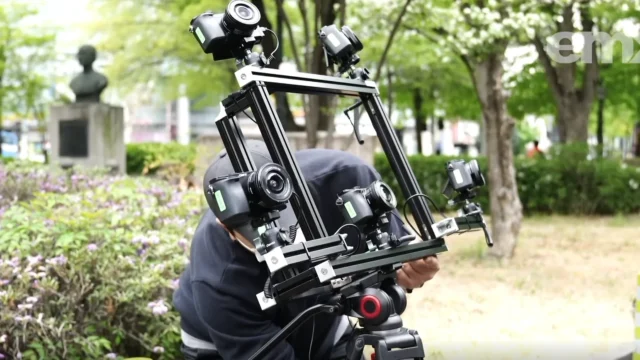
A person adjusts a tripod-mounted rig holding several small cameras in a park, from Volinga's 4D Gaussian Splatting explainer. Image: volinga.ai
CEO Fernando Rivas Manzaneque told Digital Production that PLY is the most widely used splat format, which emerged from the original Gaussian Splatting research, while NVOL carries additional metadata used inside Unreal Engine.
Arquimea AI will apply Volinga's capture tech to autonomous systems and simulation
In the announcement, Rivas Manzaneque writes that media and entertainment has been a challenging sector and that "The pace and scale of opportunities in the sector have not developed as quickly as anticipated." He also cites technological sovereignty and security becoming bigger priorities, and 3D Gaussian Splatting gaining traction in new industries.
Volinga describes Arquimea AI as Arquimea Group's division "focused on real-time artificial intelligence for unmanned autonomous systems in mission-critical environments." The stated goal is applying Volinga's technology to "safer, more reliable agents and the next generation of simulation systems."
Volinga was founded in 2023 as a spin-off from Arquimea Research Center. The group's 20th-anniversary release says it spins off companies when research doesn't directly apply to aerospace or defense, and lists Volinga among them as AI for audiovisual production.
The group's research center AI page frames its NeRF work around 3D scanning for both VFX and robotics, alongside research on safe operation of autonomous vehicles, drones and robots.
A separate Arquimea release on novelty detection describes AI for unmanned systems from the group's AI division, which that release names Neural Domains. Volinga's announcement uses the name Arquimea AI.
A six-person Canary Islands team with Disguise integration and a Netflix Calle Alcala LED rebuild
Per a Radiance Fields platform profile, Volinga is a team of around six based in the Canary Islands. It launched with an Unreal Engine plugin for NeRFs before moving to Gaussian splatting, integrated with Disguise, partnered with XGRIDS on handheld capture, and counts an LED volume rebuild of Madrid's Calle Alcala for a Netflix series among its credits.
The same profile lists Plugin support for Unreal Engine 5.4 to 5.8, with the Pro tier covering Pixotope, Disguise RenderStream, Zero Density, Aximmetry and LiveFX. It also notes that Volinga still labels the renderer beta.
Volinga directs users to an FAQ page on its site for transition details.
Dark Slope is building a new virtual production stage at North Shore Studios in Vancouver, launching in December with LED screens, tracking cameras and hardware taken from Pixomondo's shuttered stages, as The Hollywoo…
Foundry announced it is bringing Nuke Stage to macOS, adding Apple ProRes support plus genlock and synchronization across multiple Mac render nodes and iPhones, with early access expected in 2027. Foundry is aiming th…
Prime Video introduced Prime 360, an AI-powered virtual camera system that reconstructs recorded basketball action as a 3D scene and shows replays from angles its physical broadcast cameras can't capture. Virtual view…