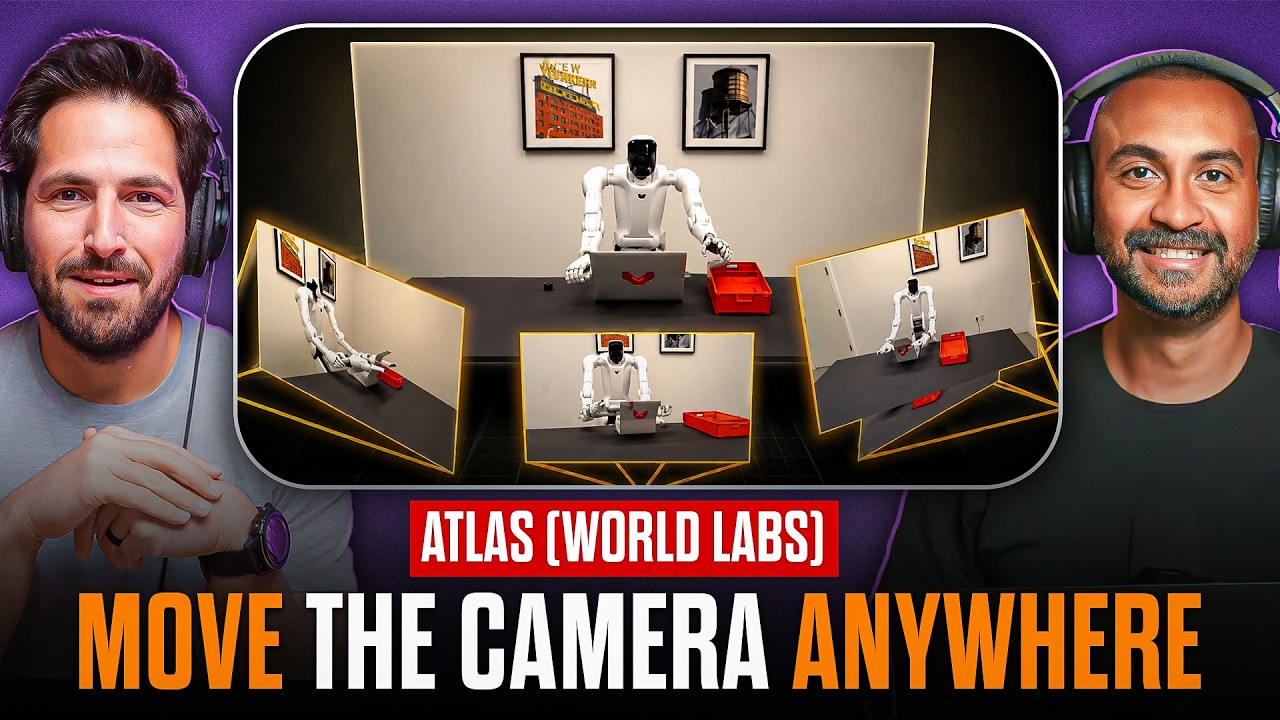
Filmmakers we met at TIFF often heard “AI” and pictured fully synthetic video with little creative control. We unpacked that disconnect, tested ChatGPT Image 2.5, explored TypeSafe’s Jev model, and examined generative tools moving directly into Premiere. Each discussion came back to control: who has it, where it lives, and how much friction stands between an idea and a usable result.
Jump to:
- 01:28 Filmmaker attitudes toward AI at TIFF
- 06:21 Building shots with 3D control
- 11:48 Testing ChatGPT Image 2.5
- 19:21 Structured decisions instead of chat
- 25:22 Generative media inside an edit
Quick Take
The episode tracks two views of AI production. Many filmmakers still associate it with surrendering control, while the tools we examined focus on preserving a subject, defining camera movement, filling a specific timeline gap, or handling a narrow data task. Demos alone may not close that gap. Filmmakers need to see where their decisions remain intact and where the model takes over.
What We Debated: Filmmakers at TIFF Still Associate AI With Fully Synthetic Work
During the Toronto film festival, we found that conversations about hybrid production often stalled as soon as AI entered the discussion. The assumption frequently jumped to fully synthetic video and low-quality output rather than productions that combine actors, photography, animation, generated environments, and assisted post work.
Kling had the clearest model-company presence. The company joined an official TIFF Market panel about workflows spanning scripts, story development, previs, editing, and final images. It also teased upcoming models without sharing specifications.
The festival had relatively little AI programming. Autodesk held a separate session focused on Flow Studio, while Runway screened work at an event outside the official program, as we discussed at 11:05 in the episode.
Showing a finished example only goes so far. Our debate centered on whether filmmakers need direct experience generating and revising material before the difference becomes clear. A finished clip can still look like a black-box result. A controllable process exposes the choices that produced it.
We also pushed back on the idea that models can only recombine old material. Our position was more specific: a model will not discover a filmmaker’s intended visual language on its own, but a filmmaker can direct, reject, and revise outputs toward something distinct. That tension also surfaced in our coverage of AI’s path into production.
What We Explored: Flow Studio Uses 3D Control Before Generative Rendering
We examined Autodesk Flow Studio as an example of AI tooling built around explicit scene control. The web-based workflow lets filmmakers block shots in 3D, set camera movement and character action, then carry that structure into a generative pass.
The movement between 2D and 3D matters. Artists can define cameras, motion, and staging in a simplified 3D environment before generating the final image.
We also discussed Autodesk’s work on character movement. The workflow described at TIFF can use recorded movement data to retain a particular walk or performance pattern when animating a character. That keeps a repeatable motion choice available to the artist instead of generating a different interpretation each time.
Flow Studio targets filmmakers who want accessible previs and performance-capture tools without opening Maya. The system did not accept Gaussian splat imports when we discussed it, though an Autodesk representative indicated that support was planned.
What We Tested: ChatGPT Image 2.5 Preserved Subjects While Rebuilding the Scene
We compared OpenAI’s Image 2.5 release with its predecessor using a recurring test: a 1970s New York street scene. The newer output contained more period-specific signs, varied cars, clothing details, and background activity, though it still produced spatial errors such as a distorted Empire State Building.
Subject preservation showed the clearest improvement in our tests. We changed clothing and backgrounds while the person’s position and likeness remained stable. In a repeated-copy test, the newer model also held the source composition more consistently across generations.
The release includes two options:
Flare prioritizes speed and lower cost. It is aimed at ideation and work that does not require the highest editing accuracy.
Sunburst handles more precise edits. It offers multiple quality settings and was the option we examined for modifying part of an image while preserving everything else.
At the highest 4K setting shown during our test, one image cost about $0.40. That is expensive for a single generation, but stronger prompt adherence may reduce the number of discarded attempts. The practical cost depends on whether the first usable result arrives sooner.
A Rubik’s Cube reflection test raised a useful caution. The colors appeared consistent between the object and its reflection, but the reflected cube’s angle looked wrong. We could not verify whether the hidden-face pattern was physically valid, so we treated the demonstration as promising rather than conclusive.
What We Questioned: Jev Replaces Open-Ended Chat With Structured Probabilities
We worked through TypeSafe’s Jev model, which is designed for structured inputs and predictable outputs rather than conversation. It accepts defined choices and criteria, then returns probabilities that software can use to make a decision.
Jev is meant to sit beneath an application. A user-facing model or interface can convert a request into structured data, send it to Jev, and translate the resulting probabilities into an action. One example is a model router deciding whether a request needs a fast model or a more capable agent.
TypeSafe lists input pricing at $45 per billion tokens and says output tokens are free because they are too inexpensive to meter. The company positions Jev for classification, routing, and other high-volume tasks where a general chat model may add cost or produce unreliable formatting.
Our working description was a machine-facing decision model. We are still testing where it makes sense inside real applications, especially for jobs that would otherwise rely on a collection of scripts or repeated language-model calls.
What We Examined: Premiere’s Beta Generates Missing Media Inside the Timeline
We examined how Adobe is placing generative video and audio inside an edit through the beta version of its Premiere Generative Media tool.
An editor can drag a placeholder into the timeline, select reference frames from adjacent clips or other project media, choose an available model, and keep editing while the result generates. New media returns to a dedicated project bin.
The editor defines the exact gap first. The generated result has a specific duration and position instead of arriving as a disconnected clip that must be fitted into the sequence.
The audio workflow follows the same pattern. Editors can define a duration, type a prompt, or record a vocal approximation of a sound. The model then generates music, sound effects, or ambience to fit that space.
Keeping these steps inside Premiere removes the screenshot, upload, download, and re-import cycle. It also makes experimentation less disruptive because generated material sits alongside the existing edit and remains optional.
We also considered whether the workflow could improve difficult transitions. Traditional morph cuts can struggle when body positions change sharply between clips. A generated transition has additional frames in which to reconcile that movement, though we did not test it during the episode.
What We Questioned: US Hosting Removes One Barrier, Not Every Compliance Check
We closed with a new way to run ByteDance’s video model on infrastructure hosted in the United States. The Seedance US Compute listing from fal covers version 2.0 rather than 2.5.
We had assumed US productions were largely avoiding the model because inference occurred outside the country, but feedback from working filmmakers corrected that assumption. Some teams were already experimenting with it.
Compute location can affect whether a studio evaluates a model. US hosting removes one potential objection, but each production still has to examine where data is processed, what the provider’s terms allow, how cloud systems handle submitted material, and which security requirements apply.
Those checks affect every hosted model. Compute location addresses one part of the review rather than settling the entire question.
Bottom Line: Control Is Becoming Easier to See and Harder to Generalize
The episode moved from festival skepticism to practical interfaces that expose where filmmakers retain control:
TIFF conversations. Filmmakers we spoke with often interpreted AI as fully synthetic output, so hybrid production remained difficult to explain without hands-on examples.
Flow Studio. Camera placement, staging, and character motion can begin in 3D before a generative rendering pass.
ChatGPT Image 2.5. Our tests showed stronger subject preservation and denser scene detail, alongside unresolved spatial errors.
Jev. Structured probabilities offer a narrow alternative to using conversational models for every software decision.
Premiere and Seedance. Integrated generation and US-hosted compute reduce specific points of friction, while creative judgment and security review remain project-specific.
Each discussion returned to the same production concern: filmmakers need to know which decisions remain theirs before they can judge whether AI belongs in the workflow.
Links from This Episode
Tools & Platforms
Events & Analysis
WATCH THE FULL EPISODE ON YOUTUBE →