
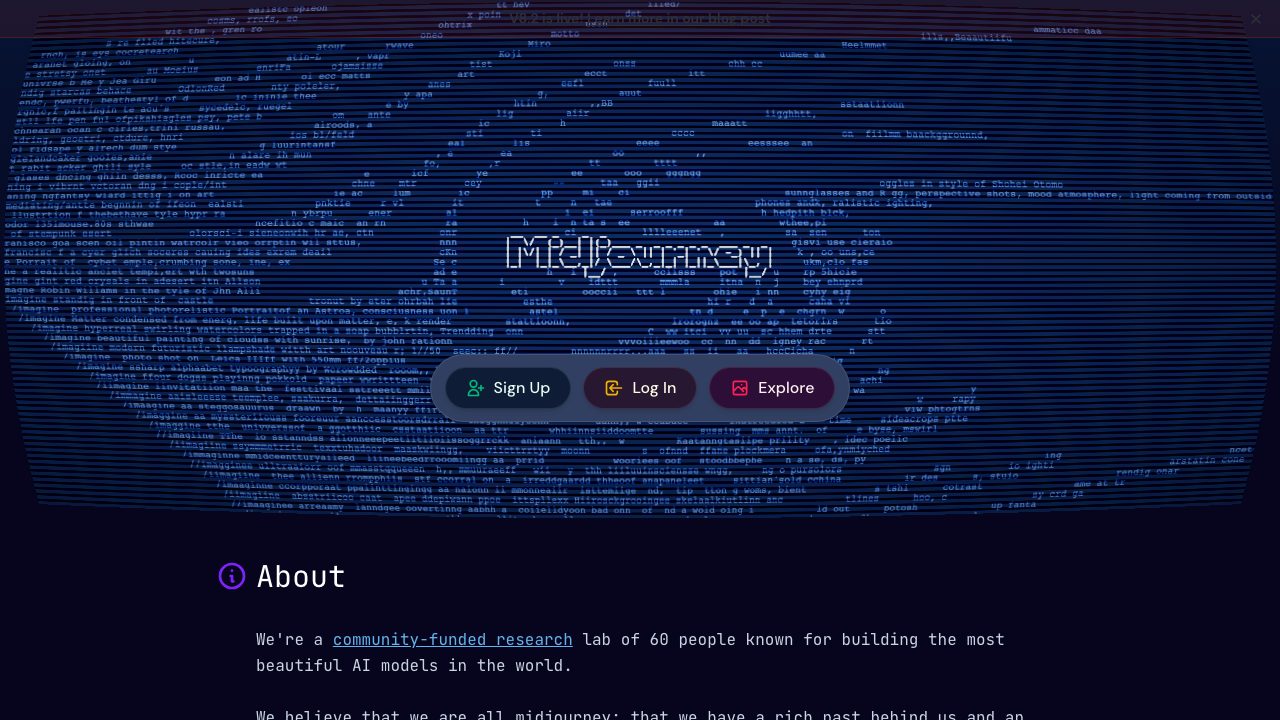
About Midjourney
Midjourney is an independent research lab and generative AI service that turns natural language prompts into detailed images and, in newer releases, short video clips. Initially launched as a Discord-only bot, it now offers a full-featured web app where users can enter prompts, manage projects, and browse a personal gallery. Midjourney is widely used for concept art, storyboards, product visualization, mood boards, and stylistic experiments thanks to its distinctive visual aesthetic and rapid feedback loop.
Under the hood, Midjourney runs large-scale diffusion-based image models hosted on Midjourney’s own infrastructure. Users type a short prompt (e.g., “cinematic cyberpunk city at night, wide shot”) into the web “Imagine” bar or the `/imagine` command in Discord. The system generates a grid of candidate images, which can then be upscaled, varied, or re-prompted. More advanced workflows include image prompts (using an existing image as a style or composition reference), style and character references, aspect ratio parameters, and quality settings that trade GPU time for additional detail. Recent versions also support generating short videos from text or from existing images, though this functionality is still evolving and less documented than image generation.
The service is targeted at creatives—including illustrators, filmmakers, game developers, product designers, marketers, and agencies—who need fast visual ideation rather than final production assets. It excels at expressive, painterly, or highly polished concept images and excels in areas where other models often struggle, such as rendering hands and complex compositions. A modern web interface adds organization features like custom folders and smart folders, making it easier to manage large prompt libraries and datasets for ongoing projects.
There are notable limitations. Midjourney is entirely cloud-hosted, with no self-hosted or offline option, and as of 2024 there is no public API for direct integration into pipelines or tools like Premiere, After Effects, or Blender. The platform operates on a subscription model with several tiers; free trials appear only intermittently and are constrained by strict non-commercial terms. While paid plans allow commercial use of generated images, copyright status can be complex or jurisdiction-dependent, and machine-only generated content may not receive traditional copyright protection in some countries. Users working in professional production environments should review Midjourney’s terms of service and local regulations before relying on it for critical IP-sensitive work.
