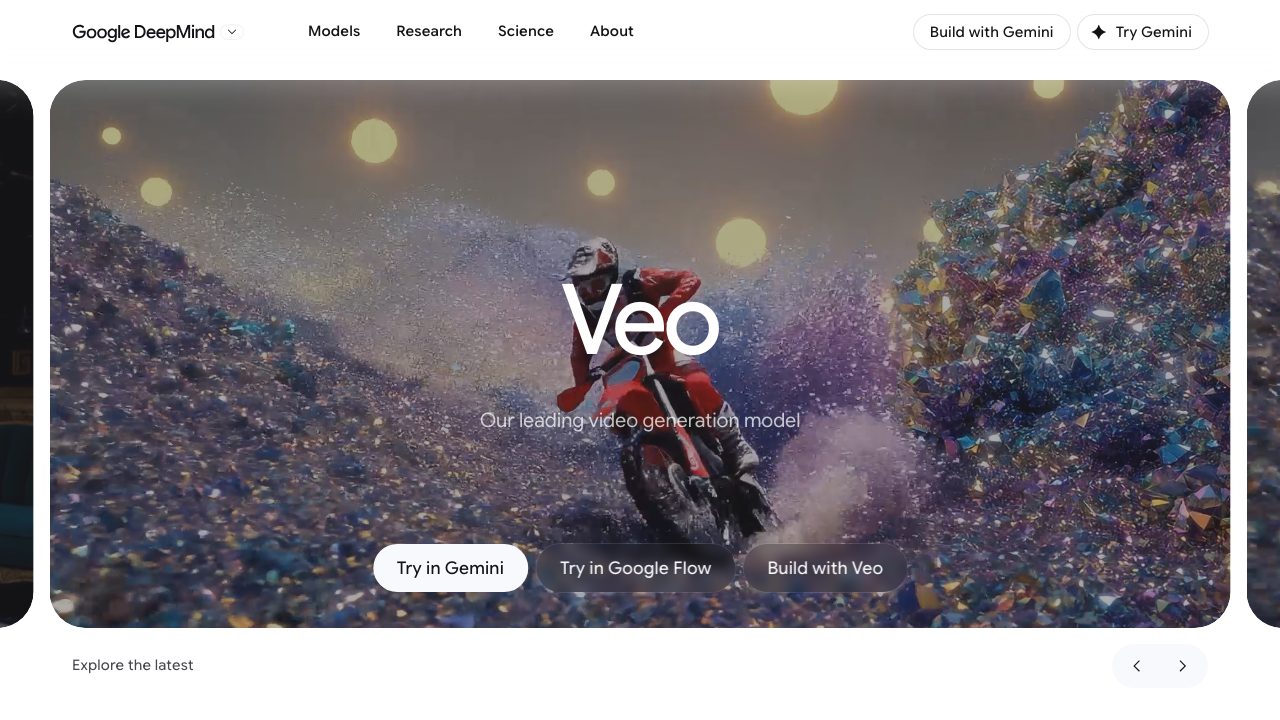
About Veo
Veo 3.1 is Google DeepMind's flagship video generation model, positioned as a leading tool for creating cinematic video content with synchronized audio. Built on Google's AI research infrastructure, Veo 3.1 extends the capabilities of its predecessor Veo 2, offering improvements in video quality, coherence, and creative control for professional and creative workflows.
The model operates as a text-to-video generation system, allowing users to describe scenes, shots, and narratives in natural language and receive video output with audio synthesis. This positions it as a tool for rapid ideation, pre-visualization, and content creation across filmmaking, advertising, and digital media production. The inclusion of audio generation within the same model streamlines workflows by eliminating the need for separate audio synthesis tools.
Veo 3.1 appears designed for creative professionals seeking to accelerate pre-production phases, generate concept footage, or produce final-quality video assets. The emphasis on "cinematic" output suggests the model has been trained to understand and replicate professional cinematography principles, lighting, composition, and narrative pacing. As a Google DeepMind product, it benefits from cutting-edge research in diffusion models and multimodal AI, though specific technical architecture details are not detailed on the promotional page.
Limitations and access details remain unclear from the available information—the page does not specify resolution caps, maximum duration, pricing structure, availability status (beta vs. GA), or distribution channels. Professionals considering adoption should verify current access terms, output quality benchmarks against competitors like OpenAI's Sora or Runway Gen-3, and integration possibilities with existing production pipelines.