AI Agents Can Generate Anything Except Good Taste, Says a16z's Justine Moore
VP Land
Sep 2, 2026 · 6 min read
AI models can take an image, generate an audio track, cut it into a video, and lip-sync a character in one automated pass. What they still can't do, according to Justine Moore, is judge whether any of it is good.
Moore, an investor at a16z, tracks the generative media market for the firm. Her read is that the models keep improving, but taste stays a human job, and the real power over what audiences see has shifted to the recommendation algorithms.
In this episode of Inside the AI Studio, we talked with Moore about how the algorithm decides what audiences watch, why generative media still needs human judgment, and where the market is heading as agents start picking the tools.
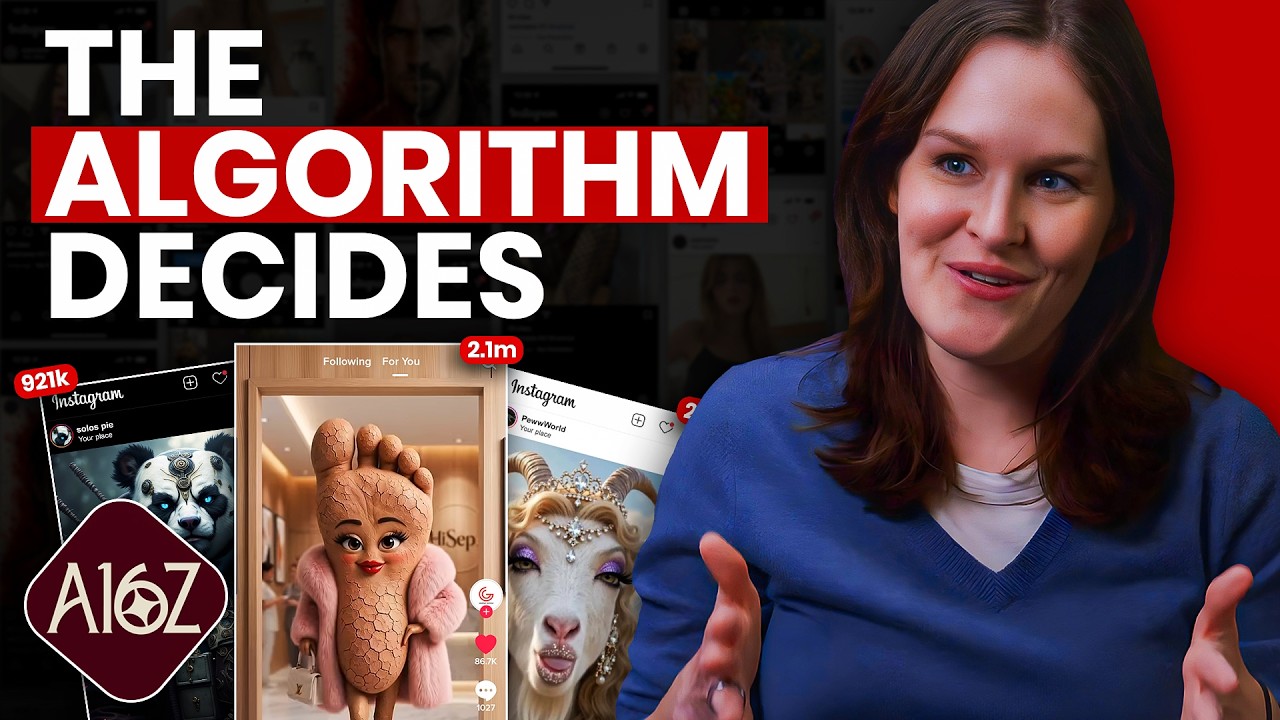
Algorithms are the new gatekeepers. Moore argues social platforms, not studios or distributors, now decide what reaches viewers, using engagement data to filter feeds.
Agents are good at tasks and bad at taste. They execute defined tool calls well but still need humans to direct quality.
Microdramas already out-earn China's domestic box office. Moore says the vertical, short-form format is a natural fit for AI production.
Agents are becoming the buyers of AI generation. When an agent picks the model, providers need to look capable, accessible, and affordable to that agent.
The size of the generative media market is still unknown. Moore sees early signs it could be large, spanning consumer memes to enterprise content.
Social algorithms, not studios, now decide what reaches viewers
Moore reframes an old media question for the AI era. The judges of quality used to be studios and distributors. Now, she says, "the gatekeepers are actually the algorithm" running the major social platforms, which track how many people watch a clip to the end, click through to the creator, or tap "not interested."
Asked whether cheap, easy generation will drown feeds in low-quality output, Moore points back to that same measurement machine.
I think they're collecting a ton of data to make sure that even if people are submitting more slop or really low-quality content to these platforms, it won't be flooding our feeds because the algorithms will direct us towards either the overall higher-quality content or content that matches our unique interests more.
Agents handle the tasks but not the judgment
Moore draws a sharp line between what agents can execute and what they can evaluate. They are "really good at defined tool calls or tasks," she says, like generating an audio track for an image and lip-syncing it onto a video, or stitching five photos into a walk-through clip.
Where they fall short, Moore says, is knowing whether the result works.
They are not great at taste. So the human still very much needs to direct them and provide guidance. And sometimes that's hard when you're working with an agent because they'll go through the whole thing, they'll give you the output, and you'll be like, technically this is what I told you to do, but it kind of sucks.
That gap shows up most in longer-form storytelling. Moore points to the friction of re-uploading the same character reference for every image, or re-matching a character's voice across shots. Some of that eases as models get better at long generations, she says, but a lot of the work sits in what she calls "the harness," or "the tooling and the structure that controls these models" toward a coherent narrative with less prompting friction.
Agents are quietly becoming the buyers of AI generation
Moore sees a bigger shift coming in who actually chooses the model. As agents take over more of the generation pipeline, Moore says, the customer for an image or video model may stop being a person.
agents may be eventually controlling a lot of generations and agents may be selecting when a user says generate an image. What if the agent is picking what that image model is? If you're an image model provider, you want to make sure the agents think highly of your model and it's relatively accessible and they don't consider it to be too expensive.
She compares it to what already happened with developer tools, where products favored by coding agents pulled ahead, and to vibe coding, where the agent quietly picks the host, the auth provider, and the database. We've previously covered the Model Context Protocol that lets agents call outside tools. Moore notes marketers are already coining a name for the search equivalent: "People call it GEO," she says, the generative counterpart to SEO.
Many newcomers, Moore adds, generate through the ChatGPT or Gemini apps, which steer users to their makers' own models. On surfaces not owned by the big model companies, she says, it becomes a question of where the agents point.
Microdramas are the format built for AI
One market Moore tracks closely is microdramas, the vertical, serialized soaps that have taken off on mobile. "In China, the revenue from microdramas is already bigger than the domestic box office," she says, and US apps like ReelShort and Dramabox grew into some of the fastest-growing apps in the country.
Moore, not a romance-genre fan herself, still sees why the format fits AI production.
I think they're like the perfect form of content to do with AI because they don't have to be the highest production value. It's often relatively limited casts, so you can do things like shoot in a soundstage with a few people and then generate backgrounds with AI or dub into different languages with AI or things like that.
AI is also letting these companies push past romance into sci-fi, fantasy, and anime, she says, opening a more male-skewing audience alongside the female-skewing romance base.
The generative media market is large and still unmeasured
How big generative media becomes is, in Moore's words, "an unknown question." She says "we don't know the answer yet of how large the market is going to be," though she reads the early signs as pointing to something huge.
Her case spans the range. Consumer image products like Nano Banana and GPT-4o Image are, she says, "probably the most viral products I've maybe ever seen" in a decade of consumer investing.
At the other end sit professional tools with enterprise features, team collaboration, shot mapping, and asset provenance that a casual user would never touch. Between them is a long tail of marketing, training, and educational content that AI can produce faster and cheaper.
Moore also counts a wave of new creators the tools bring in. She points to Fruit Love Island, a fan's AI remake of the reality franchise recast with fruit, which drew real drama and went viral on TikTok.
AI media will pull some attention from traditional movies and TV without replacing them, she says, the way YouTube and TikTok fragmented viewing rather than ending it. It echoes a point we covered from Netflix's Ted Sarandos, that AI's value is quality, not just cost.
Taste, direction, and story stay human while agents absorb the mechanical work
Moore's throughline is a division of labor. Models and agents keep absorbing the mechanical work of generation, while the decisions that make content worth watching, taste, direction, and story, stay with people.
For teams building or buying AI tools, that points to two bets. Deeper products that give creators real control over narrative and camera, and models positioned to be picked by the agents that will increasingly do the choosing.
The full conversation with Justine Moore is in this episode of Inside the AI Studio, shot at AI on the Lot, and covers microdrama economics, the tooling gaps in narrative generation, and the platform layer sitting between creators and the big models.
Ellenor Argyropoulos says she used to get death threats over her AI filmmaking. She says the reaction has flipped in the space of about a year and a half, and now studios and well-known directors are the ones who brin…
Caroline Ingeborn thinks the AI industry sold creatives the wrong idea when it pushed them to become prompt engineers. The chief operating officer of Luma argues that skilled filmmakers should talk to an agent the way…
Christy Anzelmo says AI has reversed the way visual effects artists work. Instead of building an image step by step and refining as they go, compositors now start from the result they want and trace back to the data o…