Current market dynamics show strong demand for tools that can adapt to short-form content cycles. Social platforms like TikTok, Instagram Reels, and X Video have created an environment where content creators need rapid turnaround capabilities. AI solutions that can generate multiple variations, test different approaches, and iterate quickly provide significant competitive advantages.
Democratization Effects: The platform enables non-specialists to create professional-quality motion graphics without traditional expertise requirements
This accessibility shift has significant implications for creative industries. Small businesses can now produce marketing videos internally rather than hiring specialized agencies. Educators can create engaging visual content for courses. Independent creators can develop branded content without substantial upfront investment in software and training.
The democratization extends beyond individual users to organizational workflows. Marketing teams can generate multiple concept variations for A/B testing. Social media managers can create content that responds to trending topics in real-time. Product teams can prototype video concepts before investing in full production.
Technical Integration Challenges: Successful adoption depends on output quality consistency and workflow integration capabilities
Automatic generation presents quality control challenges that manual processes can address through human oversight. Prompt engineering may require iteration to achieve desired results, particularly for brand-sensitive or highly specific content requirements. The platform's success will depend on its ability to maintain consistent output quality across different prompt types and user contexts.
Integration with existing creative workflows represents another critical factor. Professional users need tools that complement rather than replace their current processes. Export capabilities, file format compatibility, and collaboration features will influence adoption rates among established production teams.
Industry Implications: AI motion graphics tools are reshaping roles, workflows, and creative processes across media production
The emergence of platforms like Vibemotion signals a broader transformation in how creative work gets divided between human creativity and automated execution. Traditional motion graphics specialists may shift toward creative direction, concept development, and quality refinement while routine animation tasks become automated.
This evolution parallels changes in other creative fields where AI handles technical execution while humans focus on strategy, narrative, and artistic vision. The result may be more efficient production pipelines that allow creative professionals to focus on higher-level creative decisions.
Competitive Landscape Analysis: Vibemotion enters a field with established players pursuing different strategic approaches
The AI motion graphics space includes several notable competitors:
Pippit focuses on automated video creation with features like "Smart Creation" and "AI Taking Photo" capabilities that convert static images to talking videos
Runway offers comprehensive text-to-video and image-to-video generation with advanced editing tools designed for professional users
Adobe's AI initiatives integrate motion graphics automation into existing Creative Suite workflows
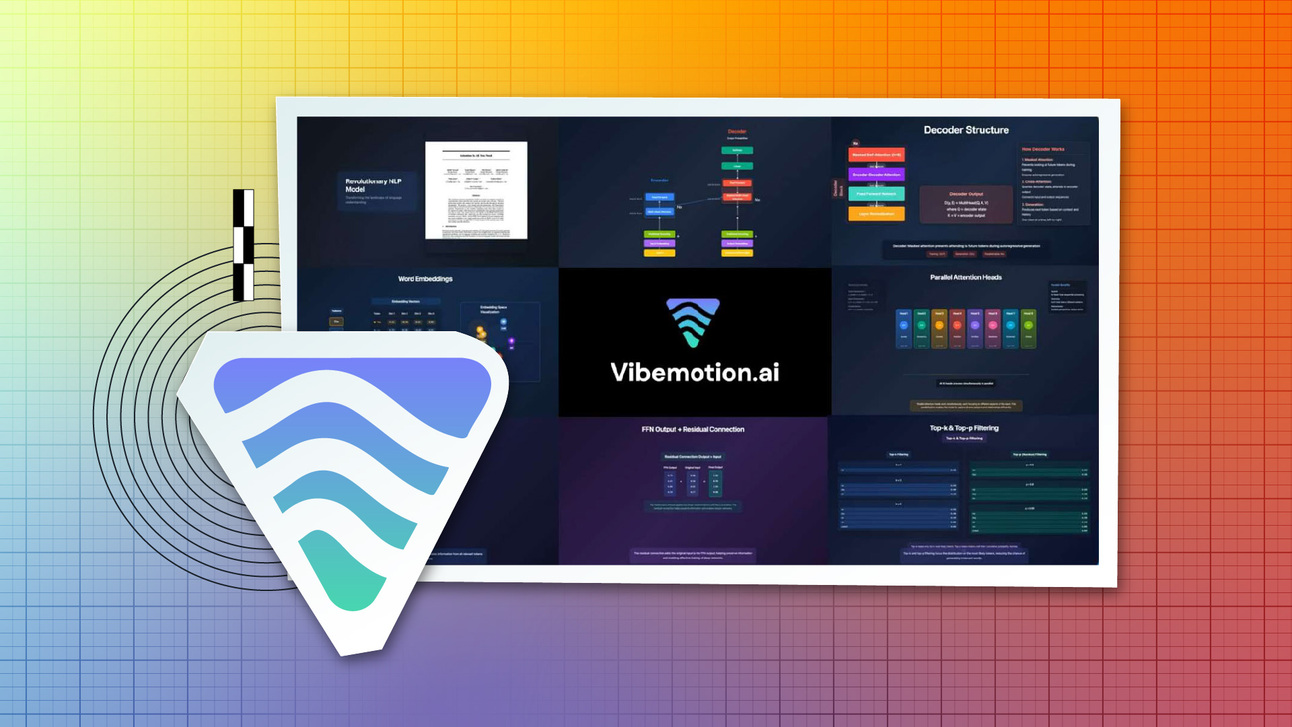
Vibemotion's positioning as a "first ever" solution suggests differentiation through simplicity and speed rather than feature breadth. The one-prompt approach may appeal to users who find existing tools too complex or time-intensive for their needs.
The Final Cut: Vibemotion's launch represents a pivotal moment where AI automation meets creative accessibility, potentially reshaping how motion graphics production scales across industries
The platform's success will depend on its ability to deliver consistent quality while maintaining the simplicity that differentiates it from more complex alternatives. As AI-generated content becomes mainstream, the value proposition shifts from technical capability to creative enablement and workflow efficiency.
For creative professionals, Vibemotion and similar tools offer opportunities to expand project scope, reduce turnaround times, and explore creative concepts previously constrained by technical limitations. The challenge lies in integrating these capabilities effectively while maintaining the human creativity that drives compelling storytelling and brand differentiation.
The broader trajectory suggests that AI motion graphics tools will become as routine as current design software, fundamentally changing how creative teams approach video production and content strategy. Success in this environment will require balancing automation efficiency with creative authenticity.