inclusionAI Releases Invoker-Render, an Open-Weight Model That Renders Greybox Camera Moves Into Video
VP Land
Nov 25, 2026 · 4 min read
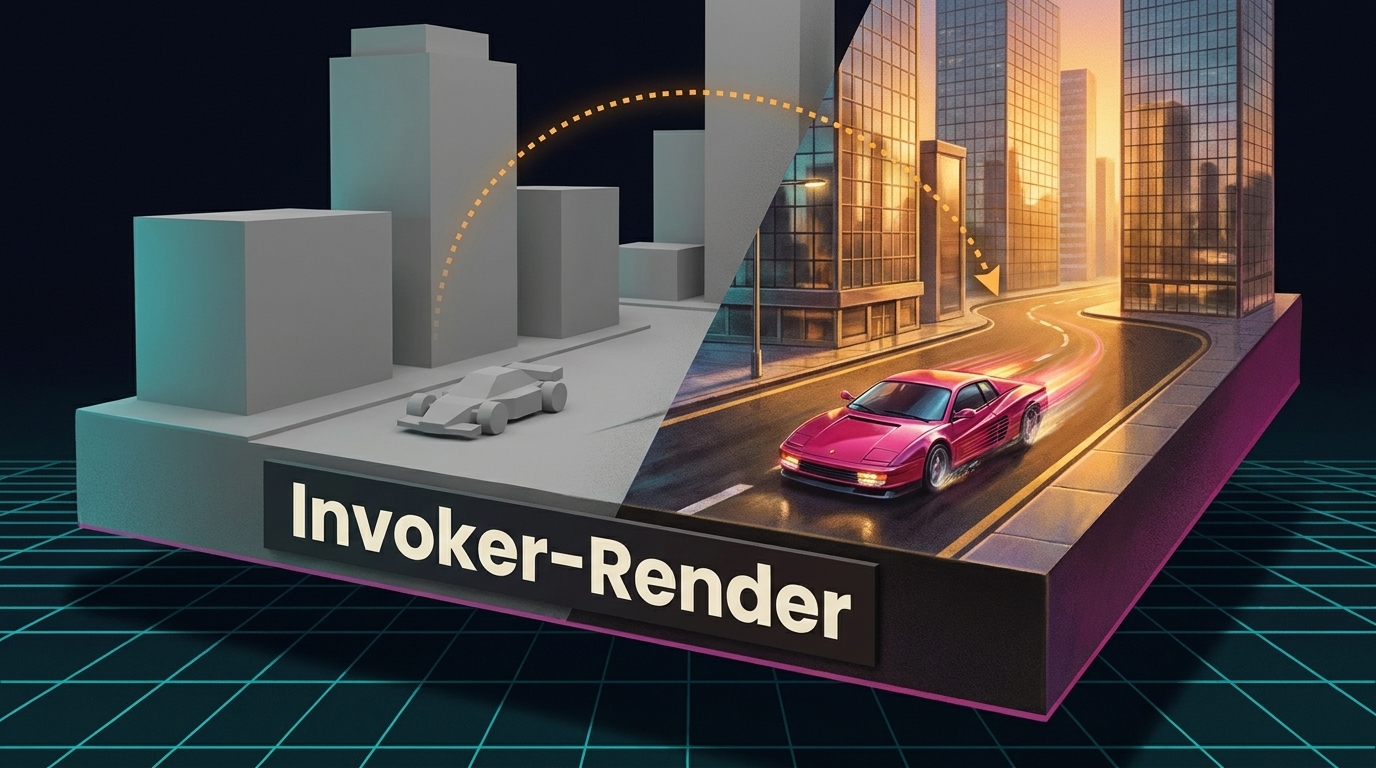
inclusionAI released Invoker-Render 1.0, an open-weight video model that takes the camera path, layout and motion from a structural proxy video and the look from a single reference frame. As an AI FILMS Studio breakdown lays out, that turns a blocked greybox camera move into a look-dev test, without a diffusion model guessing the space from text.
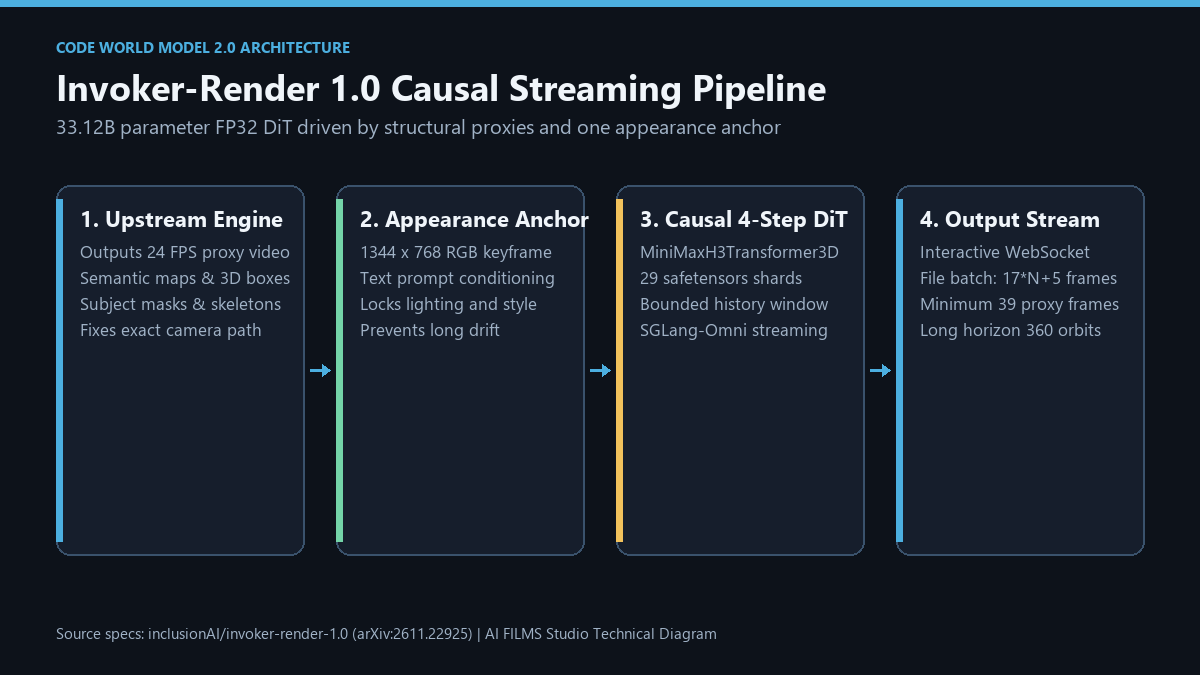
Proxy for structure, one frame for appearance. The model takes a 24 FPS structural proxy, a 1344 x 768 RGB first frame and a text prompt, and the project page demos show the output following each proxy's camera route and motion.
Five proxy types, picked at run time. Semantic maps, sparse 3D boxes, subject masks, shaded geometry and boxes with skeletons all drive the same model, from rough blocking to fine geometry.
Long takes stream without resets. A fixed appearance anchor and a bounded history window let a session run as long as proxy frames keep arriving, including one continuous 30-minute racing generation.
Big, and non-commercial. The 33.12B-parameter FP32 checkpoint weighs about 132.5 GB and carries Apache 2.0 plus CC BY-NC 4.0 terms, per the Hugging Face model card.
A 3D engine owns the shot while the model paints materials and light
Invoker-Render is the renderer half of Code World Model 2.0, a research project from Ant Group's inclusionAI with researchers from Westlake University and Zhejiang University. The upstream engine keeps the world state, and the video model only generates appearance.
According to the technical paper, an aligned training corpus of roughly 200 hours lets the model honor fine geometric constraints when you supply them and fill in plausible local motion when the proxy is coarse.
The project page demos hold one first frame fixed and change only the camera route, such as a dive down a glass tower or a drone climbing beside a rocket launch. Others keep the camera and change the event, and two bullet-time shots freeze the action while only the camera moves.
Proxies at different levels of detail beside the video Invoker-Render generated from them. Image: AI FILMS Studio
AI FILMS Studio's suggested previs workflow exports greybox camera moves from Blender scenes as shaded geometry proxies, each paired with one approved concept still.
Moves blocked in Unreal Engine work the same way, so directors can judge lighting and lens framing before committing to a full CG render.
For wide 360-degree orbits, the breakdown recommends sparse 3D boxes and skeletons, which lock every prop and actor to world coordinates through a full rotation.
Those same greybox scenes can now hold Gaussian splats too, since both apps added native support, as we covered in our story on Netflix exploring splat streaming.
Four denoising steps per chunk reach a reported 18 frames per second
The streaming model runs causal four-step inference, trained with a staged curriculum the paper calls Progressive Forcing. inclusionAI reports a chunk every 930 ms on eight GPUs, 1.82 times faster than its 1,770 ms baseline.
The streaming pipeline, from upstream proxy engine to rendered output. Image: AI FILMS Studio
On 140 held-out rollouts, inclusionAI reports an overall Elo of 1343.2, ahead of SolarRenderer (Causal) at 1245.3, StreamRender-H3 at 1051.9 and Streaming CWM at 359.6. The 30-minute racing demo used a reference-guided quality policy that the default service does not enable, according to the CodeWorldModel GitHub repository.
The companion code ships three ways to run it.
WebSocket session service. Built for live, interactive sessions.
File client. Batch renders need 17*N+5 proxy frames, at least 39. The 24 FPS figure sets the video timeline, not inference throughput.
Browser client. An interactive front end for streaming sessions.
One repo demo is a gamepad-driven session in which the gamepad steers a low-poly proxy and the rendered car follows.
Running it locally takes a multi-GPU node, separate assets and a license review
The checkpoint is stored unquantized across 29 safetensors shards and keeps the transformer architecture of MiniMax's H3 model, which the inference code also builds on alongside SGLang and SGLang-Omni.
The default production profile uses eight NVIDIA GPUs on one node. The weights repo leaves out the VAE, Qwen text encoder and causal decoder, which you prepare through the CodeWorldModel repository's inference docs.
A separate LoRA of about 2.3 GB for the bidirectional teacher model sits in the same repo, and the model card warns not to apply it on top of the causal weights. The full game projects behind the promotional demos are not open-sourced.
AI FILMS Studio advises a license review before the weights go into commercial client pipelines. You can test the model without a server in a free Hugging Face Space that takes a proxy video and one reference image in the browser, according to the same breakdown.
Maxon introduced the Agentic License, a monthly subscription arriving in November 2026 that lets an AI agent run its own headless copy of Cinema 4D or Autograph over MCP. The agent can work on a separate machine while…
Maxon launched Maxon Plus, a separate cloud subscription that generates editable 3D models from text, photos or sketches, creates textures for existing models and lets clients review 3D work in any browser. Models gen…
David Fincher has defended using generative AI in filmmaking as viewers call out apparent AI shots in The Further Mis-Adventures of Cliff Booth, his Quentin Tarantino-scripted sequel to Once Upon a Time in Hollywood.…