Assets can be stored locally or networked, and responsive formats like Three.js ensure compatibility across various screen types and orientations. It bridges generative content with studio operations.
Users can generate custom images or video loops using natural language prompts, powered by models like Stable Diffusion and Runway.
Once created, assets can be cast directly to the wall—no manual uploading required.
Voice commands also control visual parameters like exposure, scale, and color temperature, eliminating traditional UI friction.
The assistant can even understand tagged asset metadata, allowing users to call up visuals by mood, setting, or usage type. And Vū's backend is flexible, figuring out the best model for the job or accessing custom enterprise APIs.
Our thought's always been to create content at the speed of thought. You really have to have a new way of communicating with technology. And so you'll see with all the systems we deploy, we have a touchscreen, we have voice activation...we believe those modalities are much more natural than the keyboard and mouse.
Tim Moore, CEO
Ideas in Motion: AI-assisted brainstorming and gesture control are shaping the next phase of creative interaction
Gen 3 introduces early prototypes that aim to make content creation feel more like a conversation than a task list. The system is being developed to listen, learn, and respond in collaborative environments.
A brainstorming mode is in the works, where AI listens to live conversations and suggests visuals or assets based on what’s being discussed.
Interactive “mind mapping” tools are being designed to allow users to explore concepts visually in real time, branching ideas as they go.
The team is exploring Minority Report–style hand gesture controls and body tracking for spatial navigation, content manipulation, and presentation.
The goal is to move away from slides and toward a more fluid, spatial form of storytelling, where the room itself becomes part of the creative process.
One Button to Unreal: Simplified UE integration bridges real-time 3D with studio control
For creators using Unreal Engine, Vū’s prototype simplifies what’s historically been a cumbersome workflow.
Unreal scenes are launched from a library using a single button, thanks to pre-packaged game files and pixel streaming.
Key controls—sun position, camera position, focus, and more—are adjustable in a user-friendly interface.
A custom plugin is in the works, enabling creators to prep scenes specifically for Vū’s environment.
This streamlining opens up UE to teams that may not have dedicated engineers, making interactive 3D environments more usable in live or fast-paced production contexts.
From Soundstage to Schoolroom: Vū sees applications beyond film sets
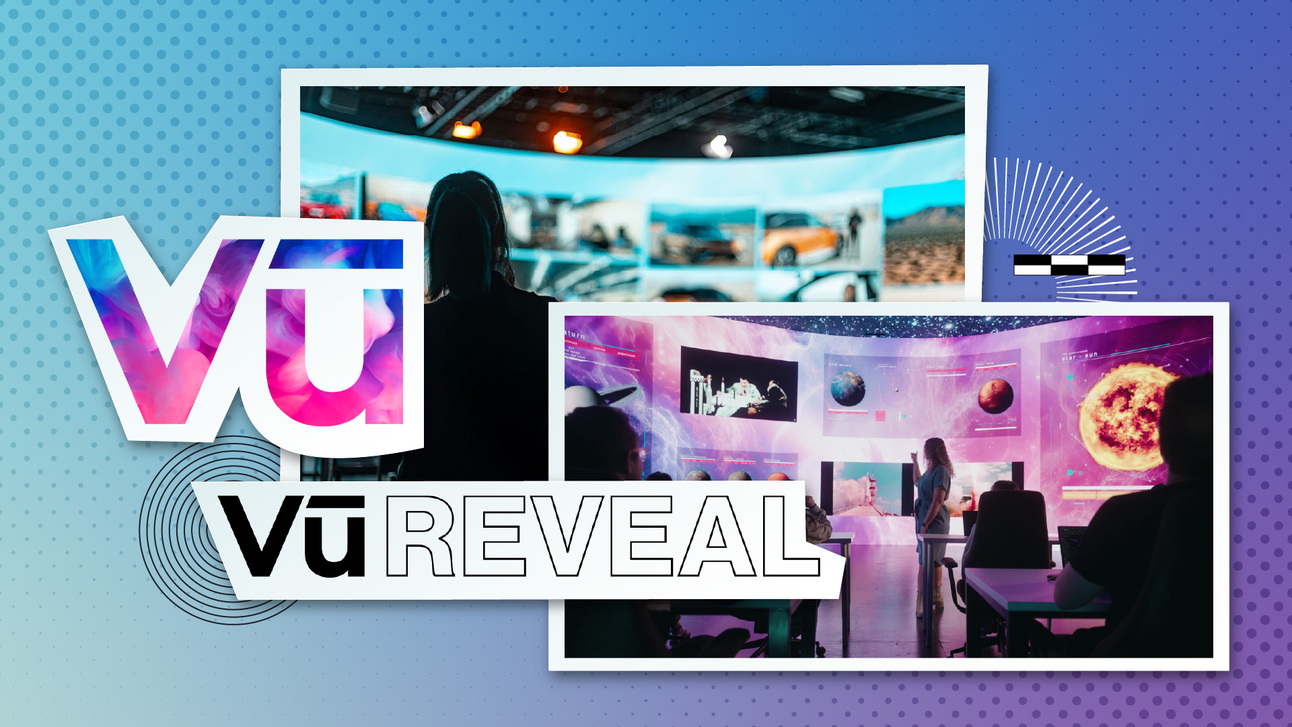
Vū is positioning Gen 3 not just for directors and DPs, but also for educators, executives, and enterprise teams.
In education, Vū is working with Pearson to deliver adaptive learning environments where AI generates visuals tailored to how students learn.
In the enterprise world, Vū is prototyping personalized dashboards that activate when users tap in, showing schedules, meeting content, or product previews.
Auto brands are experimenting with life-sized car configurators, using Vū’s large-format displays to replace showroom floors.
The future of work for us is much more visual...with programs like Vū Studio, now any idea you have, you can have the visual equivalent of that shown on the screen as a visual to the room...it's a new mode of communicating.
Tim Moore, CEO
Final Frame: Gen 3 hints at a new visual grammar for the creative industries
With Gen 3, Vū is making the LED wall just one component of a broader visual interface—a system that listens, learns, and generates in real time.
This positions Vū at the convergence of several major shifts: AI-powered creation, spatial computing, and the democratization of virtual production technology. It also offers a potential blueprint for how other creative tools may evolve—toward multimodal input, real-time output, and highly adaptive environments.
As the cost of displays continues to drop and browser-native experiences become more powerful, Vū’s Gen 3 platform could mark the beginning of a more visual, responsive, and context-aware future of storytelling.