Matt Workman Sees a Generative AI Talent Shortage That Favors Film Production Experience
VP Land
Aug 16, 2026 · 6 min read
Generative AI has a talent shortage, and according to Matt Workman, the openings he sees ask for people who have worked in film production and know animation studio pipelines. The DP behind Cinematography Database, who spent years mastering lighting and building previs tools, now works at fal and thinks that craft background is exactly what these companies are building for.
In this episode of Inside the AI Studio, shot at AI on the Lot, we talked with Matt Workman, a DP now working at fal, about why he went all in on generative AI and what years of film craft are worth now.
Production experience is in demand. Workman describes a talent shortage in generative AI, with openings he knows of requiring film production and animation pipeline experience.
Craft value shifts toward taste. When AI can generate a lit shot, Workman thinks a technician's value shifts toward the taste to choose the image.
Animation may get there first. Workman thinks stylized 2D and 3D animation will reach production-ready generative AI before photoreal work does.
Film pipeline experience is a stated hiring requirement
Workman posted on Instagram that he works in generative AI and invited interested people to connect on LinkedIn. He has been talking one-on-one with DPs, directors, VFX and animation companies, and concept artists who fear public backlash from their communities.
Many of the DPs he knows are tech-forward. A lot of them are building tools with fal, which Workman says can range from storyboarding and previz to final pixel.
Workman sees a clear opening for people who come from production.
There is a massive talent shortage in generative AI and they're hiring like crazy. I mean, I'm one of the newest and they're looking. And one of the requirements is you need to have worked in film production. You need to know pipelines from animation studios 'cause that's what they're building for.
For one well-known director who runs a studio with paid cinematographers, not learning the tools felt irresponsible if they could make a rival studio more competitive.
The choice is harder for individual contributors such as grips and ACs, and he understands why, comparing their position to the film loader, a role he sees as perhaps less relevant than it once was.
Taste matters more once AI can light a shot
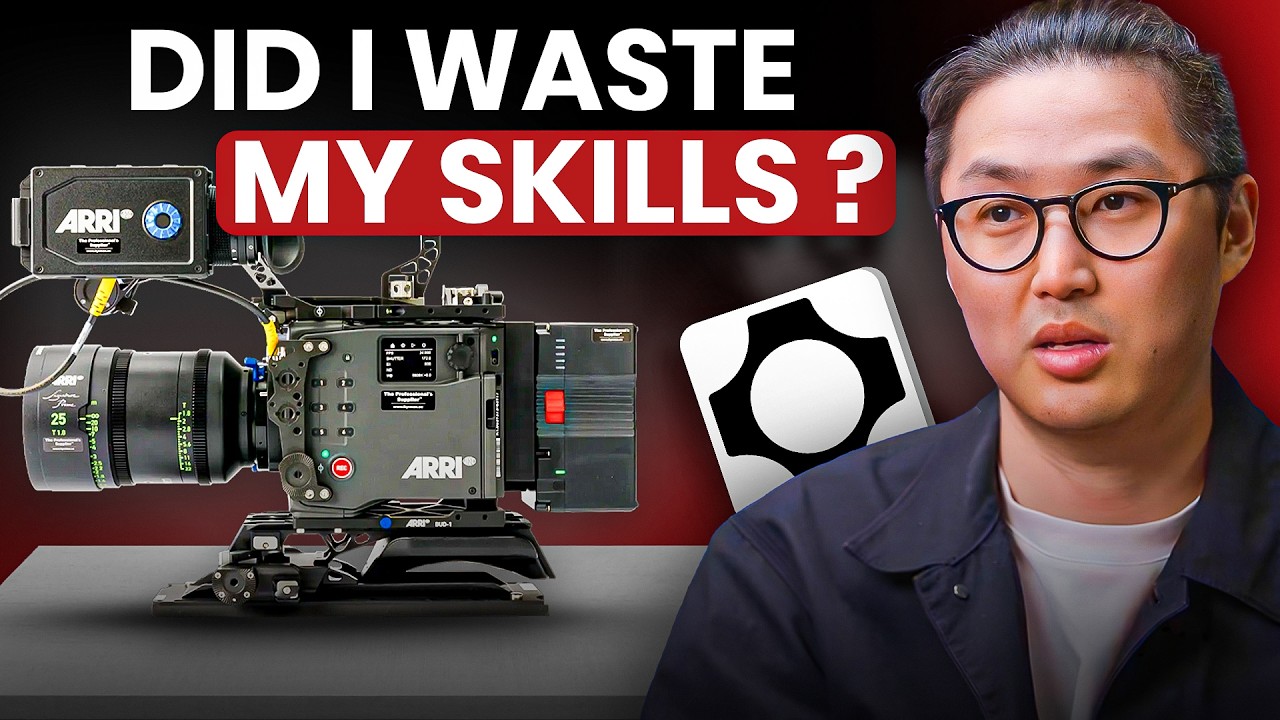
Workman went through the same existential fear that live-action cinematographers and animators feel. He had spent years building games by hand, including an ARRI SR3 film magazine he 3D modeled for a film-loading game in Unreal Engine, and a prompt could produce linear versions of many of those visuals.
Those hard skills left him asking, "are those worthless?" He would still love to shoot film, but in his experience a small order raises practical questions about where it gets processed, and his crews haven't loaded film in a long time.
Workman's answer moves a technician's value away from execution.
My skills to be able to make this thing, to be able to film this way, to light this way, that may not be what my value is anymore. And I think that's what a lot of us technicians look at. I can light better than other people. I know these things.
Once AI can generate the image, "the value proposition is different," in his view, though "there's still taste to choose it."
For himself, the shift also meant leaning into presenting concepts, talking with people, and networking, which he calls possibly his value as a human in the world of generative AI.
His definition of AI cinematography sets the process aside and judges the result. "I love film cameras, but this is a new form of it," he says, a line that still hurts him to say.
Cine Tracer began as a real-world video game experiment
Workman's long-running goal was to bring traditional cinematography and digital worlds together, work that came to be called previs. Epic Games reached out while pushing into film, gave him resources to experiment, and he built Cine Tracer in about a month, livestreaming the start on Twitch.
By his count, he kept developing it for roughly eight years. The Steam listing describes a cinematography simulator built around real-world-based cameras, lighting, and actors running in Unreal Engine 4.
The driving question behind it was "How much of the real world can I put into a video game?" Real-time ray tracing arriving in Unreal Engine was part of the pull, a new way to make images that he wanted to see for himself.
Workman connects that same impulse directly to his generative AI work.
I still pretty much follow that same line of thought as, how can we combine cinematography with new technology to make images? These days, there's a new way.
Working professionals turned a skeptic toward AI
Workman first dismissed generative AI with a flat "this is not real. This is not cinematography." Seeing serious professionals test the tools in useful ways changed that, followed by a run of models that included Nano Banana Pro, Veo 3, Kling, and Seedance.
Workman connected the shift to the e-com commercials he used to shoot as a DP.
I used to shoot commercials, like ecom type commercials, and they paid well. Big crews, 8-hour days... But realistically, it's a little bit generic, some of that stuff. And I started to see this stuff with generative AI, I was like, this is good. I can see this being a big part of production.
Higgsfield offered him credits within his first week of talking about generative AI, and its lens controls resembled UI he might have built for Cine Tracer. He asked for Panavision C-Series flares and got anamorphic-looking images he found convincing, a look that, in his DP days, depended on lenses he says were hard to get outside California.
The backlash pushed him further. After watching commenters dismiss Roger Deakins over a festival remark that left room for filmmakers using AI to tell their stories, he decided to act as if he had fully accepted the technology and "go to the endgame."
Content made with that mindset led to conversations with Amazon, another company he chose not to name, and fal.
Public posting is part of the fal job
Workman chose fal because he views it as the funnel for generative AI into media and entertainment. The company presents itself on its official site as a generative-media platform for developers, offering image, video, audio, and 3D models with serverless GPU infrastructure.
The role also lets him, within reason, keep testing how far the tools can go on his personal platforms, which now count as part of the job. He compares it to employees at newer tech companies who answer users directly on social media.
Workman's default test for a new model comes straight from his years behind the camera.
Let me test a new image model. Let me test a new video model. I want to make it look like traditional cinematography. That's my go-to. Not all of them can do that.
For this job he is stretching into stylized animation, since illustration is a valid form of content. Watching Amazon chase production-ready generative AI, he expects animation and stylized 2D and 3D to get there first, with photoreal less certain.
The full conversation with Workman, including the Kodak commercial he shot and graded at Eastman Kodak, is in the episode above, and every past guest is on the Inside the AI Studio page.
Christy Anzelmo says AI has reversed the way visual effects artists work. Instead of building an image step by step and refining as they go, compositors now start from the result they want and trace back to the data o…
Caroline Ingeborn thinks the AI industry sold creatives the wrong idea when it pushed them to become prompt engineers. The chief operating officer of Luma argues that skilled filmmakers should talk to an agent the way…
AI models can take an image, generate an audio track, cut it into a video, and lip-sync a character in one automated pass. What they still can't do, according to Justine Moore, is judge whether any of it is good.