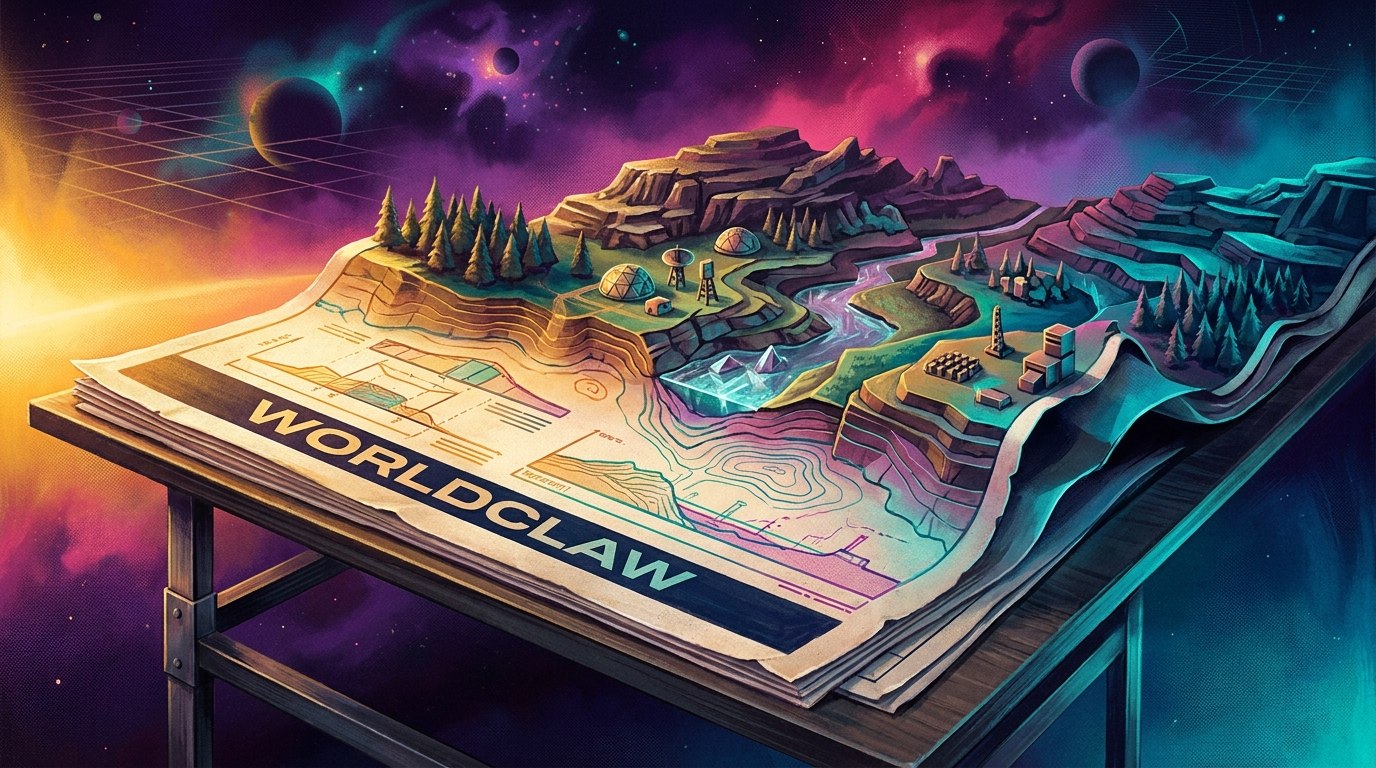
WorldClaw, a new paper from Tencent Hunyuan, describes a text-to-3D system that builds large, explorable scenes and returns editable, instance-level assets rather than a single locked render. The method leans on planning agents that turn a prompt into a structured scene, then refine it region by region.
- Editable, instance-level assets. For detail-heavy regions, the system reconstructs textured meshes and recovers their placement on the terrain, leaving assets the paper says are suitable for downstream editing and reuse.
- Agentic, coarse-to-fine pipeline. Planning agents convert a prompt into a structured specification of regions, terrain, assets, materials, and spatial relations before render-based agents refine terrain, objects, appearance, and contacts.
- Global coherence is the stated goal. WorldClaw builds a terrain foundation from semantic layouts and a region-aware height field, which the authors say holds one consistent terrain structure across a large scene.
- Tencent Hunyuan research. The paper comes from Tencent Hunyuan researchers Chunchao Guo, Jinpeng Li, Yang Li, and Zilong Huang, posted as arXiv preprint 2608.05248 with a project page.
Agents plan the scene, then build outward
According to the paper, planning agents first translate a text prompt into a structured specification of regions, terrain, assets, materials, and spatial relations. WorldClaw then assembles a globally coherent terrain foundation from semantic layouts, reusable assets, generative or procedural materials, and a region-aware height field.
For regions that need more detail, the system generates terrain-conditioned compositions, reconstructs editable textured meshes, and recovers where those meshes sit on the terrain. Render-based agents make a final pass over terrain, objects, appearance, and contacts. The authors published a project page alongside the preprint.
Instance-level editing is the claimed step beyond a locked world
WorldClaw's stated advance is instance-level editable assets held together by a consistent global terrain, so a generated scene can be adjusted piece by piece rather than regenerated whole. We covered Tencent's prior Hunyuan3D World Model 1.0, which the company called the industry's first open-source 3D world generation model and which shipped as an open-source release.
For now the WorldClaw repository lists only the paper and project page, with no code, weights, or demo, so the editable-asset claim rests on the paper until a release lands.