World Labs' Atlas World Model Opens to Everyone, Turning Photos Into Video and 3D Gaussian Splats
VP Land
Nov 13, 2026 · 4 min read
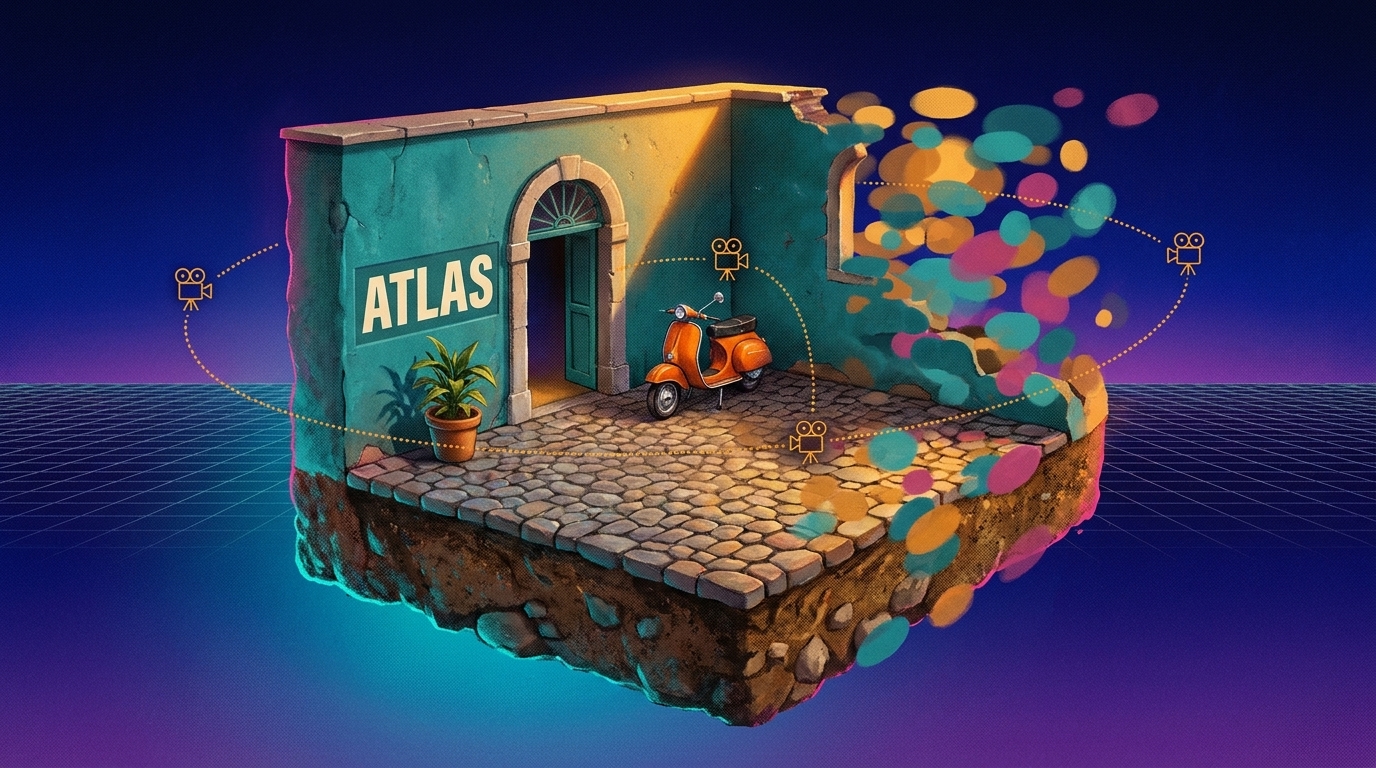
World Labs opened its Atlas world model to the public, adding two web apps, Viewfinder and Chisel, plus the API endpoints that power them, the company posted on X. Anyone can now build a 3D world from a single image, a set of location photos or a blocked-out layout, then export keyframes, video clips or 3D Gaussian splats for use elsewhere in a pipeline.
Viewfinder reconstructs real places from up to 64 photos. It can also generate an entire world from one image, and it exports spatially consistent images, videos or 3D Gaussian splats.
Chisel builds explicit 3D geometry through an agent. You start from a text prompt or reference images, create the world in 3D, then render images and video or export splats in a range of visual styles.
The API endpoints are public. World Labs is releasing every endpoint behind both apps so developers can build their own tools or point an agent straight at the models.
Generated worlds can leave as meshes. Scenes can be saved as Gaussian splats or converted into mesh models for Blender and game engines, TokenPost reports.
Pricing is still unpublished. World Labs has not posted a dedicated Atlas pricing page, and the docs and API hostnames still carry beta labels, according to AlphaSignal's breakdown.
Viewfinder starts from photos, Chisel starts from blocked-out geometry
Both apps run on the same Atlas model but take different inputs. Access to Atlas had been limited to partners, AlphaSignal reports, and the model now has its own front door on the Atlas site instead of living only inside Marble Studio.
Viewfinder works from images. One photo produces a plausible surrounding scene, while up to 64 overlapping photos reconstruct a real environment. AlphaSignal notes that generations include color plus per-pixel depth, the estimated distance from camera to each visible surface.
Chisel works from geometry. Per AlphaSignal, you assemble planes, blocks and basic shapes into walls, furniture and structure, then style the scene with text prompts or reference images while the agent applies a sequence of revisions to the layout. TokenPost describes the flow as setting room layouts and object positions before generating images from that structure.
Atlas card showing a painted courtyard alongside a wireframe 3D version with a camera path. Image: X (formerly Twitter)
Both apps export keyframes, video clips and splats, and AlphaSignal says outputs can be exported as SPZ or PLY files.
The public API exposes posing, view generation and masked edits for agents
AlphaSignal lists six operations in the API reference:
atlasGenerate for scenes and new views
atlasTextToImage for creating image inputs from text
atlasChisel, which AlphaSignal ties to the Chisel workflow and the docs use for masked edits across posed views
atlasMasked for edits limited to a selected region
images2PosedRGBD for estimating camera poses and depth from input images
splats2Mesh for converting a splat into a polygon mesh
The Atlas documentation lays out the workflow. You pose your images first, which returns a camera and depth map for each, then send those posed views as context to atlasGenerate along with the new camera positions you want rendered.
Flythroughs. For a video or camera move, the docs say to submit the full ordered camera path in one request.
Speed. Reusing the previous response's prompt with prompt enhancement turned off skips recaptioning and reduces generation latency.
Object edits. In the docs, atlasChisel takes grayscale masks across posed views, with black marking the area to edit and white preserving the image.
Video input. A separate guide covers selecting frames from a walkthrough or synchronized cameras, useful for jobs like rebuilding iPhone video into a world you can fly through.
Coding agents can also install World Labs skills that carry these workflows, per the docs.
Costs, benchmarks and real-time playback are still open questions
World Labs' Atlas announcement claims the model generates up to one minute of video at 1440p from a small number of reference images. AlphaSignal notes that independent replication of World Labs' benchmark numbers is still pending.
Cost is the bigger unknown for production teams. AlphaSignal points out that Marble Studio's credit schedule offers a rough reference, but Atlas workloads may be priced differently.
A real-time variant is available as a research preview, with World Labs streaming generated worlds from cloud GPUs to a browser at up to 15 frames per second while you control the camera, according to AlphaSignal. TokenPost reports that users can now explore the environments they create through Frameboy, where the public version previously offered only prepared scenes.
Adobe debuted Project Live Set, an early research preview that lets editors change a subject, transform an environment, introduce a reference character or redirect the camera on an existing clip, then see the result i…
MiniMax released H3-Image, an open-weight model that generates 16-megapixel images and edits from up to 16 reference images, claiming 4K generations in 10 seconds in its launch post on X. High-resolution stills and re…
Google has released Gemini 4 Carbon, its new frontier model for long-horizon agent work, to paying developers, enterprises and Google AI Ultra subscribers, alongside a /swarm preview that turns one prompt into a coord…