GENERATIVE AIWorld Labs Launches Atlas for Freezing and Reframing Multi-Camera Video
VP LandSep 10, 2026 · 3 min read
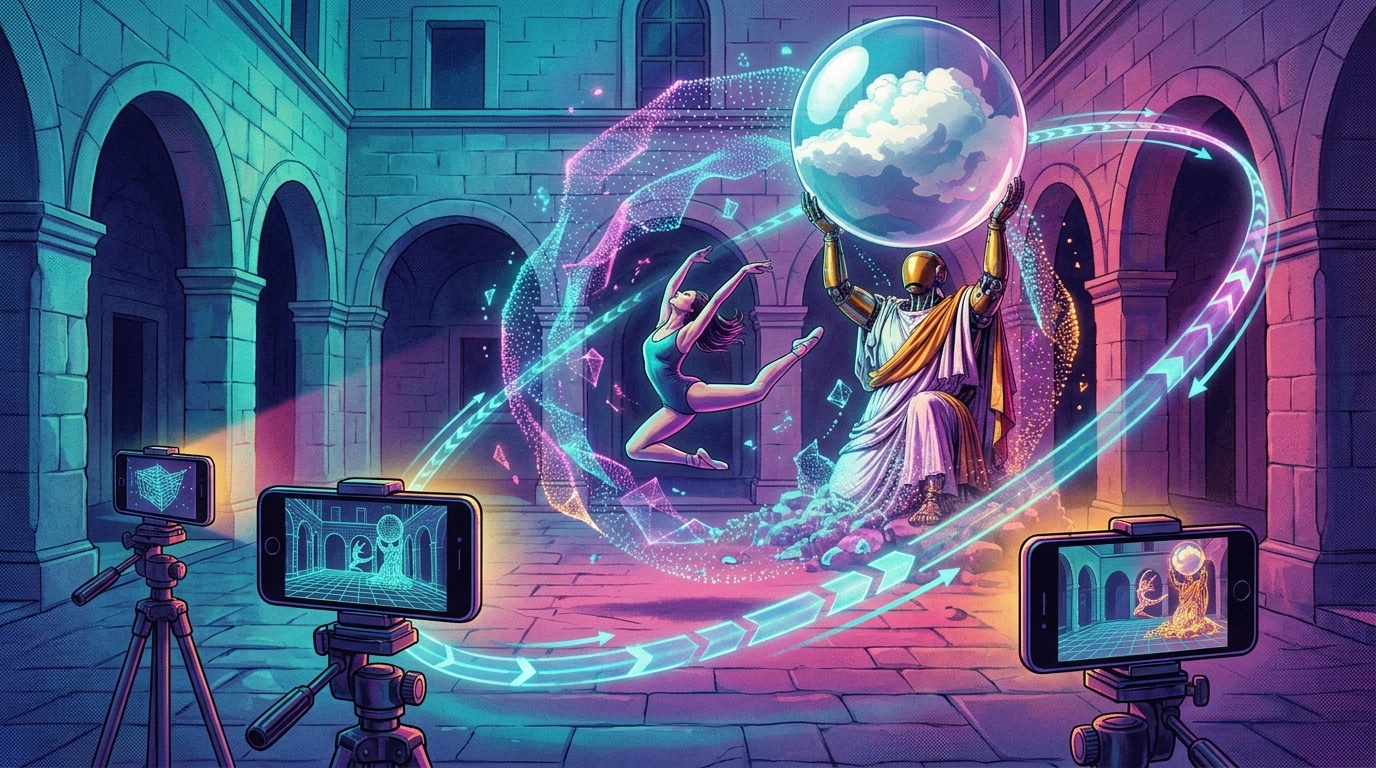
Atlas turns footage from a few ordinary cameras into a space-time capture that can freeze action and generate new viewpoints after filming. In its Atlas launch post, World Labs says the model reconstructs spatial structure and how a scene changes over time; its demonstrations show visibly detailed reframed shots, without publishing a mode-specific sharpness measurement.
- New viewpoints extend beyond the original cameras. World Labs says Atlas can reframe footage from positions the source cameras never occupied.
- Three to five cameras can support frozen-action shots. The company demonstrates bullet-time-style captures using phones or action cameras.
- Observed coverage and generated regions remain distinct. More source views provide more scene information and reduce the geometry Atlas must generate.
- Atlas can produce explicit 3D outputs. World Labs says the model can output point clouds and 3D Gaussian splats from reconstructed scenes.
- Still-image camera paths are a separate workflow. Atlas can generate up to one minute of 1440p video from one to six reference images and a designed camera path.
Multi-camera footage becomes a reframable record of space and time
World Labs says Atlas models both a scene's spatial structure and its evolution over time. It represents video as image sequences, grounds images and depth maps in explicit camera poses, predicts depth across frames, and combines that information into a 3D reconstruction.
In a short-film demonstration, David Pantera says two people captured footage on phones before Atlas generated unseen parts of the scene, froze the action, and created views from positions that were never filmed. The result makes the post-capture viewpoint control visible, while the unseen areas remain model-generated.
Gowthami's stop-time example shows the same Atlas-powered effect in a shorter clip. World Labs says its own examples used three to five cell phones or action cameras on portable tripods and clamps.
More camera coverage reduces what Atlas has to generate
Atlas can reconstruct a real-world scene from sparse inputs, but World Labs distinguishes between observed detail and geometry it must infer. The company says more input views give Atlas more context and reduce the amount of unseen scene material it has to generate plausibly.
That limit matters when a reframed shot moves beyond the original coverage. World Labs says Atlas can produce faithful reconstructions from two or three images in some cases and can accept more than a hundred images in its spatial context, but regions no input camera observed remain generated estimates.
The company says Atlas can output point clouds and 3D Gaussian splats, including reconstructions derived from video. Atlas is also intended to power future versions of World Labs' Marble, which uses the same splat representation.
Still-image paths use Atlas' camera-controlled generation mode
Atlas also generates new views from one to six reference images along manually designed camera paths. World Labs attaches its up-to-one-minute, 1440p specification to this still-image generation mode, not to multi-camera video reframing.
Ben Mildenhall's stylized-scene demonstration shows controlled 3D viewpoints across single-view and multi-view scenes. World Labs says Atlas can generate new angles from one image by filling in parts of the scene outside the original view.
Pantera's camera-keyframe example shows designed keyframes moving through different scenes while Atlas fills the views between them into a continuous transition. World Labs also reports benchmark advantages for camera-conditioned generation and sparse 3D reconstruction, claims that remain vendor-reported while Atlas is in early access with select partners.