In this week’s fast-moving tech roundup, Addy and Joey unpack the tools and research reshaping filmmaking—from a $5K LiDAR camera and realtime AI video generator to on-device vision models and mini AI workstations—signaling a future where capture, creation, and AI inference converge both on set and on desktop.
XGRIDS PortalCam: Spatial capture for $5,000

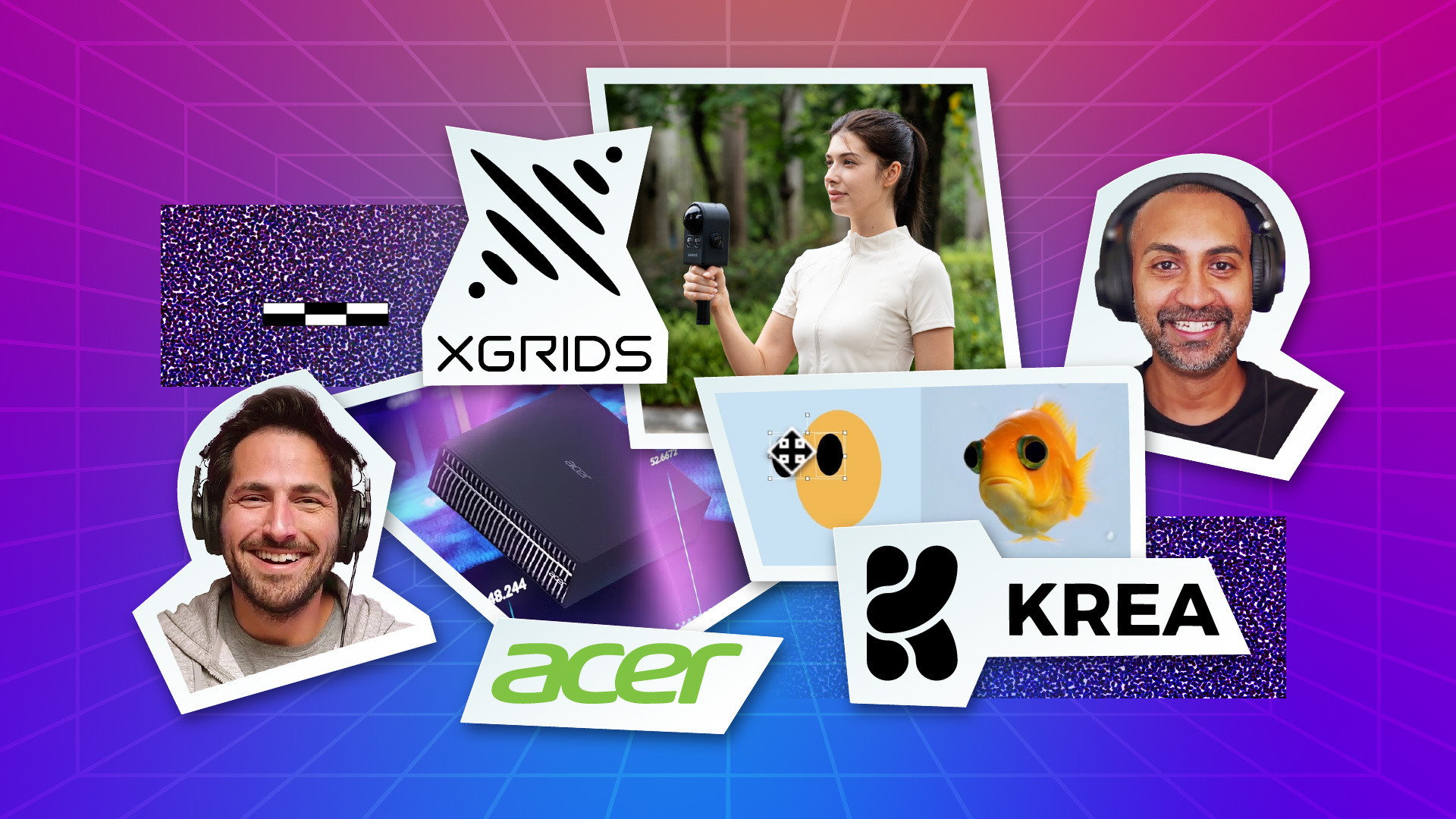
The standout product of the week is the PortalCam from XGRIDS. Traditionally, professional LiDAR and photogrammetry scanners have been priced from roughly $15K to well over $100K—equipment that’s designed for survey-grade range and accuracy rather than cinematic fidelity. PortalCam changes that calculus. Priced at $5,000, it targets filmmakers directly: a lighter scanner with a four‑camera array (two fisheye, two forward sensors) and SLAM tracking to create rich spatial captures.
Key practical points for production:
Speed vs. detail tradeoff: the device captures more geometry and texture the slower and closer an operator scans a surface—useful for dialing in high detail on props or set dressing.
Location scouting & measurements: teams can scan a location and later take accurate measurements, plan shots in virtual space, or share scans with remote crew for virtual scouting.
Integration & export: PortalCam’s software aims to bridge the gap for filmmakers not fluent in 3D tools, while also allowing export to Unreal, Blender, or RealityCapture workflows.
For VFX pipelines this is a bread‑and‑butter tool: accurate geometry and high‑resolution texture capture speed look development, matchmoving, and set augmentation. If PortalCam integrates with RealityCapture or exports optimized Gaussian splats, it becomes even more production-ready for LED walls or virtual production stages.
Krea Realtime Video: The coming fork between quality and immediacy

Krea teased a realtime video generator that preserves temporal consistency while letting users drive scenes with simple shapes and inputs. This is the interface that previously made waves for its on-the-fly image generation; the leap is that video now holds together frame-to-frame.
Why this is important:
Rapid ideation & previs: filmmakers can iterate camera blocking, framing and lighting ideas in seconds—valuable during pre‑production and early design passes.
Performance & puppeteering: artists could “play” a composition in real time—drive character movement or change background elements while recording the session.
Game design & interactive art: even if photorealism lags, a realtime renderer that accepts vector inputs can power 2D/experimental games and immersive performances.
Krea’s demo hints at both cloud and device constraints. If similar tools run locally at scale, games and interactive installation work will be immediate. If they remain cloud‑centric, latency and cost will restrict on‑the-spot creative iteration. Either way, this is a fork: high‑quality batch generation vs. lower‑fidelity instantaneous creation—both will coexist.
Wan2.2-S2V: Speech-driven avatar animation

Alibaba’s Wan2.2-S2V adds another model iteration focused on speech‑to‑video. Give it a static character image and an audio file, and the model generates believable lip‑sync and facial animation that matches the performance. Notably, the model can run locally and has ComfyUI integration, so developers and creators can test and incorporate it without cloud costs.