On the Denoised podcast, we weigh custom post-trained video models against general models that keep getting more capable, starting with Ben Affleck's account of how InterPositive built its models before Netflix bought the company. We debate whether one production's footage can reach Netflix delivery quality and whether smaller teams can build their own models. We also cover image models built around precision editing and a frontier model that struggled with a character rig in Blender.
Jump to:
00:21 InterPositive and the Netflix deal
07:32 Why we're skeptical of post-training
14:43 Utopai's model and DIY post-training
19:29 Ideogram 4.5 precision editing
21:13 Gemini 4 Argon and Opus 5.5 in Blender
Quick Take
As Joey describes InterPositive's workflow, a production's own dailies train a bespoke model for that project. We spend the episode asking whether one team's footage is enough data, and whether an open-weight base plus a capable AI assistant puts that workflow within reach of smaller productions.
What We Explored: How Affleck Says InterPositive Post-Trained an Open-Weight Video Model
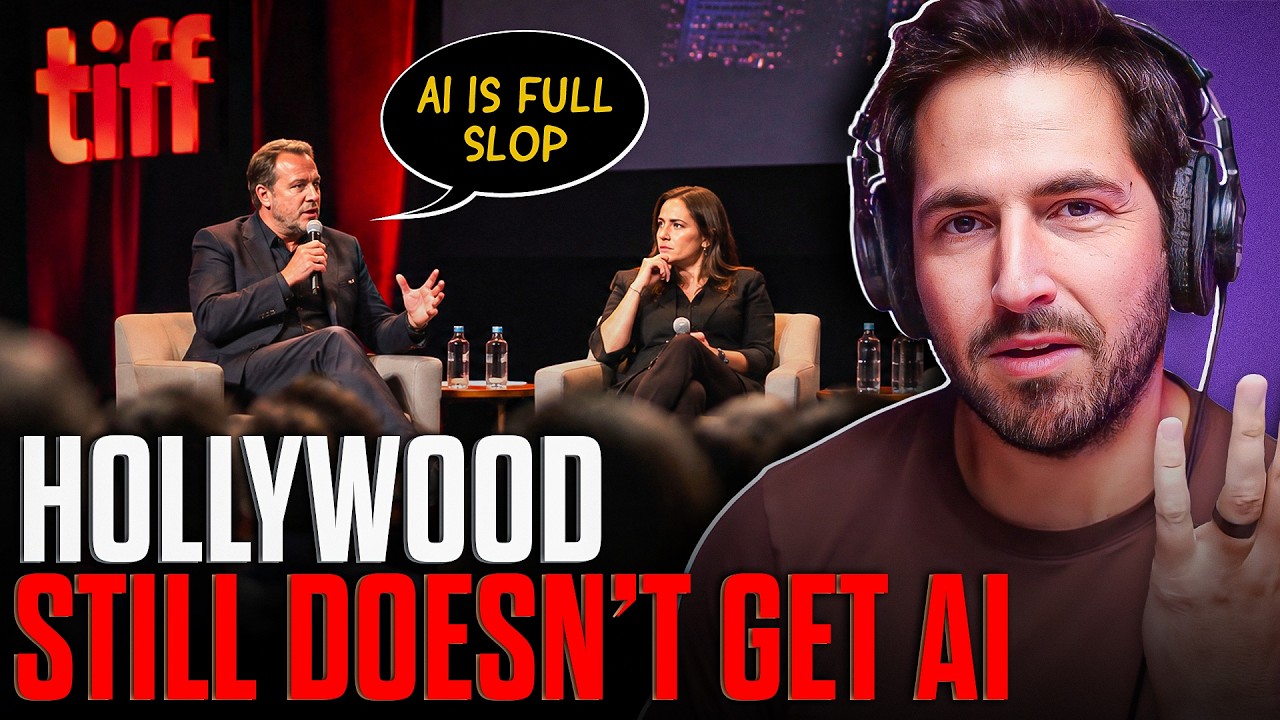
We start with Affleck's Bloomberg Screen Time interview with Lucas Shaw, where he shared more technical detail about InterPositive than he had before the acquisition.
Netflix paid $587 million for the company, according to The Hollywood Reporter.
Affleck's account of how the models were built:
- An open-weight base. His team post-trained an open-weight video model but did not say which one.
- Eight months of shooting. They spent roughly eight months shooting their own production footage as training data.
- Training picks up where it stopped. Affleck described unfreezing the weights and continuing from the model's last training step.
Joey's guess is that the base was an early model from the Wan family or an early LTX model.
InterPositive's workflow, as Joey describes it, trains on a film's own dailies. Each production's dailies feed into InterPositive's system to create a custom model for that project, and the acquisition demo showed wire removal, a different camera angle, and other VFX work.
Affleck's tech history goes back to the '90s. He told Shaw he tried to build a nonlinear editing system as a cheaper alternative to Avid, and it failed because the disks were too slow and dropped frames.
He also used to build gaming PCs and knows Python, which is why Joey calls him a secret James Cameron.
Affleck said he visited OpenAI when DALL-E was on its first version, had a panic attack, and called Matt Damon, before concluding it didn't match how filmmakers work.
He drew a line on training data. Joey reads Affleck as fine with models trained on public web data, but not on what Affleck called his peers' work.
Affleck said AI was used heavily on his Netflix film but declined to say where, likening disclosure to a magician revealing the second rabbit hidden in the table.
Joey's argument: Some productions will set aside Chinese models like Seedance from ByteDance Seed on ethical or geopolitical grounds, even though Addy notes Seedance can handle wire removal from a clean keyframe. Those studios want a model that is local, walled off, secure, and custom to one project.
Addy's counter: Models work best at scale and need the cloud.
What We Debated: Whether Post-Training Can Reach Netflix Delivery Quality
We question how much post-training can add to a model its researchers already stopped training where they judged best. Addy explains that more passes over the same dataset push a model toward overfitting, which is why training stops where it does.
Addy compared post-training a finished model to swapping out a Ferrari's factory tires.
It's like, oh, we're gonna change out those factory tires and put in these way wider tires. Well, the reason Ferrari has those tires is because that is what was engineered to go with the engine and the chassis and the weight of the car and everything else.
In his view, post-training suits narrow jobs, the way a LoRA does, and Joey wonders whether InterPositive's per-film models are closer to that. Addy flagged that he is not certain this holds for every model and asked viewers to correct him.
One production's footage may be too little data. We both had that first reaction, and Addy estimates a full-weight change takes thousands of hours of footage.
Resolution is another open question. Joey points out that the open models InterPositive likely started from were trained on and output 720p. Even shooting in 4K, he expects output around 720p 8-bit, the lo-fi web quality we keep talking about.
Addy's answer is upscaling, with tools like Starlight from Topaz Labs and Beeble's model. Joey adds Blackmagic to the list but counters that these upscaling and HDR models are all relatively new and flourished after InterPositive was likely training.
Addy's counter: Netflix is full of AI and machine learning talent and would not pay that much for an inferior product, so he believes InterPositive has methods outside public view.
What We Debated: Whether Post-Trained Video Models Are Within Reach of Smaller Teams
We compare InterPositive with what others are shipping, starting with Utopai Studios. Utopai, which also offers an agent called PAI (Production Assistive Intelligence), released a model post-trained on MiniMax H3, but with no API available, it is unclear whether it will work outside Utopai's own platform.
That matches the approach of fal.ai, which built its own post-trained MiniMax H3 Max. Joey sees MiniMax as the clear choice for anyone post-training a video model.
Addy notes the favored base keeps moving. LTX 2.3 held that spot before, LTX has since released LTX 2.5, and there is always an open-weight model ready to tune.
Purpose-built VFX models from fal and LTX:
- fal's gray box model. A post-trained H3 Max takes a Blender gray box or playblast as input and outputs a final render.
- LTX's equivalent. LTX released its own model for the same job as part of a run of VFX tools.
- AlphaGen keying in beta. LTX's AlphaGen takes a video clip, keys it, and returns a composite.
- ACES support. Addy has heard LTX supports ACES color workflows, which fits its VFX focus.
Joey's argument: Assistants like Fable and GPT-6 Astra may let a small team handle post-training work that once required AI research scientists, so a production might not need to be an InterPositive to build its own model.
Addy's counter: Compute is the limit. Training takes serious capital, and Addy's understanding is that InterPositive has around 16 people and substantial investment behind it.
Training data is the other constraint. Joey points to Beeble, which built a light box and shot its own training data for a relighting model. CorridorKey generated synthetic training data, though Addy notes that adds compute cost before training starts.
What We Explored: Ideogram 4.5 and FLUX 3 Center Image Models on Precision Editing
We move to image models, where Ideogram 4.5 centers on precise edits to existing images. Addy's take is that most brand and marketing work starts from existing imagery needing Photoshop-style changes, like making a product red or relighting it, which Nano Banana Pro has handled for some time.
Open weights may follow. Joey confirms on the show that Ideogram 4 is an open-weight model, and Addy believes 4.5 could follow, which would let you run it in ComfyUI.
Black Forest Labs released FLUX 3 Image, which lets you draw boxes on a layout, describe what belongs in each, and have the image build around them. Joey compares the layout approach to Krea's annotations.
The image model may not be on APIs yet. Addy's take is that hardly anyone does pure text-to-image anymore outside of ideation.
We both work mostly from existing images and references. Joey defaults to reference frames over start and end frames, arranging location and character references deliberately, while Addy treats edited camera frame grabs as keyframes for a video model.
Temporal keyframe adherence matters for timing in video. For video generation, Addy says FLUX 3 and Aleph 2 from Runway stick to assigned keyframe positions pretty well. With eight keyframes in a 100-frame shot, for example, you can assign keyframe 2 to frame 23.
Joey adds that Luma AI is also big on keyframes, which helps when you need to hit specific moments in a shot.
What We Questioned: Gemini 4 Argon's Benchmark Lead and What Frontier Models Are For
Google's benchmarks place Gemini 4 Argon ahead of GPT-6 Astra, Opus 5.5, and Fable. The model is still in safety reviews and not publicly available.
Joey is skeptical of what benchmark charts tell working creatives. We pulled up a joke chart showing OpenAI ahead of competitors purely because its model version numbers are higher.
Addy flagged that Demis Hassabis stepped down as chief executive of Google DeepMind, and we confirmed on the show that he remains chair.
Joey reads it as a reshuffle of executive leadership across DeepMind and Alphabet AI, which The Guardian described as a big shake-up in Google's AI team.
Opus 5.5 stretches a subscription further. Joey finds it highly capable and far more efficient with his weekly Anthropic usage allotment than Fable or Astra, which burn through it.
Addy's Opus 5.5 character-rig attempt failed. He connected Opus 5.5 to Blender to build an animation rig of himself; environments and buildings work, but the deformable skeleton rig did not. Addy allows he may have instructed it wrong.
Addy says the same class of models is reportedly helping with fusion computations, supersonic aircraft parts design, and unproven theoretical math. He points out that it is the same model we use for Blender compositing, scripting, and previs, and Joey adds that you don't need a specialty-trained model for that range.
Bottom Line: Custom Models Versus Capable General Models
Each segment weighs what a custom or specialized model gives you against what general models already do.
- InterPositive. Affleck describes post-training an open-weight model on footage his team shot, and we question whether one production's data and 720p-era bases can reach Netflix quality.
- DIY post-training. Utopai and fal both built on MiniMax H3, and AI assistants may lower the skill barrier, but Addy sees compute and training data as the limits.
- Precision image editing. Ideogram 4.5 and FLUX 3 Image center on precise edits and layout control, and we both work mostly from existing images and references rather than pure text prompts.
- Frontier models. Gemini 4 Argon leads Google's own benchmarks but is not publicly available, and Addy's Blender rigging attempt with Opus 5.5 failed.
Across these segments, the workflows we discussed start from existing material such as dailies, Blender gray boxes, and frame grabs.
Links from This Episode
News & Analysis
Tools & Platforms
Companies
Affleck's InterPositive, the AI company Netflix acquired
Utopai Studios, AI studio behind PAI
fal.ai platform, maker of post-trained H3 Max models
Topaz Labs, maker of the Starlight upscaling model
Luma AI, AI video platform that emphasizes keyframes
ByteDance Seed, team behind the Seedance video model
Google DeepMind, Google's AI research lab
OpenAI, the lab Affleck visited
Beeble relighting, shot its own training data
CorridorKey training approach, tool built on synthetically generated training data
WATCH THE FULL EPISODE ON YOUTUBE →