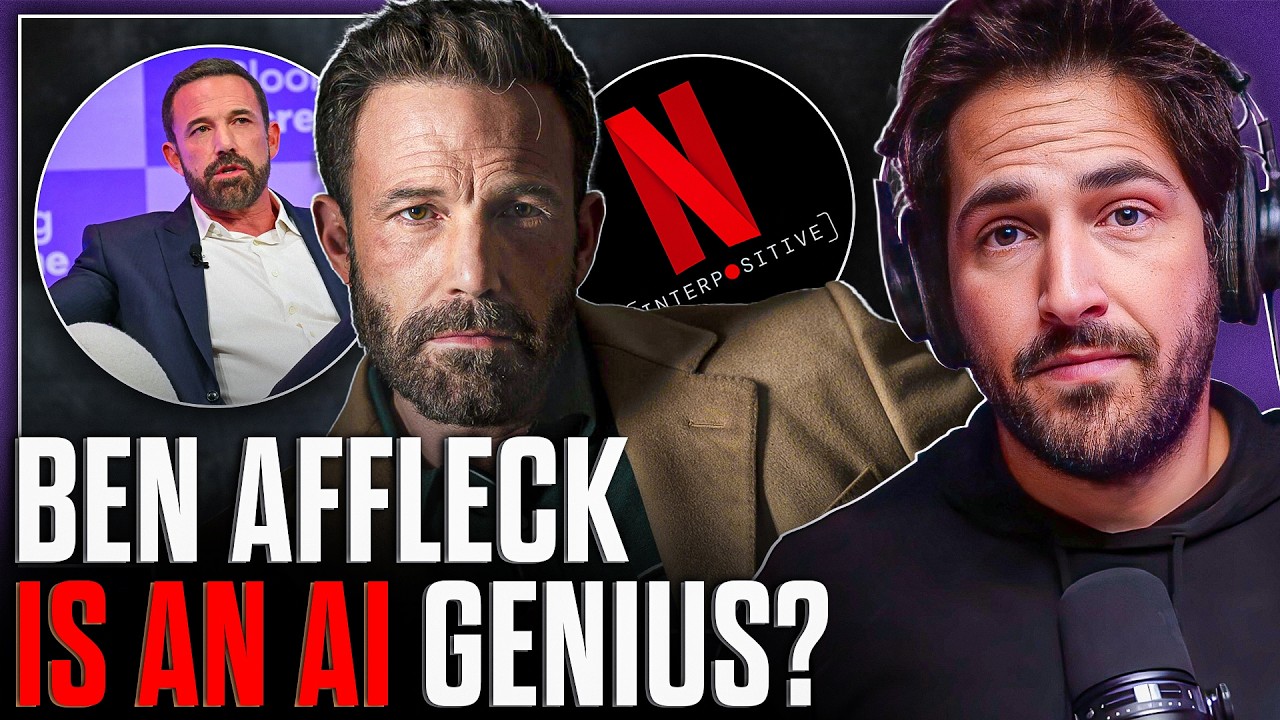
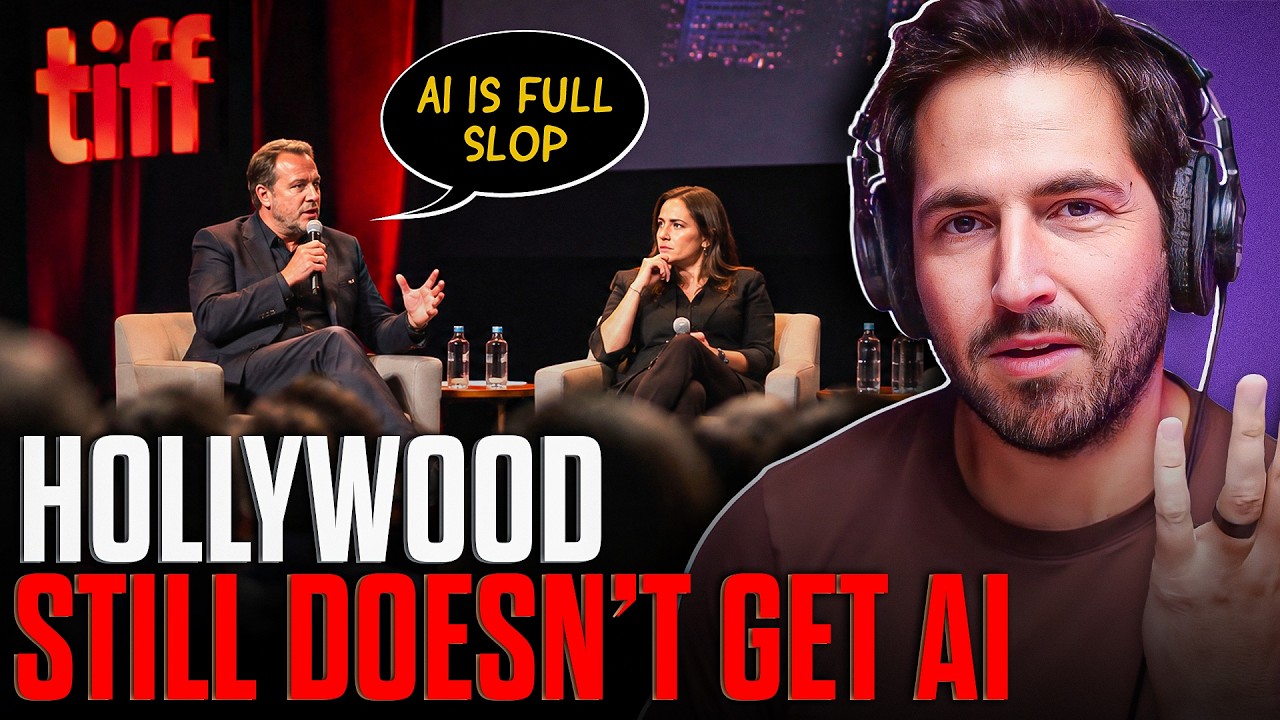
Jeffrey Katzenberg wants Hollywood to stop resisting AI and start shaping it, and on the Denoised podcast we ask whether the executive behind Shrek should build a studio or sell tools. We also break down how Opus 5.5 solved a Blender shot-matching problem, size up the open-weight Qwen-Image-2.1, and question the thinking behind an upscaler acquisition.
Jump to:
00:19 Commenters who proved our TIFF point
05:20 Katzenberg's essay and career
25:55 Opus 5.5 in Blender
34:59 Qwen-Image-2.1
40:26 The upscaler acquisition and local GPUs
Quick Take
Katzenberg argues Hollywood should experiment with AI so creatives, not Bay Area engineers, set the rules. We agree with the premise but question his plan, because, as we see it, the tools he wants to build are getting cheap enough for anyone to make, which puts his edge in studio leadership.
What We Debated: Commenters Who Heard "AI" and Proved Our TIFF Point
In our TIFF recap, we argued that filmmakers hear "AI" and picture sloppy microdramas until they learn the work means shooting real people with AI helping production. The comments on that episode delivered the exact knee-jerk reaction, which we unpack at the top.
Many skeptics work in the industry. Addy noticed screen names pointing to VFX artists and studio staff insisting AI will never do one thing or another. Two or three years into this technology, we don't see how anyone can be that certain.
We are skeptics too. Progress in Blender and computer control has still surprised us, and we've called out ethical misses like the Tilly Norwood drama.
As Addy said, "You're only doing yourself a disservice if you're not curious about it, if you're not willing to test it out."
What We Explored: Katzenberg Wants Hollywood to Set AI's Rules Before Tech Does
Katzenberg posted a long essay on X titled "The World is Changing: AI for Creativity." It lays out his observations on how AI is entering creative work, which we break down in the episode.
Addy worked under him at DreamWorks Animation in the early 2000s and calls him an early-career hero, citing his work ethic and focus. Katzenberg was also behind Disney's 1990s revival, including The Lion King and Aladdin, before starting DreamWorks and later Quibi.
His 90% prediction is getting close. As Joey paraphrased it, Katzenberg once predicted AI could handle about 90% of a high-quality animated film within three years. We're not there yet, but animation, free of the uncanny valley, is the nearest target.
Reasoning versus creating. The essay raises a question that had challenged Katzenberg for months, the difference between reasoning and creating. In its words, "Creating is fundamentally generative. It produces something that didn't exist before. And crucially, there's no single right answer waiting to be found."
A tale of two cities. Katzenberg frames the split as Bay Area engineers building the models while LA holds the creative talent, and he wants Hollywood to experiment now so it can define how AI comes into play.
Addy's take: Katzenberg is a little late to the party. Netflix and Disney already pair studio perspective with Bay Area tech, and startups like Asteria, Promise, and Secret Level combine both worlds.
Joey's counter: The mashup is in its early days. Union questions remain unsettled, much studio AI work happens quietly, and there are no established guidelines.
What We Questioned: A Pixar of AI and a Picks-and-Shovels Business Pull in Opposite Directions
We weighed two things Katzenberg said on The Town podcast that point in different directions.
He thinks he'll have to start the studio himself. Asked whether the Pixar of AI is among the companies circulating around the Bay Area, Katzenberg said, "No, I think I'm gonna have to start it." He also said, "I'd rather build the picks and shovels and provide them to everybody."
Addy's first reaction was that everybody already builds those, starting with Google and Runway.
Joey added Adobe along with Magnific, Artlist, and Higgsfield.
Joey's argument: A Pixar of AI and a tool for everyone are separate businesses. A studio needs a proprietary edge like Pixar's Presto animation software, unless Katzenberg builds a model of his own, and his venture firm did back real-time AI video startup Reactor.
Addy's take: Katzenberg's strength is leading teams that make hits over and over, as at DreamWorks, while building tech and tools is where, in Addy's view, he has failed several times.
Addy explained what made Shrek work.
Shrek wasn't necessarily about computer graphics at the time or all of the wonderful innovations that were happening with CG. Shrek was really about disrupting the Disney fairy tale format in a way that became a parody of all of the things that he made previously.
Perfectionism could slow him down. Addy recalled Katzenberg telling a DreamWorks company meeting that a dog stain on a concrete wall kept him from enjoying his new view of LA. In generative AI's fast-moving environment, Addy argues, you can't fixate on little things.
The 2D-to-3D shift is the precedent. Katzenberg's essay cites the move from hand-drawn to 3D animation. As Addy describes it, DreamWorks started with hand-drawn films like The Prince of Egypt, many 2D artists refused the new tools, and roughly 25 years later, animation is mostly 3D.
What We Explored: Opus 5.5 Fixed Blender Focal Lengths That GPT-6 Astra Missed
Joey has been running Opus 5.5 through his Blender and tool-building work, and he finds the quality is back after a rough stretch for Anthropic's Opus line.
Opus 5 drew a lot of online dislike, and Joey found its responses convoluted. Meanwhile, Fable arrived powerful but expensive, and GPT-6 Astra drew buzz for video editing and 3D modeling.
For Joey's tool-building and 3D work, Opus 5.5 matches Fable for less. It also matches or beats Astra on 3D tasks, though Joey notes he isn't pushing it to extremes.
Joey's Blender test. He was matching live-action shots to a 3D environment he's building behind them in Blender.
- Astra did an okay job but missed perspective and sizing when cutting from wide shots to close-ups.
- Opus 5.5 noticed the Blender camera sat at one focal length for every shot.
- It corrected each focal length and exported new background plates.
Addy, who hadn't used Opus 5.5 yet, came away planning to try it.
Anthropic still has no native image generation. People get visuals out of Opus 5.5 through code instead, like Ryan Sael's interactive lens lab, a website explaining camera focus with a 3D focal-plane display.
In a comparison from Magnific, Opus 5.5 and GPT-6 Sol received the same brief.
The Opus 5.5 version, built with ByteDance's Seedance, felt more cinematic to us, with more shot variety and a standout reflection in a pair of sunglasses.
Our camera-tier analogy.
- Fable is the ARRI 65, and you don't need 65mm for everything.
- Opus 5.5 is the URSA from Blackmagic Design, about 90% of the result for 10% of the cost.
- GPT-6 Astra is the Sony Venice 2, equally capable at the top end.
Joey ranks Astra as GPT-6's top public tier, the Fable equivalent, with Sol as the Opus equivalent. He has heard Sol and Terra come close to Astra for most work at a lower cost, though he hasn't used them.
What We Explored: Whether Open-Weight Qwen-Image-2.1 Reaches Nano Banana Quality
Alibaba's open-weight Qwen-Image-2.1 image model has drawn reactions placing its quality near Nano Banana at a much lower cost. We walked through published examples.
- Transparent layers and text detail, which Addy sees as a fit for graphics and animatics.
- Image editing, like isolating a tree's leaves in front of Seattle's Space Needle.
- Up to 10 reference images, shown combining photos of the Cheers cast into one portrait.
- ComfyUI support, so you can run it on your own GPU.
Joey's summary is that it won't beat everything you've seen, but it's open weight and looks on par with Nano Banana 2. He sees open releases that gain adoption as the main advantage Chinese companies hold.
Where video models rank for us.
- Addy says most people put Seedance 2.5 on top, though Addy's own favorite is Wan 3.0.
- Joey finds Seedance 2.5 pricey but notes it appears to be adding cheaper fast and lower-resolution modes that up-res later without changing the output.
What We Questioned: Whether Adobe Bought Topaz for Local GPU Processing
We've discussed Adobe's acquisition of Topaz Labs before, and Addy raised a theory spotted online that Adobe wanted Topaz's strength at running tasks locally on GPUs. The poster was speculating from outside the deal.
Joey's counter: Adobe is among the companies that most love subscription fees, and he doesn't see it offering local processing. Addy agreed the business model is hard to find if everything runs locally.
Topaz's local models vary by footage. Joey's results with the generative upscalers are mixed, and GAN models like Gaia sometimes suit the task better. He hopes Adobe keeps the Topaz Video app, while Addy suggested it could end up included with Creative Cloud.
Bottom Line: Cheap Tools Put the Edge in Studio Leadership
The Katzenberg and Opus segments kept returning to who builds the tools and who decides what to make with them.
- The comment section. Industry skeptics who dismissed "AI" on sight proved our TIFF point.
- Katzenberg's essay. His reach gives his call to experiment weight, even though studios and startups already bridge tech and Hollywood.
- Pixar of AI or picks and shovels. We think his edge is a hit-making studio, since Google, Runway, Adobe, and others already sell tools.
- Opus 5.5. In Joey's Blender and tool-building work, it matched Fable at a fraction of the cost.
- Qwen-Image-2.1. Published examples suggest near-Nano Banana quality from an open-weight model you can run on your own GPU.
- Adobe and Topaz. Adobe's subscription model makes us doubt local GPU processing drove the deal.
Addy put it in blacksmith terms, saying the shovels and axes are cheap and the work that matters is building the log cabin.
Links from This Episode
Tools & Platforms
Projects
News & Analysis
Companies
WATCH THE FULL EPISODE ON YOUTUBE →