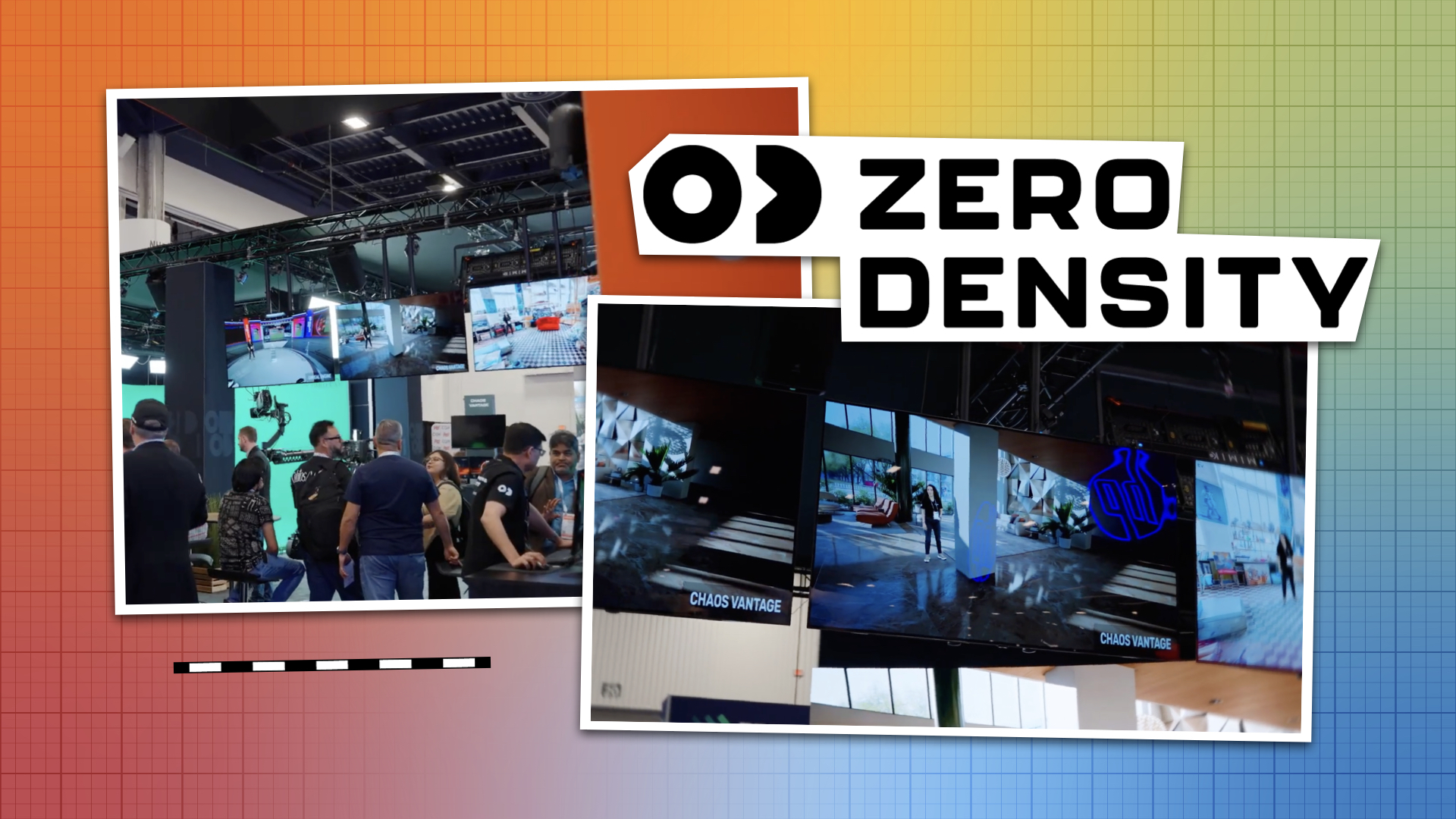
Zero Density showcased its full broadcast graphics stack at NAB 2026, with demonstrations built around Reality 5, the EVO III Pro hardware platform, and the Traxis tracking ecosystem.
The preview centered on three things broadcast teams will want to test on the show floor:
Three real-time rendering paths inside one system: Chaos Vantage for ray tracing, NVIDIA Gaussian splatting, and Unreal Engine 5
AI-assisted newsroom automation inside Reality Hub, aimed at MCR and on-air graphics operations
The Traxis Hub Automatic Lens Profiler and automatic 3D color profiling for XR video walls
The booth is organized around seven demo pods covering Broadcast Graphics, Newsroom & MCR Workflow, On-Air Graphics Operations, Reality 5 Green Screen, Camera & Talent Tracking, Real-Time AI Processing, and AI-Assisted Workflows.
Three Rendering Paths, One Pipeline
Chaos Vantage, Gaussian splatting, and Unreal 5 were all running inside Reality 5 at the booth.
The headline engineering story is Zero Density decoupling the render engine from the rest of the graphics pipeline. Operators can choose Chaos Vantage when a scene demands physically accurate ray-traced reflections and global illumination, switch to NVIDIA Gaussian splatting for photorealistic captured environments, or stick with Unreal Engine 5 for the game-engine-native workflows the industry already builds around.
That flexibility matters because broadcast graphics teams have had to pick one engine and build their production around it. Pulling three paths into a single template-based system lets the same set, graphics package, and tracked camera setup drive very different looks depending on the show.