GENERATIVE AIAI Agents Move Into Houdini, Unreal, and Adobe as NVIDIA Rallies Creative Apps Around MCP
VP LandJul 20, 2026 · 5 min read
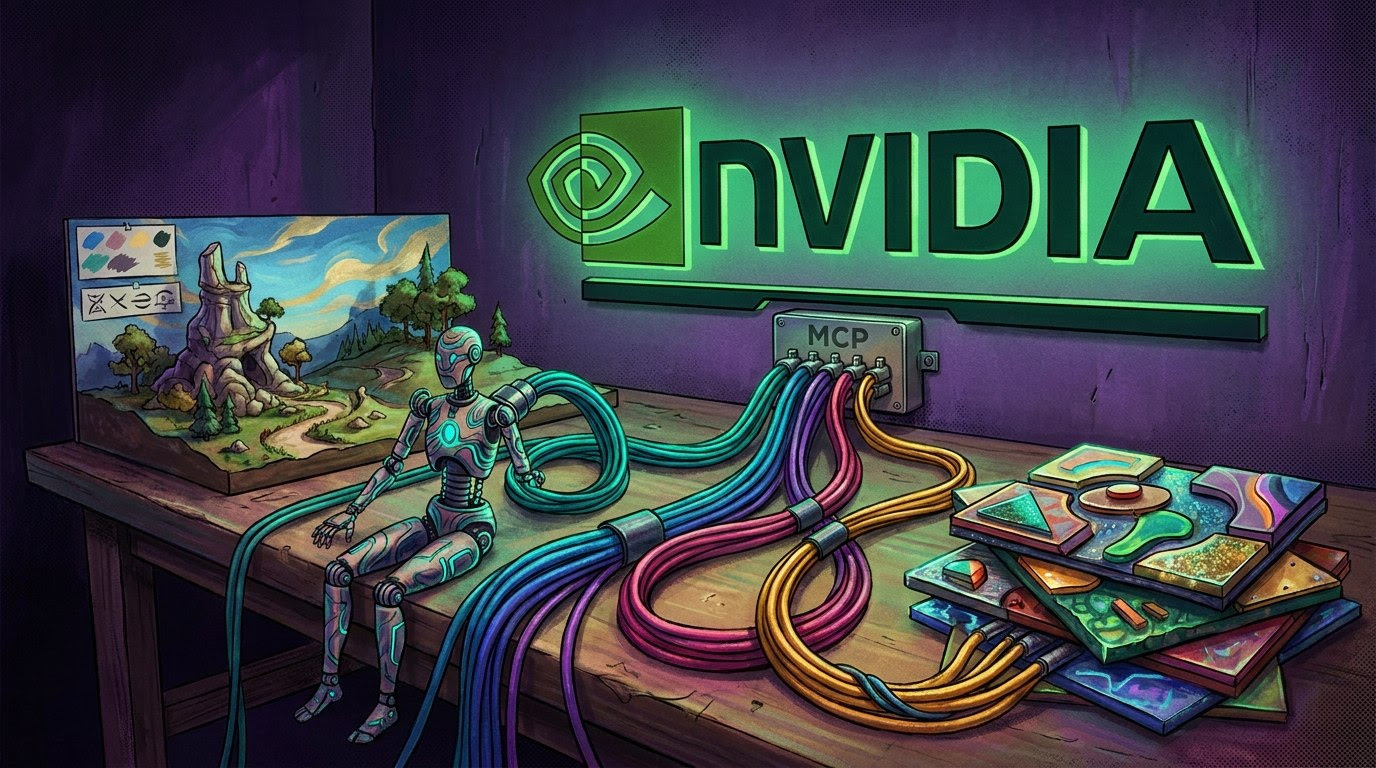
NVIDIA used its SIGGRAPH announcements to line up a wave of creative software behind Model Context Protocol (MCP), the open standard that lets an AI agent read an application's state and operate it directly. Tools from Adobe, Affinity, Blender, Boris FX, Foundry, SideFX, and Epic Games now expose MCP connections, putting agent control inside the apps artists already run.
The shift is from chat to control. Instead of generating an asset in a separate window, an agent can inspect a project, change settings, and render inside the host application.
Repetitive production work is the first target. NVIDIA lists texture inspection, color-management validation, export-variant prep, playblasts, and shot validation as jobs an agent can take on.
NVIDIA supplies the plumbing, not the apps. The company is positioning its Agent Toolkit, RTX PRO workstations, and DGX systems as the layer underneath.
MCP lets an agent read a project and call its functions, not guess from a screenshot
MCP gives an AI client a structured way to see an application's project state and call its functions, rather than working from pasted text or a captured image. We covered the pattern when Unreal Engine embedded an MCP server in its editor. NVIDIA's SIGGRAPH slate extends that same approach across a wider set of creative tools at once, standardizing on one protocol rather than a per-vendor plugin.
Seven creative apps now expose MCP connections
Adobe is expanding its AI Assistant across Firefly, Express, and Creative Cloud, and shipping an Adobe Express Developer MCP Server so coding assistants can build Express add-ons against official documentation.
Affinity by Canva added an AI Connector for Claude that uses MCP for natural-language automation, covering layer renaming, asset resizing, bulk edits, vector optimization, and file preparation.
Blender offers a lightweight MCP server through Blender Lab, exposing a natural-language interface to Blender's Python API and documentation.
Boris FX Silhouette ships an MCP server that lets an assistant inspect projects, build node trees, edit shapes and keyframes, and render frames.
Foundry Griptape natively supports MCP, providing AI orchestration built for professional VFX pipelines; we covered its Griptape agents landing in Nuke and Blender.
SideFX Houdini brings MCP support to Houdini 22 through its new APEX Script workflow, aimed at procedural character-rig generation.
Unreal Engine connects AI clients to the Unreal Editor through MCP for workflows that interact with editor capabilities.
NVIDIA supplies the agent framework and the hardware, not the creative apps
NVIDIA's role sits underneath the software. Its Agent Toolkit adds MCP client and server support so developers can wire agents to these tools, and the company points creators toward RTX PRO workstations plus DGX Spark and DGX Station systems for running models locally. Its Omniverse libraries are also exposed as agent-accessible tools. Virtual-production experiments already pointed at where this goes: Aximmetry's MCP server lets an agent build and adjust scenes from a plain-language request.
A shared protocol means one agent can move from Houdini to Nuke to Unreal
The connective thread across these announcements is standardization. When Adobe, Foundry, SideFX, and Epic all expose the same protocol, an agent built once can move between applications instead of being locked to a single vendor's integration. For artists, the near-term payoff is offloading setup and cleanup work; the larger one is a toolchain where the same assistant can follow a project from Houdini to Nuke to Unreal. Availability varies by vendor and much of it is early, but the direction is now shared across the biggest names in production software.