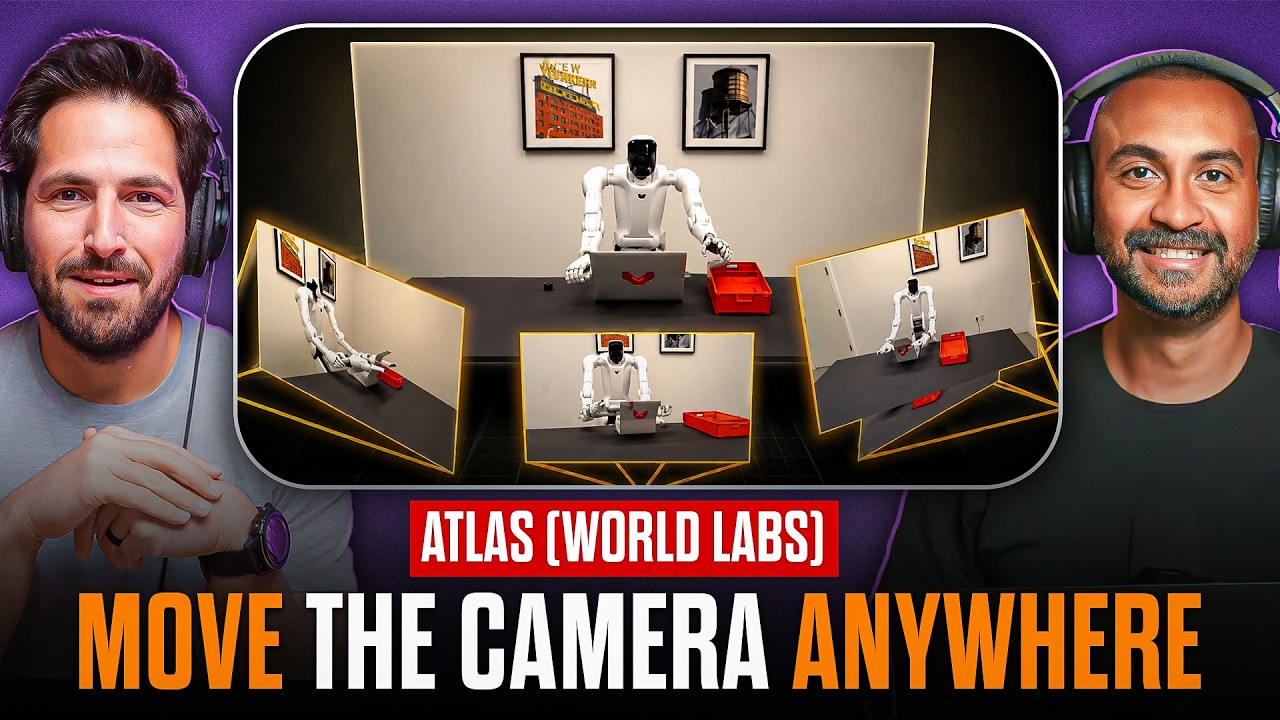
This new episode of Denoised brings forward three distinct stories that showcase the rapidly evolving landscape of creative technology and media. Hosts Addy Ghani and Joey Daoud explore Google DeepMind's significant progress with humanoid robots and AI, introduce the concept of "vibe filmmaking" as an emerging creative methodology, and discuss a concerning case of potential censorship facing Miami Beach's O Cinema.
Google DeepMind's Advances in Robotics and AI
Google DeepMind, the research arm of Google, is making significant strides in robotics and artificial intelligence that could reshape how we interact with technology. Despite Google not always being at the forefront of AI conversations compared to companies like OpenAI or Anthropic, their research team is producing impressive results that deserve attention.
The hosts discuss a recent video demonstrating DeepMind's humanoid robots responding to natural language commands in real-time. In one example, the robot can be instructed to match dice numbers, demonstrating an understanding of both verbal commands and visual input. The system processes camera feed as input (similar to human vision) and translates that into commands for robotic movement.
"The magic to all of this is taking any camera feed as input, like our eyes, and using AGI, turning it into actual responses and commands for the robotic limbs," Addy explains.
Key aspects of this technology include:
Real-time inference: The system processes visual information and makes decisions at around 10 frames per second, which is slower than human perception but represents significant progress.
General intelligence application: Unlike specialized systems (such as Waymo's autonomous vehicles), these robots aim to understand and interact with the world in a more general way.
Physical world understanding: The system bridges the gap between AI comprehension and mechanical movement in three-dimensional space.
The hosts also highlight Google Gemini Flash 2.0, which offers conversational photo editing capabilities. Users can upload images and use natural language to request specific edits – from colorizing black and white photos to adding objects into scenes. While it lacks the precise control of dedicated editing software, its ability to understand natural language instructions and execute appropriate edits represents a significant advancement.
What makes these developments particularly notable:
Training in simulated environments allows for thousands of iterations before implementation in expensive physical prototypes
Real-world applications extend beyond entertainment to autonomous vehicles, healthcare, and potentially everyday household assistance
The technology represents a shift from specialized systems to general-purpose AI that can adapt to diverse tasks
While acknowledging the positive potential of these technologies, the hosts also briefly touch on concerns regarding military applications and autonomous weapons systems, noting that such technological capabilities inevitably have dual-use possibilities.