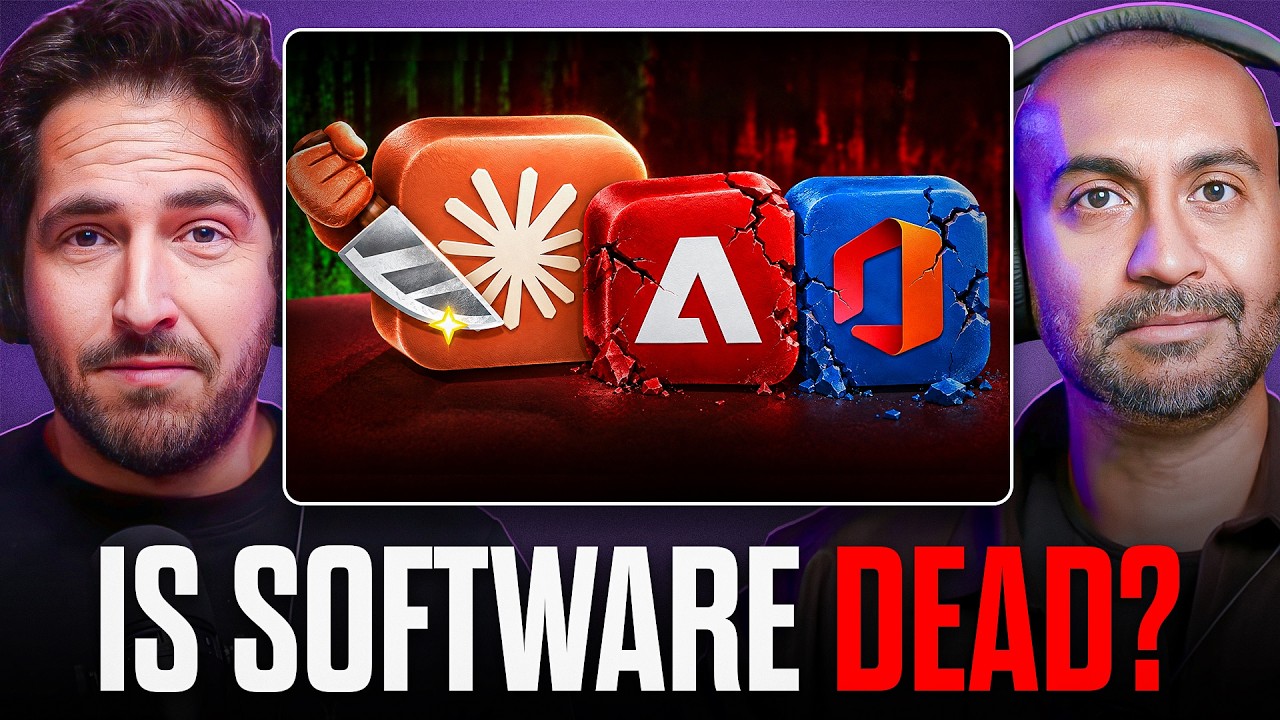
World models had their biggest showing yet on this episode, and Atlas from World Labs is the one we kept rewinding. Feed it a few phones shooting ordinary video and it rebuilds the scene into a 3D space you can freeze mid-action and fly a fresh camera through. We break down what that does to on-set coverage, then argue over Runway's new world and interface models, OpenAI's Mac Mini stockpiling, and Markiplier spending box-office money on cameras and file infrastructure.
Jump to:
01:57 Atlas rebuilds video into a freezable space
10:56 Runway GWM Worlds 2
14:17 Runway Solaris interfaces
23:09 OpenAI buys Mac Minis
28:19 Markiplier, GoPro, and Strada
Quick Take
Every tool in this episode points the same direction: the constraints keep falling away, and nobody is fully sure what the capability is for yet. Atlas can rebuild a real moment into a space you steer after the fact, Runway's models generate worlds and interfaces on the fly, and the recurring worry is that creators now have enough power to change almost anything in anything. The fun of the episode is watching that promise and that unease sit in the same demo reel.
What We Broke Down: Atlas Rebuilds Phone Footage Into a Space You Can Freeze and Reframe
We spent the top of the show on Atlas, the new world model from World Labs. Give it a handful of images or, more interesting to us, a few short videos, and it reconstructs the scene as a 3D space you can pause, freeze on one frame, and orbit with a camera that was never there.
The demo that got us was a person flinging liquid, shot on three iPhones, with the splash frozen in midair while the camera flies around it and holds its sharpness. Another used dominoes caught mid-fall, every tile locked in its real position relative to the rest.
Video in, reframable space out. The World Labs write-up notes you can export a Gaussian splat, but what you watch is generated from the world model rather than a splat played back. The sharpness in these clips is what the demos show, not a published spec; outputs looked to land around 720p and handled roughly up to a minute of footage.
This is the multi-camera-coverage idea we chewed on before, pushed further. Joey's argument: picture a stage ringed with cameras where you reframe any moment afterward. Addy's counter: take it a step further, treat a synthetic camera angle as your plate, then relight, stylize, and upscale it into finished frames without a hardware camera in the loop.
Feed it images from different worlds and it stitches a logical path between them; one demo blended a nature scene, a space station, and San Francisco into a single walkable space. Next to Marble, which we found too fuzzy to move through much, Atlas held together. It is still predicting the parts it cannot see, but the guesses read as plausible rather than broken.
The unease is the flip side of the capability. Addy put the worry plainly:
There's so much power in somebody's hands to do what they want. I almost feel like we have too much power now across the board to just change anything in anything.
Everything here is from World Labs demos ahead of a beta signup, so we have not put our own footage through it yet.
What We Debated: Runway's GWM Worlds 2 and Where World Models Make Money
The same weekend, Runway showed up with GWM Worlds 2, an update to its general world model. The changes we noticed: longer coherence, so you can keep navigating instead of hitting a short time cap, plus a quality bump that holds high-frequency detail instead of smearing into a soft filter. It also generates sound and adds dedicated camera control.
Where does the money come from? We kept landing on robotics and industrial simulation as the real revenue, with games as the obvious but thin consumer case.
Addy's counter: on-device mobile gaming could matter once inference shrinks enough to run on a phone, but it needs deterministic level design so a game's layout and goals stay fixed run to run.
The 3D-turntable, Unreal Engine-style camera control we have been seeing across video tools feels like a stopgap next to a world model you can simply stand inside and shoot.
What We Explored: Runway Solaris and Interfaces That Generate Themselves
Runway's other drop, Solaris, is what it calls its first interface world model: an operating layer that generates interactive interfaces in real time and streams the interface itself.
The example that clicked was web shopping where you move products around a photo of your own living room and it updates live. We could see it deployed as a backend other companies build on rather than a Runway-only playground.
Joey's argument: it reads like a standard other interfaces could sit on top of. Addy's counter: he is sold on a generative interface once you are already inside a world model, even if a fully generative website on its own still gives him overlord vibes.
What We Tracked: NVIDIA's Hugging Face Deal and Gemini's Video-Reading Flash Models
Two smaller beats fed the same open-versus-closed thread. We talked through the reported acquisition of Hugging Face at a figure floated near $13 billion, and neither of us was certain the hosting-plus-inference business alone justifies that number.
The buyer's logic stuck with us anyway: for NVIDIA, more open-weight models running on more hardware is good for chip sales, the way Linux quietly runs most data centers while the rest of us stay on Mac and Windows.
Separately, Google's Gemini 3.7 Flash can now take video as an input and reason over it, with 3.8 Flash following as the newer Flash release. That video-in capability is exactly why we are testing it against our clipping workflow.
What We Questioned: OpenAI Stockpiling Mac Minis to Train Computer Use
One reason models keep getting better at building 3D scenes in Blender might be sitting in a rack of Mac Minis. We got into a report that OpenAI has been buying them in bulk to run macOS around the clock and generate real computer-use training data.
Buying a $600 machine and running it 24/7 pencils out cheaper than renting virtual Macs in the cloud, which helps explain the Mac Mini shortage everyone noticed.
Separately, Apple moved the Mac Mini's base from $599 to $799 as silicon and storage costs climbed.
What We Broke Down: Markiplier Turning Iron Lung Money Into GoPro and Strada Bets
The media-industry story we closed on: Markiplier, the YouTuber who self-funded and largely self-distributed Iron Lung, is now putting box-office money into hardware and workflow tools.
Iron Lung ran in theaters on the back of his own audience, with fans helping book screens, and pulled figures in the $20 million to $30 million range for a film he financed himself.
The GoPro bet. He posted a review praising GoPro's new Micro Four Thirds, interchangeable-lens camera, roughly $700 shooting 8K RAW open gate, as a RED alternative for indie filmmakers. Days later a Bloomberg report named him GoPro's largest shareholder, through ordinary public stock with no special access or influence.
Then GoPro itself: reported as being acquired for about $285 million by an optics maker, Starman Optical, with a defense and manufacturing angle and a New Jersey facility, while GoPro stays a separate public brand.
The Strada bet. He also backed Strada, the peer-to-peer file service that turns a plugged-in drive into a shared cloud drive without cloud storage limits.
Addy's take: the pattern reads like a low-budget-filmmaker toolkit coming together, camera plus infrastructure, with more moves likely to follow.
Bottom Line: The Constraints Are Falling Faster Than the Use Cases
One thread ran through the whole episode: the tools now let you change almost anything, and nobody is fully sure what they are for yet.
- Atlas. A few phones of ordinary video become a frozen, reframable 3D space, moving reframing off the camera and onto a mouse and keyboard.
- Runway GWM Worlds 2. Longer coherence and sharper detail push world models toward robotics and industrial simulation more than games.
- Runway Solaris. Interfaces that generate themselves in real time hint at a new interaction layer, if Runway can productize it.
- OpenAI and Mac Minis. Racks of cheap Macs running around the clock are quietly generating the computer-use data that makes agents better at software.
- Markiplier. Box-office success is funding a bet on the low end of filmmaking, from GoPro's camera to Strada's file workflow.
The capability keeps arriving ahead of the playbook, which leaves the interesting part to the people who actually build with it.
Links from This Episode
Tools & Platforms
Atlas by World Labs. World model that rebuilds video into a freezable, reframable 3D space.
Runway GWM Worlds 2. Updated general world model with longer coherence and camera control.
Runway Solaris. Interface world model that generates interactive UIs in real time.
Marble. World Labs' earlier 3D world generator.
Hyper3D. Image-to-3D-mesh model from Deemos.
Strada. Peer-to-peer, cloudless file collaboration for editors.
Gemini agentic video. Gemini 3.7 Flash takes video as input.
Companies
NVIDIA. Reported acquirer of Hugging Face.
Hugging Face. Model host that also runs inference on hosted weights.
OpenAI. Buying Mac Minis to train computer use.
Apple. Raised the Mac Mini base price to $799.
News & Analysis
WATCH THE FULL EPISODE ON YOUTUBE →