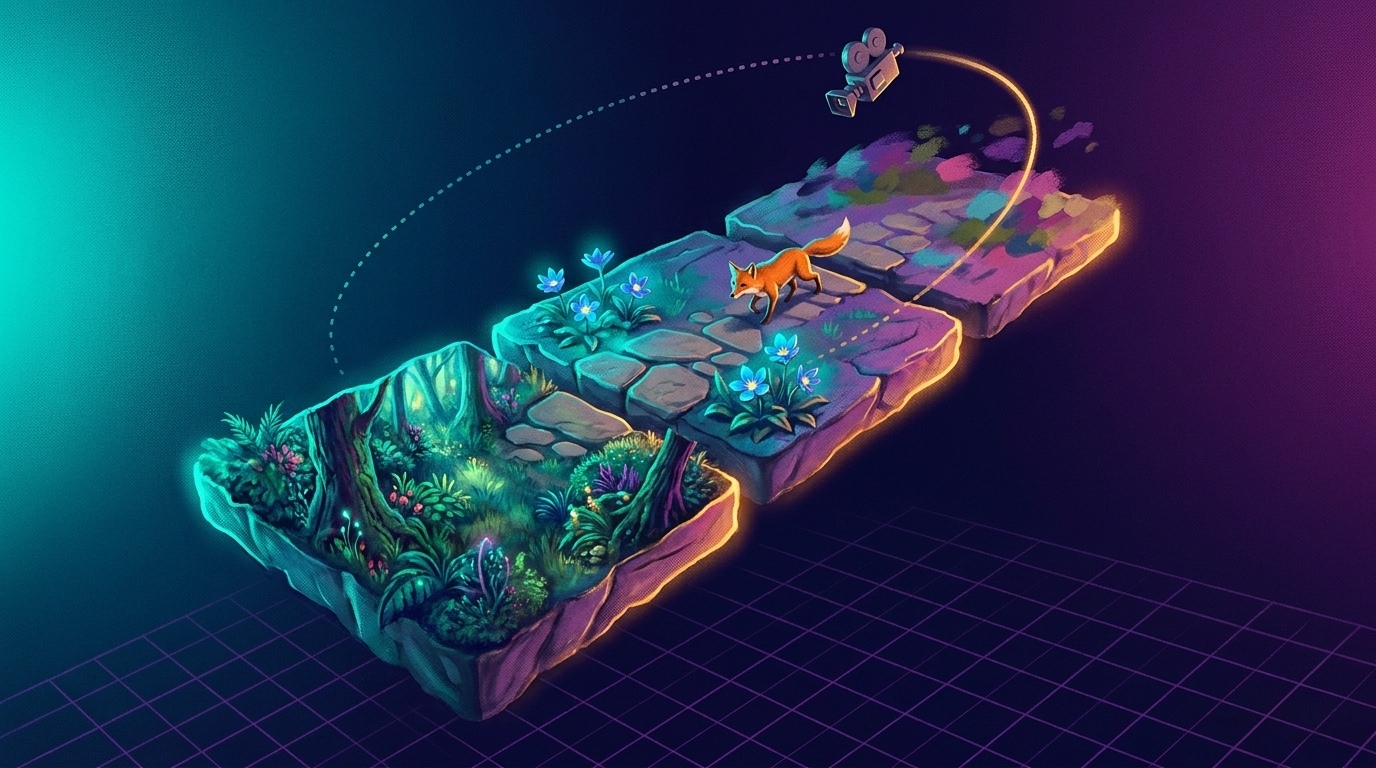
The model keeps an explicit 3D cache that it reprojects to whatever view the camera is looking at, which handles spatial recall when you turn around and come back to a place. Alongside it, a compressed frame-history embedding carries temporal continuity so recent motion stays consistent. Camera moves are grounded through lightweight AdaLN modulation tied to that 3D cache.
The stability piece is an error bank. During training the model is exposed to its own accumulated mistakes so it learns to correct rather than amplify them, which is what lets the rollout hold together past 60 seconds instead of collapsing. A DMD distillation pass handles the runtime side so the whole thing can generate at 24fps.
You drive with a joystick and rewrite the scene on the fly
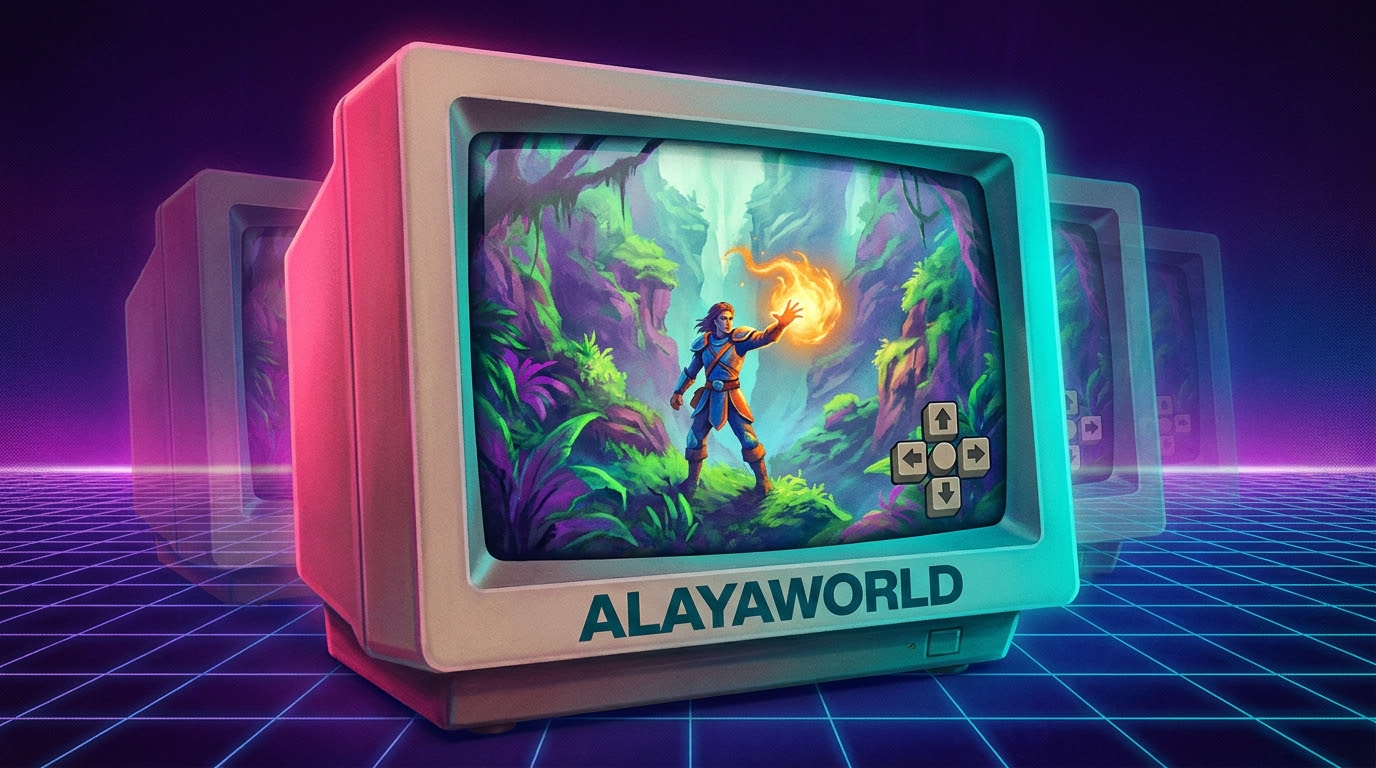
The interaction model is built for open-ended play rather than fixed clips. An on-screen joystick handles the 6-DoF camera, so you navigate a generated space the way you would move through a game.
Prompt switching happens at chunk boundaries. Type an action and it executes inside the world you are already in, which is how the demos show combat, monster summoning, and spell casting with distinct fire, ice, water, earth, light, void, and poison effects. AlayaWorld also swaps visual style on command across seven looks, including realistic, oil painting, cyberpunk, pixel, and anime.
This is the interactivity distinction we covered with Genie 3: video models generate footage you watch, while world models generate environments you control.
An open-source release aimed at the gap the closed models leave
AlayaWorld lands in a crowded stretch of the world-model race, and its pitch is access. Google DeepMind's Genie 3 generates interactive worlds at a comparable 24fps but stayed behind limited access. An open release lets researchers and studios fine-tune, adapt, or deploy the system on their own terms.
On specs, it sits alongside other open efforts. We reported on Skywork's Matrix-Game 3.0, an open-source real-time world model that runs 720p at 40fps with 5 billion parameters. AlayaWorld trades some of that frame rate for a larger 15-billion-parameter model and an explicit focus on holding a scene together past the one-minute mark. PixVerse took a different route with its real-time R1 model, which generates 1080p as users interact but remains a hosted product rather than open code.
What a full-minute, camera-controlled world means for production
For virtual production and previz, a controllable world that holds up for a full minute is closer to a usable scouting or blocking tool than the few-second clips these models produced a year ago. A director could fly a camera through a generated environment, change the action, and swap the look without rebuilding anything.
The caveat is timing. Until Alaya Lab ships the weights and inference code, AlayaWorld is a paper and a framework rather than a tool on your machine, and its real-world usefulness depends on the hardware needed to run a 15-billion-parameter model at 24fps once the code lands. Alaya Lab frames the open release as a way for researchers and studios to adapt, fine-tune, or deploy the system themselves. If the weights arrive as promised, that gives studios the full pipeline for building playable, camera-driven worlds rather than a closed demo they can only look at.