What Reactor actually serves, and what it costs
The version available on Reactor's hosted API runs at 960p (480p is also supported) and 16fps, with latency under one second, per Reactor's specs page. Generation covers minute-level sequences, and pricing is listed at $11.88 per hour, billed as 33 credits per second.
Those numbers sit below Robbyant's headline claims of hour-long generation at 720p and 60fps with "zero quality drift" in stress tests. The hour-long, higher-resolution figures describe the research result; the Reactor deployment is the productized endpoint a developer can call. Reactor exposes the model through a Playground, a Recordings section, and API endpoints, taking image, text prompt, and control signals and returning generated video.
Two mechanisms aimed at long-horizon stability
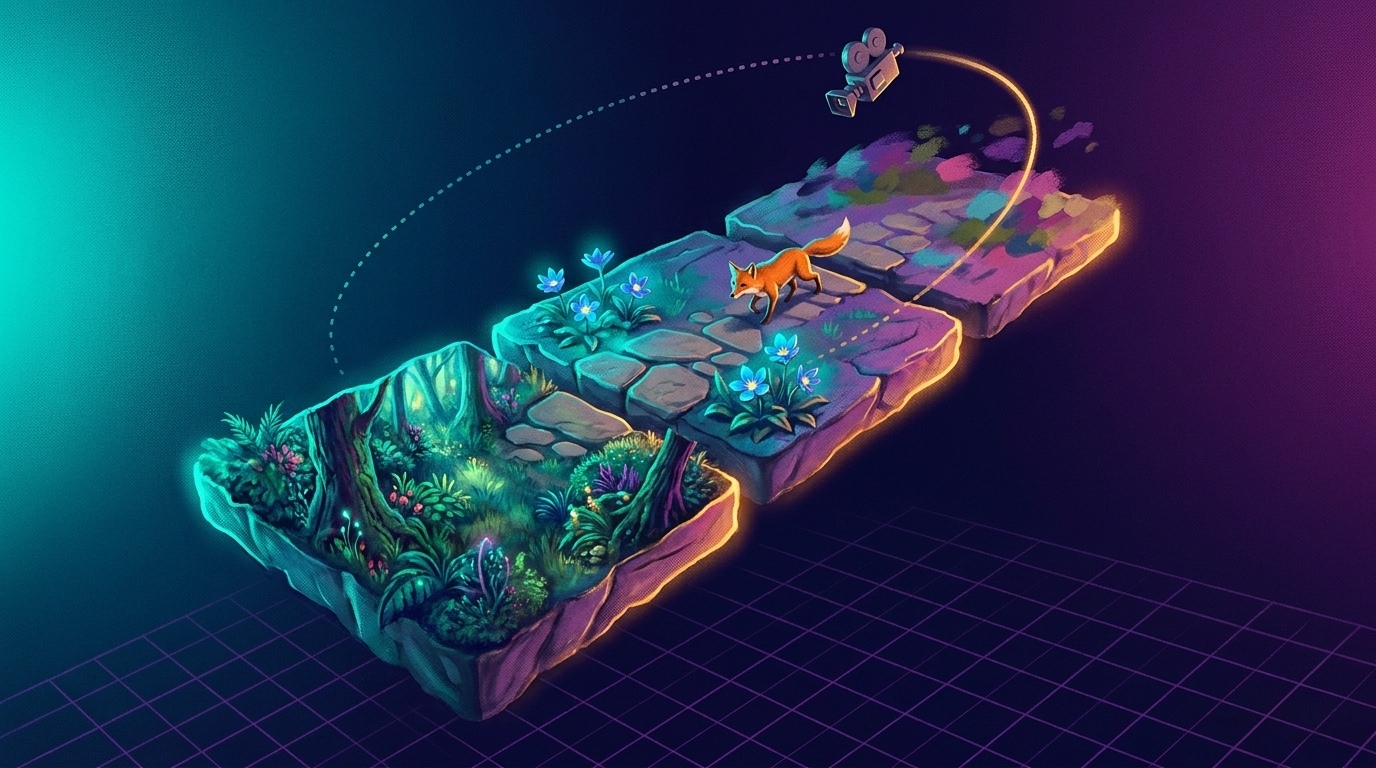
Robbyant attributes the model's consistency over time to a Causal Pretraining Paradigm paired with a proprietary mechanism it calls MoBA (Mask of Bidirectional Attention). The company says learning world evolution in chronological order reduces the compounding errors that cause texture blurring, geometry collapse, and scene breakdown as a generated world runs longer.
The interactivity is split across two agents. A Pilot Agent plans and executes character behavior, while a Director Agent introduces new events into the scene. The action space Robbyant lists includes jumping, gliding, and combat moves, and text commands can trigger day-night cycles, weather changes, and new entities inside a running world.
Camera control is the part a filmmaker can use
The camera handling is what separates LingBot-World 2.0 from a keyboard-driven game demo. Reactor accepts camera poses as an explicit control input, so a user can direct push-in shots, orbits, pans, and continuous moves through a generated space rather than only walking a character around it.
That places the model closer to previz and virtual location scouting than to a playable toy. The output resolution and 16fps throughput keep it short of finished footage, but a directable camera inside a generated environment is a usable input for blocking and shot exploration.
Open weights put it in a crowded real-time field
LingBot-World 2.0 ships under an open-source license with day-0 support for SGLang, and Robbyant released it on GitHub and Hugging Face in addition to the Reactor API. Robbyant also announced LingBot-Video, which it describes as an open-source video generation foundation model built on a Mixture-of-Experts architecture for embodied AI and robotics.
Open, real-time world models have arrived in a cluster. We covered Skywork's Matrix-Game 3.0, an open-source real-time world model running 720p at 40fps.
PixVerse brought its own real-time generation at 1080p. LingBot-World 2.0's contribution is the combination: open weights plus a hosted, camera-controllable API with published per-hour pricing.
Where this lands for production
The hosted API is the practical difference here. Open weights let a studio self-host and fine-tune, while the Reactor endpoint lets a team test camera-directed world generation without standing up its own inference stack, at a known $11.88 per hour. At 960p and 16fps, the output is a planning and exploration tool rather than a source of final frames. For teams tracking where interactive generation is heading, a camera-controllable world model behind a callable API with open weights underneath is a concrete step past the watch-only clip.