GENERATIVE AIRunway's New Ruby Model Converts SDR Video Into 16-Bit HDR ProRes and EXR
VP LandSep 10, 2026 · 3 min read
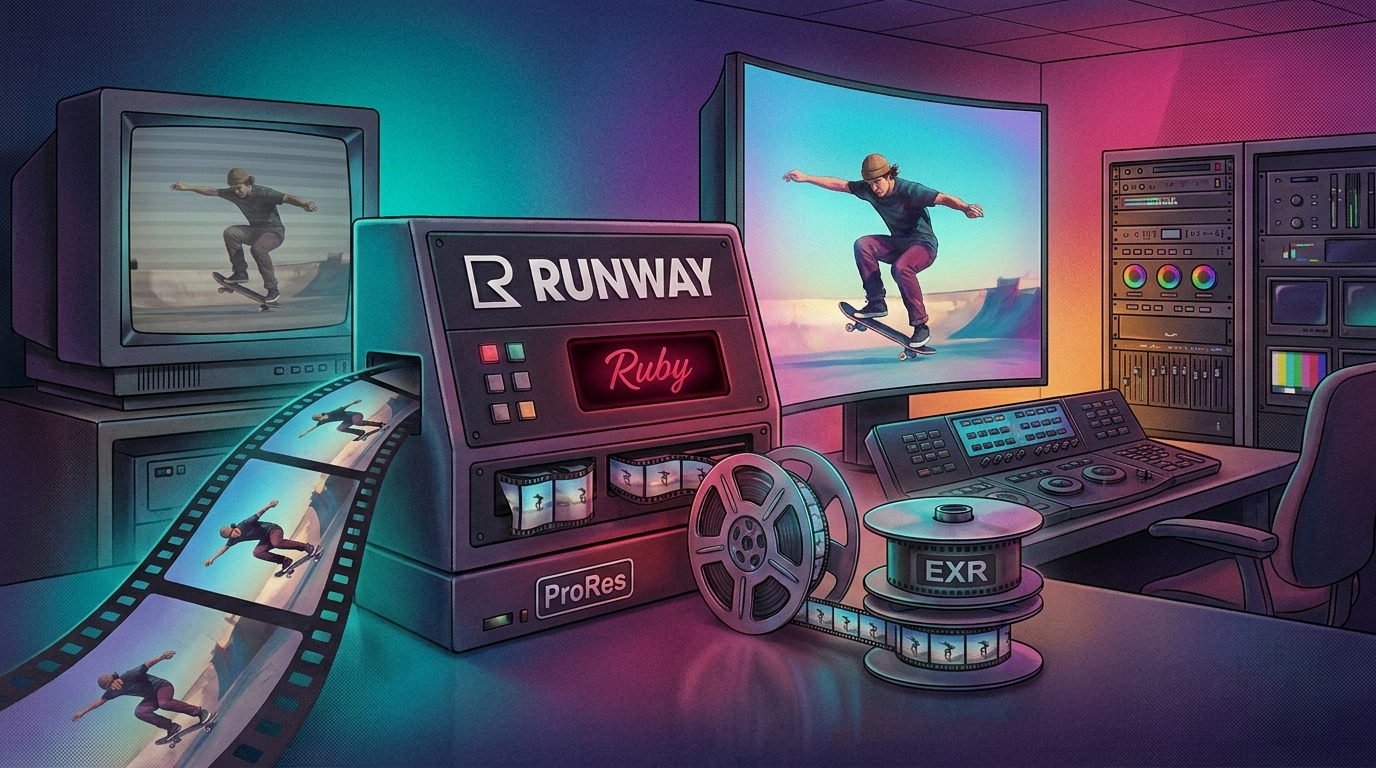
Ruby takes a finished SDR clip and converts it up to 16-bit HDR, exporting ProRes files and EXR sequences instead of a flat 8-bit master. Runway says the model, announced on X, works on any uploaded video or generated output up to 30 seconds.
- Exports ProRes and EXR delivery files. Ruby returns the containers grading and VFX pipelines already run on, so a converted clip can move into a color or compositing session directly.
- Works on uploaded footage or generated clips. Runway says any existing upload or generated output can run through the conversion, up to a 30-second limit per clip.
- The model reconstructs the HDR signal. A 16-bit EXR wrapper does not restore camera-original sensor data; Ruby has to rebuild highlight and color detail that an 8-bit SDR source never recorded.
- Available now. Ruby is live in the Runway app.
Ruby is a conversion model that ingests existing footage
Runway frames Ruby as a conversion model rather than another generator. It ingests footage that already exists, whether a camera clip, a client upload, or output from a generation model, and rewrites it into HDR delivery formats. The announcement lists ProRes and EXR sequences as the outputs, with the pitch that it fits "every format your pipeline already runs on."
The 30-second ceiling keeps Ruby at shot and short-sequence scale, not full timelines. That matches how AI-video finishing usually works, where clips get generated or captured a few seconds at a time and assembled later, the same shot-by-shot logic behind the multi-stage ETC HDR pipeline we covered. Runway has not detailed how Ruby holds temporal consistency across a converted clip, so frame-to-frame stability under a grade is worth testing.
A 16-bit container is not the same as 16-bit capture
Moving an 8-bit SDR clip into a 16-bit EXR sequence changes the container, but the container alone does not recreate what the sensor never recorded. To fill an HDR signal, the model has to infer highlight rolloff, shadow detail, and wider color that the SDR master clipped or compressed away. It is the same reconstruction bet other converters make, including Beeble SwitchHDR.
Runway's demo shows a saturated skateboard sequence and translucent graphics; it does not independently prove recovered latitude, added resolution, or measurable image-quality gains, so treat those as Runway's claims until a real grade confirms them. The useful part for finishing is the output side: a tool that emits ProRes and EXR removes a manual export-and-conform step before color or compositing. Whether the inferred HDR survives an aggressive grade is the practical question for each shot.
Ruby, Hyperion 2.5, and Ray3's SDR path are the direct alternatives
Ruby lands in a small group of models doing SDR-to-HDR conversion rather than HDR generation. Topaz Labs takes the closest path: Hyperion 2.5 converts 8-bit SDR into 10-bit ProRes or 16-bit EXR, available inside Astra with Topaz Video support coming.
We covered Hyperion 2.5 at launch. Both Ruby and Hyperion start from existing SDR and target the same container outputs, which makes them direct alternatives for a finishing pass.
Luma sits slightly to the side. Its Ray3 model is a native 16-bit HDR generator, but Luma also lists an "SDR to Generative HDR" path for generated or recorded standard video, plus EXR export. That conversion path competes with Ruby, while the rest of Ray3 is about generating HDR in the first place.
Several nearby tools solve different problems, and the labels matter:
- Resolution upscaling adds pixels and detail. Topaz Astra and Starlight do this; they are not HDR converters.
- Denoise and restoration clean artifacts and grain, a separate repair stage.
- SDR-to-HDR inverse tone mapping expands dynamic range. This is where Ruby, Hyperion, and Ray3's SDR path all sit.
- Bit-depth and container conversion moves 8-bit into 16-bit ProRes or EXR wrappers, which Ruby does alongside the tone-mapping step.
- Gamut and color-space conversion remaps footage into a wider color space.
- Generative enhancement invents new detail that was never in the source.
The LTX-2.5 model shows why the categories blur. It generates 4K HDR natively and offers a RAW finishing workflow, so it produces HDR as output rather than converting an SDR input. That puts it next to Ray3's generation side and apart from Ruby's converter role.
For AI-video finishing, Ruby gives Runway users a way to leave the app with ProRes or EXR instead of an 8-bit file, and it accepts footage from outside the Runway ecosystem. The open questions are the ones that apply to every inverse-tone-mapping model: how convincing the reconstructed highlights and color look once a colorist pushes them.