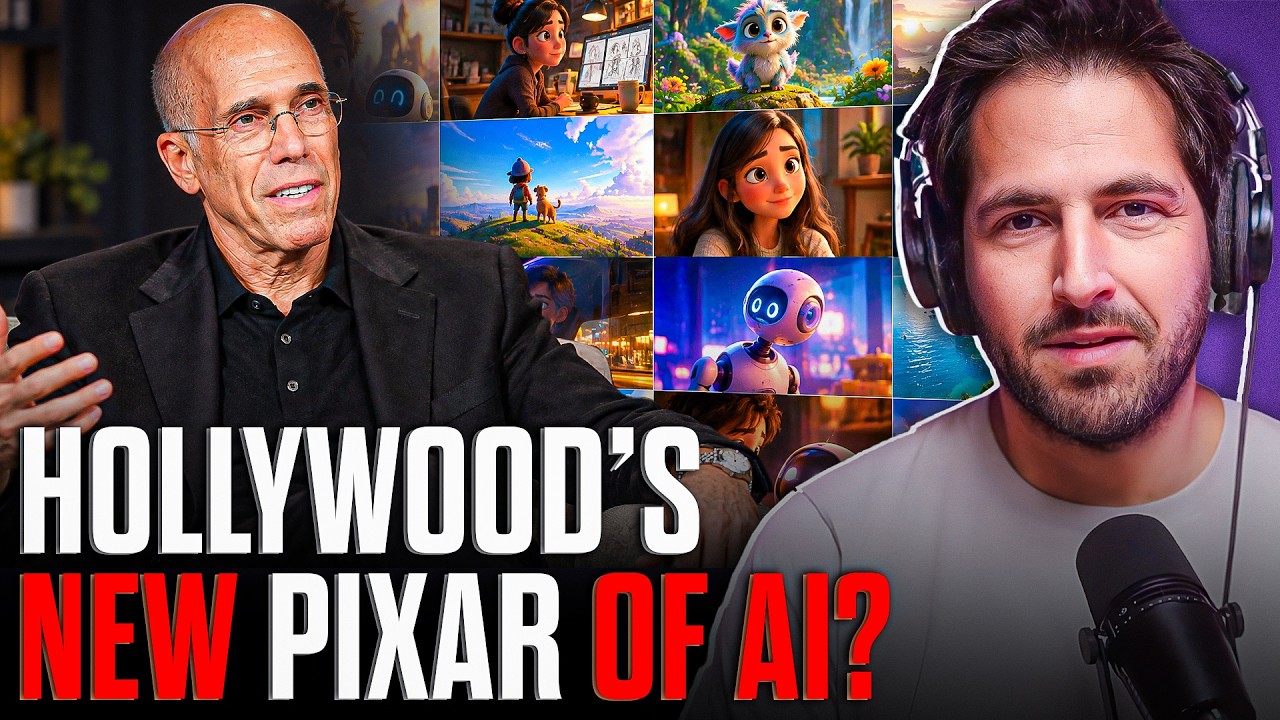
On the Denoised podcast, we recap a SIGGRAPH where film production people and AI researchers kept landing in the same rooms, chasing the same unfinished pipeline. We break down EVRN's image-to-3D staging tool, ComfyCode.ai's metadata-driven JSON prompts, and Beeble's SwitchX 2.0 roadmap. Then we pick apart Neill Blomkamp's AI-generated short film and FLUX 3's move into video.
Jump to:
04:56 EVRN turns an image into a directable 3D scene
13:00 ComfyCode.ai and metadata-driven JSON prompts
24:16 Beeble's SwitchX 2.0 and the HDR gap
37:29 Neill Blomkamp's AI-generated short film
43:40 FLUX 3 moves into video
Quick Take
Nobody agrees yet on what an AI film pipeline looks like, so production people came to SIGGRAPH asking the questions we ask, and we expect a working answer within two to three years, much as VFX pipelines settled into defined tools, roles, and seat counts over three decades. Compared with AI on the Lot, SIGGRAPH felt like an espresso shot of researchers and engineers showing work still in progress.
What We Explored: EVRN Turns a Single Image Into a Directable 3D Scene for Video Models
The new EVRN image-to-3D tool segments an image into people and objects, builds a 3D space around them, and lets you reposition the camera and create camera moves before anything goes to a video model.
It launched during an all-day AI and film production track run by NVIDIA, which filled so completely that latecomers waited in line for someone to leave.
AI input, 3D orchestration, AI output. Generative AI builds the scene, you make camera and blocking decisions as you would in Unreal Engine, and generative AI takes the result back out to video.
The output is a high-fidelity reference video for ByteDance's Seedance or another video-to-video model, and as we keep arguing, better inputs get better outputs.
Built for filmmakers who do not work in 3D. The interface is a simple timeline, like a condensed Unreal scene recorder, so a traditional filmmaker can navigate with a camera, create shots, and export.
EVRN describes a knowledge layer meant to keep off-screen areas consistent. As we understood EVRN's brief explanation, a backend agent uses diffusion models to build a knowledge database about the scene, so areas outside the original frame get filled with things that logically belong there.
That would address a problem we have seen in World Labs, where the space turns random once you pan away from the source image.
Splats first, meshes on the roadmap. EVRN builds environments as Gaussian splats and said full 3D mesh environments are planned, which would allow export to Blender and Unreal for shader and lighting control. We understand a beta is planned.
What We Explored: ComfyCode.ai Converts Camera and Lens Settings Into Detailed JSON Prompts
At a satellite event hosted by Kino and other companies, the developer behind ComfyCode.ai's tool stack showed how familiar camera controls can drive a video model. The demo took a reference image from our test where Codex built a Blender model of the Culver Theater from phone photos, then turned it back into photorealism.
Knobs in, a long JSON prompt out. The interface exposes color temperature, lens settings, and other parameters you would set in Unreal or on a camera, then converts them into a long, detailed JSON prompt.
Metadata made the outputs more directed. In the developer's experiments, video plus the detailed JSON metadata produced outputs closer to the intended shot than plain video-to-video did.
- Separate tools address AI shutter-rate issues, video-to-video, and panoramic images.
- The developer referenced SMPTE 2110 metadata, but it was unclear whether the output only mimics 2110 or the system can pull camera metadata as an input.
- The tools had not launched when we recorded.
This gives our running JSON prompting debate a practical use case, since structure earns its place when software, rather than a person, writes the prompt.
What We Questioned: Where AI Fits in the VFX Pipeline, and How Studios Will Audit It
The Future Forward VFX panel featuring Paul Debevec, The Perpetual Pipeline: 50 Years of Symbiosis in Computer Graphics, traced VFX history and asked where AI fits next.
You still need the base knowledge. In one example from the session, AI gave completely incorrect advice on lighting problems in Unreal or Maya. AI can speed up brainstorming, but it answers confidently instead of saying it does not know, so you need the expertise to catch it.
Legal and provenance concerns came up a lot. At the Academy Software Foundation's Open Source Day, projects ranged from established standards to experimental work, including a dailies review tool and a VFX-focused tracking project we think could be adapted for AI governance.
As we see it, studios want a bird's-eye view of how hundreds or thousands of people use AI models, what they prompt for, and when IP blockers and safety controls trigger. Addy's take: until the rules settle, log every input behind every shot.
In our view, CG leaves a paper trail in FBX, USD, and project files, but AI images and video carry only what their metadata holds, and a film headed to distribution needs a receipt for every shot.
What We Tested: SwitchX Driving Plates, and Beeble's Push to 4K 10-Bit With SwitchX 2.0
One of us finally put a Beeble subscription through its paces, and the SwitchX driving plates challenge what years of LED volume car work taught us about real windshield reflections.
The pro-pipeline gap is bit depth and resolution. SwitchX outputs 8-bit 1080p web-quality video, and at a packed SIGGRAPH session Beeble previewed SwitchX 2.0 with 4K, 10-bit output and improved quality.
Beeble also showed project demos we had not seen:
- A Korean production shot in an ordinary office with no clean plates, then transformed through video-to-video.
- A team scanned a historic space, got a blobby mesh, and asked Codex or Claude to clean it up, which worked.
We argue that stretching 8-bit video to 10-bit does not produce real HDR. In our view, accurate dynamic range needs a vision-language model to find light sources in every frame, so the sun lands far brighter than a light bulb, and to reinterpret the scene as sources enter and leave.
Beeble has a separate HDR model that we hear offers highlight sliders, Topaz Labs is working on dynamic range expansion as we understand it, and LTX has an HDR up-res, so we want to run a bake-off.
Cameras and displays keep pulling ahead. Sony claims 16+ stops of dynamic range for the FX5, which we pegged at roughly $5,000, while we estimate AI video tops out around 10 stops. Sony's booth also showed a 10,000-nit HDR prototype monitor built from its display tiles shrunk to monitor size.
What We Debated: Data-Driven Immersive Rooms, 4D Gaussian Splats, and Who Directs the View
The Dataland event space, new to downtown LA and host of an NVIDIA party, pairs LED rooms with a wrist tracker and an olfactory necklace that emits scents tied to the digital environments. Each room's media is generated dynamically from your data.
At the Dell booth, 4DV showed 4D Gaussian splatting captured with roughly 20 cameras for that setup, a count that depends on the shoot. We recall an earlier 4DV demo that let you reposition the view around a seated performer.
Headset viewing has felt cumbersome, so Addy sees more promise in 4D capture as base data for other pipelines and outputs.
Addy's argument: A captured basketball game could recreate Cosm-style views and switch on its own, cutting to the far end of the court or a dunk without the viewer driving a joystick. Following the action looks like the easiest part to automate.
Joey's counter: Broadcast switching happens in a split second across hundreds of cameras, and technical directors need years of experience to cut it well. One human operator pressing buttons on a video mixer looks more workable than an AI agent.
What We Questioned: Neill Blomkamp's Nightborne and How Close AI Film Has Gotten
Neill Blomkamp, director of District 9, Elysium, and Chappie, released Nightborne, a sci-fi short we understand was made entirely with Seedance 2.0 and announced on stage at a ByteDance event in Singapore.
On first viewing, one of us took it for live-action talking heads intercut with AI action shots, but it is fully synthetic. The credits list around 20 people, and we could not confirm whether they contributed scans, voices, or performance capture.
Continuity held. Shot-to-shot continuity usually gives AI films away, but these cuts flowed like a conventional film, which we credit to a working director and editorial team.
The optics still drift. Spatial and lens details give it away in places:
- A cabin interior with a back wall and roof that sit too close for the space.
- Motion jitter while characters walk.
- A background truck that looks sharper than we would expect, though that depends on the lens.
Outdoor shots, including the Apache sequences, looked photoreal. We rank it among the highest-quality AI films we have seen, and a 90-minute version would earn a ticket from us.
We want to show it to a District 9 fan without mentioning AI and see what they notice.
What We Explored: FLUX 3 Brings Black Forest Labs Into Video Generation
Black Forest Labs' FLUX 3 extends its line of image models into video, and the demos we reviewed look strong. The FLUX 3 page we reviewed lists these features:
- Clips up to 20 seconds with audio
- Text-to-video, image-to-video, video-to-video, and keyframe-to-video
- Multilingual dialogue, high style diversity, and strong typography
- Comparisons against Google Omni, Seedance, and Alibaba's Happy Horse
We believe open weights are planned so you can run it locally, though we have not confirmed it.
A lab can spend years on architecture, data labeling, training, and IP blockers, and a rival like Seedance 2.5 can drop right as it ships. We hope a good model with a loyal customer base still has a business case.
Bottom Line: The AI Pipeline Is Being Assembled From Controllable Parts
Every segment pointed at the same gap between generation and production control.
- EVRN. 3D staging puts camera control before the video model runs.
- ComfyCode.ai. Software turns camera controls into structured prompts.
- Provenance. Logging every AI input looks like the safe practice until the rules settle.
- SwitchX 2.0. 4K 10-bit output aims at professional pipelines.
- 4D Gaussian splatting. Captured performances look more promising as base data for other pipelines than as headset viewing.
- Nightborne. Experienced direction and editing closed most of the continuity gap.
- FLUX 3. Another serious video model enters a fast-moving market.
Each of these narrows the distance between AI generation and the controls, formats, and paper trails production already runs on.
Links from This Episode
Tools & Platforms
Projects
Events
WATCH THE FULL EPISODE ON YOUTUBE →